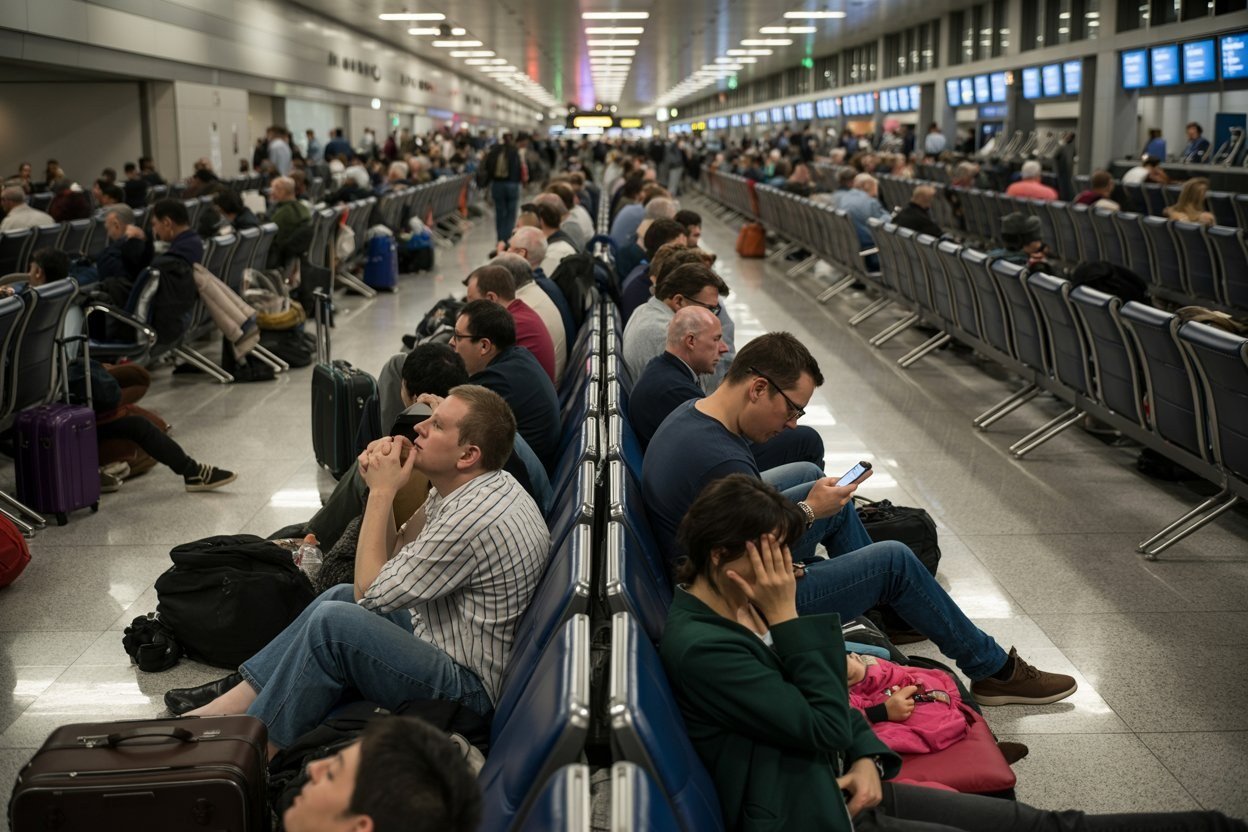
A delayed departure feels worst in the opening minutes, when rumours move faster than facts and every queue looks like the right one. Standing still can feel safer than choosing, because any move might be the wrong move. Yet the seats on later flights are being claimed while you wait. Other travellers are already on phones, already at desks, already asking for named flights. The calm response is not to rush blindly. It is to gather facts fast, join more than one line at once, and protect any connection before worry turns into guesswork. A delay is annoying, but the early minutes still belong to you if you use them well.
Freezing at the Gate While Better Options Vanish
The first error is doing nothing while hoping the screen will improve on its own. Screens do change, often for the worse, and a departure time that slips once can slip again. Treat the first announcement as a signal to act, not as a promise. Open the airline app, note the new time, and take a screenshot of the notice for your records. Receipts and screenshots matter later if you ask for a refund or claim money back, so save them while they are fresh and easy to find.
Anger at the desk rarely speeds anything up, and it can cloud your own thinking. Staff at the gate are working from the same limited facts, and they cannot create seats that do not exist. What they can do is rebook you, and they do that fastest for travellers who arrive with a clear request. Panic also narrows attention. People fixate on the original flight and miss a nearby departure to a close airport, a routing through another hub, or a seat held by a phone agent. Standing frozen means those choices pass to someone calmer.
A steadier opening move is to set a short clock in your head. Spend the first few minutes learning what changed, the next few joining every rebooking channel you can, and only then settle down to wait. Movement has a cost, of course. Leaving the gate area can mean missing a sudden boarding call, so stay within earshot or keep the app refreshing. The point is balance. Neither sprint around the terminal nor sink into a chair and surrender the afternoon. Early, small, deliberate steps beat both extremes almost every time.
Trusting One Announcement Instead of Tracking the Aircraft
A departure board tells you when the airline hopes to leave. It does not always tell you whether the aircraft for your flight has even arrived. Tracking the inbound plane gives a far clearer picture. If that plane is still sitting at another city, your wait will be long no matter what the board claims. If it is circling nearby or taxiing in, the delay may be short. Many airline apps show where your plane is coming from, and public flight trackers show the same journey in plain view.
Weather adds another layer worth checking. A storm at your airport is obvious through the window, but a storm at the hub your plane is leaving may be invisible to you. Looking at the wider picture explains why a sunny departure hall can still face hours of waiting. It also helps you judge promises. A revised time built on a plane that has not taken off is fragile. A revised time built on a plane already at the next gate is firmer, and you can plan food, rest, and messages home around it with more confidence.
Keep checking at intervals rather than staring without pause. Facts shift, and each refresh can change your best move. Tell the people waiting for you what you actually know, and separate fact from guess when you pass it on. Readers who want the rules laid out in one place can review compensation for a delayed flight before a trip, while memories are calm and there is time to read properly. Learning the broad shape of your rights at home beats trying to absorb them beside a crowded gate with a dying phone battery and a restless queue behind you.
Queuing in a Single Line When Phones Move Faster
The second error is placing all your hope in one physical line. A gate queue moves at the speed of the hardest case in front of you, and one complicated rebooking can hold it for a long stretch. Join the line, by all means, but call the airline at the same moment. A phone agent in a quiet office can often see the same seats and complete the same change while you are still shuffling forward. If the call connects first, step aside and let the line move on without you.
Come to either conversation prepared. Search for alternative flights while you wait, and write down the flight numbers, times, and routings you would accept. Asking for a named flight is far stronger than asking vaguely for anything earlier. Agents respond well to a traveller who has done the homework and can say yes or no quickly. Keep your booking reference, identity documents, and payment card within reach, since fumbling through bags wastes the moment when an agent finally picks up.
Other channels can help as well. Some airlines answer through their app chat or through social messaging, and a lounge desk or a customer service desk away from the gate may have a shorter wait. Politeness travels across all of them. Explain your situation briefly, state what you need, and thank the person who helps. If one channel fails, stay in the others rather than starting again from zero. Using several channels at once is not queue jumping. It is simply refusing to let a single slow line decide the rest of your day.
Separate Tickets and the Connection Risk They Hide
One booking that covers a whole journey carries a quiet promise. If the first flight runs late and you miss the second, the airline must carry you onward, because it sold you the full trip as one contract. That protection vanishes when the legs sit on separate tickets. Each ticket then stands alone. Arrive late on the first, and the second airline may treat you simply as a passenger who failed to appear, with no duty to rebook you and no refund owed for the missed flight.
Separate tickets tempt travellers because the combined price can look lower, and sometimes the saving is real. The risk, though, is hidden until the day goes wrong. A modest delay on the first leg can destroy the second booking entirely, forcing a new ticket bought at walk-up prices on a busy day. Checked bags add friction too, since they may need collecting and checking in again between flights, eating the very margin the connection depended on. Anyone building such an itinerary should leave hours, not minutes, between the legs.
If you already hold separate tickets and a delay strikes, act early. Contact the second airline before its flight departs, explain the situation, and ask whether the booking can be moved for a fee rather than lost outright. Some carriers show goodwill when warned in advance, though none is obliged to do so. For future trips, weigh the headline saving against the full cost of a missed onward flight, a night in a hotel, and a ruined first day at your destination. Viewed that way, a single protected ticket often proves the cheaper purchase after all.
Rights Worth Knowing Across American and European Skies
American rules give a clear protection when plans collapse. If a flight is cancelled, or heavily delayed, and you choose not to travel at all, the airline owes a cash refund rather than only credit toward a later trip. That choice belongs to you, so do not let a voucher be pressed into your hand if money back serves you better. Keep in mind that accepting a rebooking changes the picture, since you have then agreed to travel on the new arrangement the airline offered.
European rules go further on many covered routes. Long delays there can trigger fixed compensation on top of rebooking or a refund, paid because of the time lost rather than the price of the ticket. Coverage depends on the route and the carrier, so check the details for your own journey rather than assuming. The Federal Aviation Administration information for travellers pages offer a useful starting point for American travellers, covering airports, safety, and the practical side of flying within the national system and beyond it.
Care during the wait is a separate matter from refunds. When an airline causes a cancellation that stretches overnight, major American carriers have committed to providing meals and lodging help. That help rarely arrives unasked, so present yourself at a desk or call and request it plainly. Save receipts for food and rooms you buy yourself, since a clear paper trail supports any later claim. A broad flight cancellation and delay overview on Wikipedia can also help you see how delay rules differ between regions before you rely on any single promise made at a gate.
Building a Small Delay Kit Into Your Personal Item
A personal item that stays under the seat can carry a compact kit for a long wait. Start with charging. A cable and a small power bank keep your phone alive, and your phone is your rebooking tool, your boarding pass, and your link to home. Pack any medication you may need in that same bag, never in checked luggage, along with a change of essentials if an overnight stay becomes likely. Prescription items and a toothbrush weigh little and matter greatly by midnight.
Food and comfort deserve space too. Terminal prices climb quickly, and queues at cafes lengthen exactly when everyone is stranded at once. A few sturdy snacks and an empty bottle you can fill past security remove that pressure. Entertainment that works offline, such as downloaded programmes, music, or a paperback, passes hours without draining the battery you are trying to protect. A light layer helps as well, because terminals run cold and a delayed evening can stretch into a chilly night on hard seating.
Choosing flights wisely reduces how often the kit is needed. Morning departures face fewer knock-on delays, since the aircraft and crew start the day fresh rather than arriving late from earlier trouble. Nonstop routes remove the connection risk altogether. Where a change of planes is unavoidable, a generous gap between flights buys resilience. None of this removes delays from travel, and no kit turns a stranded night into a pleasure. It does, however, return a measure of control. You will wait on your own terms, informed, fed, charged, and ready to move the moment a better option appears.