A departure board flipping to cancelled can feel like the end of the trip, yet the paperwork you gather in the next hour often decides what you recover later. Airlines rarely volunteer the full picture at the desk, so calm record keeping matters more than arguing loudly. Knowing which system covers your route, and in what order to collect proof, turns a chaotic delay into a claim that stands a chance.
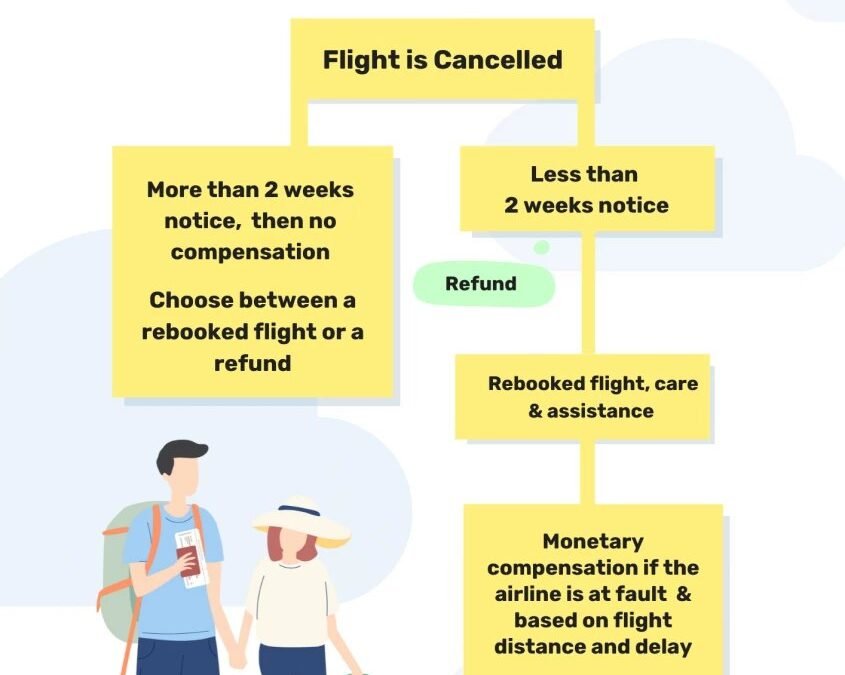
The rights picture, stated plainly, stands as follows. When an airline cancels and you opt out of travelling altogether, the unused fare should come back to the way you paid. When a covered European journey is badly disrupted, set compensation may also apply on a scale tied to distance and delay, alongside care while you wait. Everything that follows is about proving which of those positions fits your journey.
Proof gathered at the airport carries the claim
Start collecting evidence before you leave the terminal, while screens still show the old times and staff still remember the reason given. Photograph the departure board with the flight listed, save screenshots from the airline application or messages, and keep every boarding pass, booking confirmation and receipt in one folder, physical or digital. Ask politely for the reason for the disruption in writing, or note the exact words used at the desk along with the time they were spoken. Assessors decide later, far away, on paper, so the claim that wins is usually the one whose paper tells a clear story without gaps.
Record times with care, because thresholds turn on minutes. Note the scheduled departure, the scheduled arrival, the moment the doors finally closed at your last destination, and the time you actually arrived there. A delay measured at departure can look quite different from the delay at final arrival, and it is the arrival figure that decides many European claims. Keep receipts for food, drink, ground travel and lodging bought during the wait, even when the airline hands out vouchers for part of the cost, since those papers show both the length of the wait and the reasonableness of what you spent.
Disruption is easier to handle when you already know the wider rules of the road, including the entry questions that decide whether some travellers can cross a border at all, and travelling internationally with a criminal record is one such question worth understanding before a trip rather than during a crisis at a desk. The same habit applies here. Read the airline messages fully before accepting anything, and screenshot any offer of credit or vouchers before tapping acceptance, so the terms you were shown survive after the screen changes. If staff offer a choice between travelling later and taking money back, ask for that choice in writing too.
Refunds sit at the centre of American protection
For journeys under the American system, the refund is the strong right and the centre of the whole picture. A passenger who turns down travel after an airline cancels a flight is entitled to a refund of the unused fare back to the original payment method. That position matters most to travellers whose trip loses its point when the flight fails, such as a short visit that a next day arrival would render pointless. Taking the money back ends the journey, yet it ends it on terms the rules support rather than on whatever credit a desk happens to offer first.
The choice between rerouting and reimbursement belongs to the passenger once a cancellation is confirmed, not to the airline. Hold that distinction firmly during the conversation at the desk. Staff may present the later flight as the only path because rebooking is the path their screen prefers, but a traveller who no longer wishes to travel can choose the refund instead. State the choice calmly and clearly, ask for confirmation in writing or by message, and keep the confirmation with the rest of the file built at the airport.
Fees paid for services never received follow the logic of the fare itself, so charges for bags, seats or other extras attached to unused travel should be raised in the same claim, listed separately with receipts attached.
Where a traveller does accept rerouting and travels, the refund route closes, and the remaining help comes from the promises each airline makes for delays within its control, such as meals during a long wait and lodging for an overnight stay. Those promises vary by company, which is why quoting your own carrier commitment works better than arguing from general fairness. Keep expectations accurate. The American system is built mainly around getting money back when travel is declined, rather than paying set sums for lost time when travel still happens.
European rules pay a set scale for long disruption
European protection adds a second layer that the American system lacks, namely set compensation for serious disruption on covered routes. Your Europe, the official European Union portal, explains that passenger rights for lengthy delays and cancellations include care such as refreshments and, where needed, overnight lodging while travellers wait. That duty of care applies during the disruption itself, before any argument about money begins, so ask for meal support and a room as the wait unfolds rather than assuming every cost must be carried alone and argued about months later.
Fixed compensation under the European scheme grows with the length of the journey and the length of the delay at final arrival. Longer routes and longer waits attract higher bands, while shorter hops sit lower on the scale, and the amount belongs to each passenger rather than to the booking as a whole. Describe the scale only in those broad terms when you write, unless you are reading the exact band from an official source, because inventing precision weakens an otherwise sound claim. The distance of the route and the arrival delay are the two facts your evidence must establish beyond dispute.
Extraordinary events beyond an airline control can remove the fixed payment while leaving duties of care and rebooking intact. Severe weather is the familiar example. Even then, the airline should still carry you to your destination or refund the unused travel if you decline, and should still feed and house you during a long wait as the rules require. A refusal letter that leans on extraordinary events should name the event and connect it to your flight, and you are entitled to test that connection rather than accepting a single unexplained phrase as the end of the matter.
Writing the claim so an assessor can follow it
A good claim reads like a short report rather than a complaint. Open with the passenger names, booking reference, flight numbers, date and route. Follow with scheduled and actual times, the reason given at the airport, the choice you made between rerouting and reimbursement, and the exact remedy you are seeking. Close by listing the documents attached. An assessor handling many files rewards the one that can be understood in a single reading, and clarity also forces you to notice any gap while papers are still easy to obtain.
The Wikipedia entry on the Flight Compensation Regulation sets out the refund position and the fixed compensation bands in a form that helps travellers frame a European claim accurately. Use that framing to keep the two remedies distinct in your letter. Compensation answers for lost time on a journey that still happened or was rebooked, while reimbursement returns the fare for travel declined. Mixing the two into one vague demand for money invites a vague refusal, whereas naming each remedy beside its facts lets the airline grant what fits without argument about what you meant.
File through the airline official claim channel and keep proof of submission, including any reference number and a copy of the complete text sent. If the first answer refuses the claim, reply once with the missing fact or document and ask the company to identify the precise ground for refusal. Many sound claims succeed at this second pass simply because the first refusal was written from an incomplete file.
Escalation routes when an airline says no
A refusal is a stage rather than a verdict, provided the underlying facts are sound. Begin by checking the refusal against your file for the usual gaps, such as arrival time missing, the wrong operating carrier addressed, or receipts mentioned but not attached. Correct the record in one focused reply. If the airline holds its position, move the file outward to the enforcement or dispute route that covers the departure country for a European claim, following the steps that route publishes, and attach the airline final reply where one exists.
Regulators and approved dispute bodies expect the airline to have had a fair chance first, which is another reason the written claim and its reply matter so much. Send the complete file in order, with times highlighted and documents named as they appear in your letter. These bodies move slowly, yet their involvement changes the quality of attention a claim receives, and a well organised file shortens their work.
Finally, file promptly even though deadlines in many places run generously. Memories fade, applications purge old messages, and receipts bleach in wallets, while a claim filed within weeks of travel rests on fresh paper. Travellers who gather proof at the airport, choose their remedy clearly, write once and write well, then escalate without embarrassment recover what the rules intend far more often than those who accept the first voucher offered at a crowded desk and hope the matter will somehow improve on its own.
Can I still claim if I accepted a later flight?
Yes, on a covered European journey the set compensation can still apply when the delay at final arrival reaches the qualifying length, because compensation answers for lost time rather than for travel declined. Keep the new itinerary and arrival proof with the original booking papers.
Does severe weather remove every right?
No. Extraordinary events can remove the fixed payment, yet care during the wait, rebooking and the refund choice where travel is declined remain part of the picture. Ask for the specific event to be named if a refusal relies on it.
Who should receive my claim?
Send it to the operating carrier for the disrupted flight, through that airline official claim channel, and keep proof of submission. The company that sold the ticket or marketed the route is not always the company whose aircraft operated it.
What if the airline offers credit instead of money back?
Where a cancellation led you to decline travel, the refund of the unused fare belongs back on the original payment method. State that choice clearly in writing and keep the confirmation, rather than letting an offered credit quietly replace it.