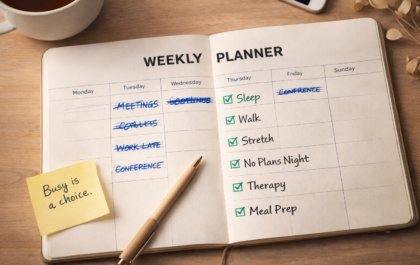
You opened the app to check one message and surfaced an hour later with no memory of the middle. Deleting everything feels like the answer, yet most people keep the apps and change the rules instead — and the rules are the part taken apart here, question by question. The apps stay on the phone. What changes is when they open, what they are allowed to interrupt, and what fills the gaps they leave behind.
That distinction matters more than it sounds. Deleting an app is a single dramatic act, and it rarely lasts, because the need it served is still there the next morning. Changing the rules is slower and less exciting, but it survives a bad day. Some people do wonder whether they should delete social media for mental health reasons, and for a few people that is the right call. For most, though, the honest fix is smaller and steadier: keep the accounts, keep the friends, and take back the hours one habit at a time.
Why does scrolling feel so hard to stop?
Scrolling feels hard to stop because the feed never ends and never asks you to choose. Each swipe brings something new, and the next item might be funny, useful, or surprising, so the brain keeps pulling the lever. Nothing tells you that you have finished. There is no last page, no closing chapter, no natural pause. A book ends. A television episode ends. A feed simply continues, and the part of you that likes finishing things never gets its signal.
The design plays on that. Short clips, bright images, and quick jokes arrive in a fast rhythm, and each one takes only a few seconds to judge. That pace makes stopping feel like missing out, because the next swipe could always hold the one post worth seeing. It almost never does, but the possibility is enough. The feed also learns what holds your attention and shows you more of it, so the longer you stay, the better it gets at keeping you there. None of this means you lack willpower. It means you are up against a system built by thousands of clever people whose job is to hold your eyes.
How much time am I really spending?
Most people guess low, often by a wide margin. An hour of scrolling spread across a day feels like a few minutes here and there, because no single session feels long. The phone keeps the true count, though, and the first step is to look at it without flinching. Open the screen time report on your phone and read the weekly total for each social app. Write the numbers down somewhere you will see them. A total you have seen in writing feels real in a way a vague feeling never does.
Look at the pattern as well as the total. The report shows when you open the apps, and most people find the same pockets of time repeating: the first minutes after waking, the gap while waiting for food, the stretch after dinner, and the last minutes before sleep. Those pockets are the habit. The total is just the sum of them. Pick the one pocket that bothers you most and start there. Fixing a single pocket is a real win, and it teaches you that the habit can change.
Check the count again after a week. Do not judge the first day, because the first day is always strange. A week shows the trend. If the total has dropped, even a little, the changes are working. If it has not, the rules need adjusting rather than your character needing a lecture. Digital wellbeing is the name phone makers give to this whole area of tools and habits, and the reports they build in are the honest starting point for any of it.
Which alerts are worth keeping?
Very few. Notifications arrive in small bursts all day and each one offers a fresh reason to open an app, which is why silencing the unimportant ones cuts scrolling more than any single rule. A like, a reaction, or a suggested post is not a message. It is an invitation to open the app, dressed up as news. Turn those off first. Keep only the alerts that come from a real person who needs a real answer, such as a direct message from a close friend or a family member.
Go through the list app by app rather than guessing. Open the notification settings for each social app and switch off everything except direct messages. Turn off badges, the little red numbers that sit on the app icon, because they create a nagging feeling that something is waiting. Turn off the preview banners that light up the screen, because each one pulls your eyes even when you do not touch the phone. What is left should be quiet. Your phone should feel like a tool sitting in your pocket, not a person tapping you on the shoulder all day.
Does moving the apps off the home screen help?
Yes, more than most people expect. The home screen is the front door of the phone, and every app sitting there is one thumb-tap away from opening. When the social apps sit on the first screen, you open them without deciding to. Your thumb moves before your mind catches up. Moving them into a folder on a later screen, or removing them from the home screen entirely, adds a small pause. That pause is the whole point. A pause of two seconds is enough for the question to surface: did I mean to open this.
Make the home screen boring on purpose. Keep the apps you need for daily life, such as messages, maps, and the camera, and move the rest away. Some people go further and switch the phone to a grey display in the evening, because a grey display removes much of the colour that makes feeds attractive, and many people find that plain look makes the phone less inviting after dark. Colour is part of the pull. Take it away and the feed feels flatter, which is exactly what you want when you are trying to stop.
What should replace the evening scroll?
Replacing a scroll with a ready alternative such as a book, a walk, or a short call works better than simply trying not to reach for the phone, because an empty moment will always look for something to fill it. Willpower leaves a hole. A replacement fills it. The evening is the hardest part of the day for most people, because the work is done, the house is quiet, and the phone is the easiest thing within reach. Decide in advance what takes its place.
Keep the replacement close and easy. A book on the arm of the sofa beats a book on a high shelf in another room. Walking shoes by the door beat shoes buried in a cupboard. A short evening walk, even around the block, changes the air and the mood in a way no screen can. A phone call to a friend or a relative gives the same feeling of connection the feed promises, except it is real and it ends. Cooking a proper meal, doing a puzzle, or working on a small hobby all count, as long as the thing is ready before the urge arrives.
Can the phone itself enforce the limits?
Yes, and this is the easiest win in the whole list. Apple Screen Time and Google Digital Wellbeing are built-in tools on modern phones that show how long each app has been open and let the owner set daily limits per app. Set a limit for each social app, such as one hour a day, and the phone will warn you when the time is up. The warning alone is useful, because it breaks the trance and hands the choice back to you.
Make the limit hard to ignore. On an iPhone, the Screen Time settings let you set a passcode so the limit cannot be dismissed with a single tap. On an Android phone, the Digital Wellbeing tools offer the same kind of limit and a bedtime mode that quiets the phone in the evening. Apple Screen Time has a clear support page that walks through each setting step by step, and it is worth reading once rather than guessing your way through the menus. Set the limit, set the passcode, and let the phone do the nagging for you.
There are also apps that block other apps on a schedule, if the built-in tools are not enough. A blocker that locks social apps during work hours or after a set time in the evening adds a firm edge that willpower alone cannot provide. Pick one tool and set it up properly rather than installing three and using none of them. A single limit that actually holds is worth more than a dozen good intentions.
Why does the bedroom matter most?
The bedroom matters most because the phone does its worst damage there. Late light and late messages both delay rest, and a feed that runs until midnight steals sleep from both ends of the night. Sleep experts advise keeping phones out of the bedroom, and the advice holds up because the bedroom is where the habit is hardest to resist. You are tired, the room is dark, and the phone is the only bright thing in reach. That is not a fair fight, so do not fight it. Remove the phone instead.
A charger kept outside the room removes the excuse to bring the phone to bed. Buy a simple alarm clock and charge the phone in the kitchen or the hallway overnight. The first nights feel odd, and many people reach for a phone that is not there. That reflex fades. What replaces it is better sleep, a calmer morning, and a first hour of the day that belongs to you rather than to the feed. Mornings change first, because the phone is no longer the first thing you see.
What if boredom keeps pulling me back?
Boredom is the engine under most scrolling. The feed is not interesting. It is available. When a moment has nothing in it, the hand reaches for the phone, because the phone promises something and the empty moment promises nothing. The fix is not to ban boredom. It is to give the empty moment something better to hold. A short list of things you enjoy, kept where you can see it, turns a blank minute into a choice rather than a reflex.
Make a small list of five things that take under ten minutes and feel good. Stretching, making tea, stepping outside for fresh air, writing a few lines in a notebook, or listening to one song properly all count. When boredom arrives, pick from the list instead of opening the feed. The list works because it is ready before the urge, and the urge is fast. A choice made in advance beats a choice made in the moment, every time.
How do I handle friends who expect instant replies?
Most friends do not actually expect an instant reply. They expect a reply eventually, and the idea that everyone waits by the phone is mostly in our heads. Replying an hour later is normal. Replying the next morning is normal too, unless the message is urgent. The pressure to answer at once comes from the read receipt and the typing indicator, which make a delay visible. Turning off read receipts removes that pressure at a stroke, because nobody can see when you read a message, only when you answer it.
Tell the people who matter. A short note to close friends, saying you check messages at set times rather than all day, prevents worry and sets the pattern. Most people will understand, and many will feel relieved, because they carry the same pressure. For the friends who send a steady stream of links and clips, a gentle word helps. Ask them to save the best ones for a weekly catch-up rather than sending each one as it arrives. The friendship does not depend on instant replies. It depends on real attention when you do talk.
How long before the new habits feel normal?
Longer than a day and shorter than you fear. The first week is the hardest, because the old reflex fires constantly and every quiet moment reaches for the phone. The second week is easier, because the replacements start to feel natural and the phone stops being the first thought. By the third or fourth week, most people find the new pattern holds without much effort, as long as the rules are still in place. Habits feel normal when they stop needing a decision, and that takes a few weeks of steady repetition rather than a single heroic effort.
Expect setbacks. A bad day, a long wait, or a dull journey will pull you back into the feed, and that is not failure. It is a normal part of changing a habit. What matters is the next day. If the rules are still in place, one bad evening does not undo three good weeks. The people who succeed are not the ones who never slip. They are the ones who return to the rules without a lecture to themselves. Be kind to yourself on the bad days and firm on the good ones.
What does a calmer week with social media look like?
A calmer week starts with a morning that belongs to you. The phone charges outside the bedroom, so the first hour is quiet: breakfast, a wash, and a look at the day ahead before any feed opens. Messages get checked at set times, such as mid-morning and early evening, rather than whenever a notification arrives. The social apps open twice a day for a short while, and the time limit on the phone ends the session before it drifts.
The evenings feel different. The phone sits in another room while dinner happens, and the evening scroll is replaced by a walk, a book, or a call. The bedroom stays free of screens, so sleep comes sooner and mornings feel lighter. Friends still hear from you, because the set times for messages are kept, and the replies are fuller and more thoughtful than the rushed lines sent between scrolls. Nothing dramatic has happened. The apps are still there. The difference is that they open when you choose, and they close when the limit says so.