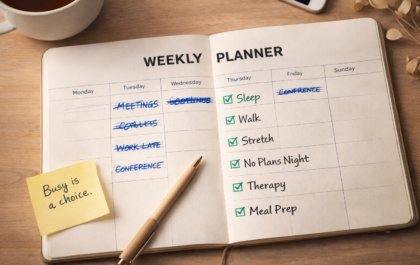
Sunday dread often comes from carrying an entire week inside your head with no map for where anything belongs. Half an hour of honest sorting turns that tangle into named days, clear priorities and a calmer Monday morning.
Gathering Everything Before the Timer Starts
Collect the ordinary tools first and keep them deliberately unremarkable, because a ritual built from familiar objects survives far longer than one that needs special equipment. You want one calendar view showing work and home together, one notebook or plain document where the weekly plan will live, a pen that works, a timer you trust, and a drink within reach so you never need to wander off mid session. Sit in the same place each week if you can, at a time when the household is relatively settled, and treat the seat itself as a cue that sorting is about to happen. Bring every loose input with you rather than hunting for it later. School letters, appointment cards, message threads you promised to answer, and the scribbled notes from your pockets all belong on the table before you begin. Anything left scattered around the house will ambush you on Tuesday and pretend the plan never existed. Any plan, from a small bakery launch to a family week, grows manageable once it is written down in one place, which is exactly why writing a business plan for a small bakery starts with gathering scattered hopes onto paper before judging any of them. Give yourself the same courtesy here. The gathering stage is not planning yet, and resisting the urge to solve things during it keeps the half hour calm. Simply assemble, breathe, and look at the whole landscape before choosing where to step first.
Step One Look Back Before Looking Forward
Begin by reviewing the week that just ended, briefly and without scolding yourself, because last week holds the clues that stop this week repeating its mistakes. Ask what genuinely got finished, what mattered more than expected, and what consumed energy out of all proportion to its value. Write short answers rather than essays, since the aim is orientation rather than a performance review. Keep just the unfinished items that still earn their place. Some unfinished items reveal themselves as dead weight during review, an email nobody needs any more, a favour that solved itself, or a project overtaken by events. Deleting those leftovers counts as a genuine win, not an admission of failure, and clearing them frees attention for work that still matters. Notice timing surprises as well. The appointment that needed travel time you never allowed, the homework that always expands, or the meeting that reliably runs long all deserve a small adjustment in the new plan. A weekly review improves quietly through these tiny corrections, accumulated without drama. End the look back by naming one thing that went well, however small. A plan built only from shortcomings feels punishing, and punishment is a poor foundation for a habit you want to keep for years. Acknowledge a kept promise, a handled problem, or a pleasant hour that actually happened, then turn the page toward the days ahead.
Step Two Empty Your Head Onto One Page
Now unload everything the coming week might contain onto a single page, in whatever order it surfaces, without ranking or tidying as you go. Appointments, errands, bills, birthdays, repairs, forms, phone calls, creative hopes and vague worries all go down together, because a worry written plainly loses much of its power to circle at night. Keep writing until the flow slows, then prompt yourself by areas of life. Home, work, family, health, money and friendship each tend to release a few more items once named directly. Check the calendar and any message threads for commitments you accepted casually and promptly forgot, since those are the surprises most likely to wreck a morning later in the week. This kind of written unloading sits at the heart of planning practice, and the Wikipedia article on time management presents the discipline as consciously controlling how time gets divided among activities, with listing and ranking named among its core techniques. Trust that lineage without turning it into a ceremony. Your page does not need categories, colours or beautiful handwriting, and nobody else ever needs to read it. Its only job is completeness, giving your mind permission to stop rehearsing everything at once. When the page feels full, draw a line beneath the final entry. That line is a boundary the rest of the session will respect, because new anxieties arriving later can wait for the midweek reset instead of hijacking the sorting you are about to do.
Step Three Choose Three Outcomes That Matter Most
From the crowded page, select exactly three outcomes that would make the week feel worthwhile even if almost everything else slipped. Three is a discipline, not a suggestion to be negotiated upward, because a longer crowned list quietly turns every day into a failure report. Choose outcomes rather than chores where you can, so finishing the report, calming the kitchen chaos, or being properly present at a family occasion each give smaller tasks something meaningful to gather around. Test each candidate honestly. If the week ended with only that outcome achieved, would you still feel the days had been used well? If the answer is lukewarm, the item may be urgent, visible or loudly requested by someone else without being truly core to your life right now. Let it live on the task list without wearing a crown. Write the three outcomes at the top of the plan where your eye will meet them daily. Their position matters, since a priority buried under errands gets treated like an errand. During the week, when new demands arrive wearing urgent costumes, those three lines give you a calm reference point for deciding what may move and what must hold. Accept that choosing three means consciously not choosing others, and that this sting is the price of a week with a spine. A plan that tries to honour everything equally honours nothing when pressure arrives, whereas a short honest ranking lets you protect what counts and release the rest without spiralling.
Step Four Give Every Task a Named Day
Move each surviving task onto a specific day, matching its weight to the shape of that day rather than piling everything onto Monday out of optimism. A day already heavy with meetings can hold small errands and short calls, while a quieter day can carry the deep task that needs an unbroken stretch. Spreading work this way respects energy as a real resource instead of treating every hour as interchangeable. Placement turns intention into geography, and the Wikipedia entry on the calendar notes that a calendar organises days for social, religious, commercial or administrative purposes, which explains why commitments gain a visible shape once they sit on named days instead of floating in a hopeful list. Use that visibility kindly. Leave breathing room around fixed events, allow travel and preparation their honest minutes, and schedule rest and empty space in the same ink as work so nobody, including you, treats those gaps as spare capacity waiting to be filled. Group small similar jobs where it helps, such as calls together or errands along one route, yet avoid building a day so dense that one late bus collapses the whole structure. Every day should contain one obvious first task, clearly identified, so mornings begin with movement rather than a fresh round of choosing. When a day looks overfull on paper, believe the paper. Move something while you are calm instead of discovering the overload at the worst possible moment midweek.
Step Five Write Monday Morning in Full Detail
Finish the session by describing Monday morning in unusual detail, almost hour by hour from waking until the first major commitment settles. Name what you will wear if choosing slows you down, what leaves the house with you, which task opens the working day, and what you will deliberately ignore until the priority work has begun. Detail here is kindness, because Monday you will be half awake and grateful that Sunday you made the decisions already. Keep the opening task small enough to start without dread yet connected to one of the three outcomes, so momentum and meaning arrive together. A tiny visible win early in the day changes the emotional weather of everything that follows, and a plan that starts with an enormous intimidating block often gets avoided entirely by a mind looking for any excuse. Close the notebook or document when the half hour ends, even if corners remain untidy. Stopping on time protects the habit, because a planning session that sprawls into an evening of organising becomes a second job and soon gets skipped. The week now has a map, the map has a clear first step, and your head is free to enjoy what remains of the day without rehearsing errands in the background.
Resetting Midweek When Life Rewrites the Plan
Expect the plan to bend, because illness, weather, other people and simple bad luck all edit weeks without asking permission. A bent plan is not a broken system, and treating disruption as normal weather keeps you from abandoning the whole habit the first time a day goes sideways. The midweek reset exists precisely for this, a short pause to look at what remains rather than mourning what moved. Take a few quiet minutes, perhaps on the middle evening of the week, and compare the plan with reality. Cross out what no longer matters, celebrate what quietly got done, and rehome the surviving tasks onto the remaining days with fresh honesty about space and energy. Protect the three outcomes where you still can, but allow one to shrink gracefully if circumstances have truly changed, since a smaller kept promise beats a grand abandoned one. Resist rebuilding the entire system during the reset. Big redesigns belong to calmer reflections, not to a tired midweek moment, and most weeks need only a handful of moves to feel navigable again. Shift a task, shorten a task, ask for help with a task, or delete a task entirely, and notice how often one of those four simple verbs restores a sense of control. End the reset the same way the Sunday session ended, with the next morning made obvious. Knowing exactly what tomorrow asks first is the thread that carries a disrupted week forward, and by the time the next planning half hour arrives you will have evidence that a flexible map, honestly redrawn, serves real life far better than a perfect plan that shattered on first contact.