Every drawer is full, the floor has nowhere left to walk, and buying a new chest would only swallow the last free corner. A cramped sleeping room usually hides storage in places already built in — under the bed, behind the door, high on the wall — waiting to be used properly.
The first move is not shopping but looking, because most small rooms already own more storage than their owners use. A clear look at the closet, the space under the bed, and the back of the door will show where things can live, and a short plan for how to install closet organizers can turn a bare closet into the hardest-working corner of the room. Everything in this piece follows the same rule: no money spent, no new piece of furniture, only space the room already owns used with more care.
Clearing out against buying more storage
Clearing out beats buying storage almost every time, because a new box only hides the same clutter in a tidier shape. A room that feels full usually holds things the owner no longer wears, no longer reads, and no longer needs, and each of those things takes a place that a daily item could use. A single honest pass through every drawer and shelf, keeping only what is worn, used, or loved, can free more room than any new piece of furniture, and it costs nothing but an afternoon.
Buying storage has its place, but only after the clear-out, when the owner can see exactly what remains and exactly where it should live. A box bought before the clear-out ends up holding things that should have left the house, and a shelf bought for a crowded corner only moves the crowd to a new spot. The order matters: clear first, count what is left, and then decide whether anything is still needed. Most owners find that nothing is, and the money stays in their pocket.
The space beneath the bed
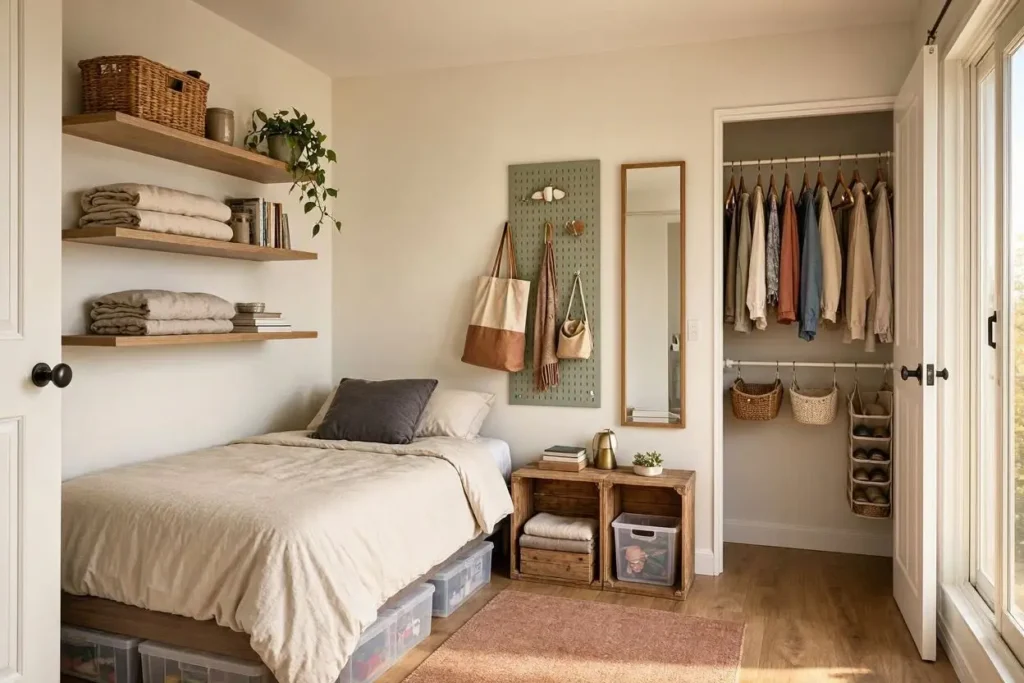
The space beneath a bed fits shallow boxes and out-of-season clothes that would otherwise crowd a closet, and it is the largest patch of unused storage in most small rooms. A low box slides in and out easily, keeps winter coats or spare bedding out of sight, and frees a whole shelf for the things the owner reaches for each day. The trick is to use boxes with lids, so dust stays out and the contents stay fresh, and to label each box in plain words, so nothing has to be dragged out and opened just to check what is inside.
Keeping that space tidy matters because a dusty pile under the bed is easy to forget, and a forgotten pile soon becomes a second junk drawer. A quick check once a season is enough: pull each box out, shake off the dust, check that the lid still fits, and put back only what belongs there. Things that have not been touched in a year should leave the box and leave the house, because storage that holds forgotten things is not storage at all, only a hiding place.
Doors and walls doing double duty
A door can carry hooks and a hanging organiser without a single screw in many cases, which turns wasted air behind the door into useful storage. Coats, bags, scarves, and belts all hang well on a door, and a hanging organiser with clear pockets holds small things that would otherwise vanish into a drawer: chargers, gloves, spare keys, and the little items that a small room seems to swallow. The door is already there, the hooks cost little, and the floor stays clear.
Walls do the same work higher up, where the eye rarely looks. A narrow shelf above the door holds books or boxes that are used rarely, and a row of hooks beside the bed holds tomorrow’s clothes, so the chair in the corner stops being a second wardrobe. The rule for walls is to store light things up high and heavy things down low, because a heavy box on a high shelf is a hazard every time it comes down. Wall space is free, it is already paid for, and in a small room it is the cheapest extra storage there is.
Folding and rolling against stacking
Rolling soft clothes saves space in a drawer compared with folding them flat, and it also lets the reader see every item at a glance instead of only the top layer. A rolled shirt takes a smaller shape than a folded one, and a drawer full of neat rolls shows each colour and each item at once, so the owner stops pulling out three shirts to find the one at the bottom. The method suits soft fabrics best, and it works in shallow drawers where flat stacks would topple the moment the drawer opens.
Stacking still wins for stiff items that must keep their shape, such as jumpers, jeans, and anything that creases badly when rolled. A stack works when it is short, with the least-worn item at the bottom and the favourite on top, and when the drawer is shallow enough that the stack cannot lean. The honest answer is to mix the two: roll the soft things, stack the stiff things, and keep each drawer to one kind of item, so nothing has to be dug out from under something else.
The closet, reorganised rather than replaced
A closet rarely needs replacing; it needs its inside arranged around the way its owner actually lives. Most closets hold a single rail and a single shelf, which wastes the space above the rail and the floor below it, and a few simple changes can double what the closet holds. A second rail lower down takes shirts and trousers, a small shelf above the first rail takes out-of-season things, and a row of hooks fixed to the door’s inner face takes bags and belts. None of this needs a new closet, only a fresh look at the one already there.
The order inside the closet matters as much as the fittings. Daily clothes belong at hand height, where they can be reached without stretching or bending, while rare items belong up high, where they cause no daily friction. A closet is, at its heart, a small room for clothes, and reading a plain account of what a closet is and how it is used helps to see it that way, as a space with a job to do rather than a dark cupboard to fill. Keep one kind of item in each zone, keep the floor of the closet clear, and the whole room will feel larger for it.
Suitcases and spare bedding as hidden boxes
Suitcases are boxes the owner already owns, and they make fine storage for things that are needed only a few times a year. A suitcase under the bed or on top of the closet holds out-of-season clothes, spare blankets, or keepsakes, and it keeps them clean, dry, and out of the way. Spare bedding works the same way: a folded duvet in a suitcase takes far less room than a duvet draped over a chair, and it stays fresh because the case keeps the dust out.
Sorting by how often you reach for things
Sorting belongings by how often they are reached for puts daily items at hand height and rare items up high, where they cause no daily friction. The things used every morning, such as work clothes, a phone charger, and a hairbrush, belong within arm’s reach of the bed or the door, while the things used once a month belong on a high shelf or under the bed. Daily items should take no effort to reach; if reaching takes effort, the item is stored in the wrong place.
This one rule fixes more small-room frustration than any other, because most clutter is simply a daily item stored in an awkward place. A bag kept on the floor by the door gets tripped over each morning, yet the same bag on a hook beside the door is out of the way and ready to grab. A charger buried in a drawer gets left behind, yet the same charger in a small tray on the bedside table is always found. Move the daily things to where the hand already goes, and the room starts to work with its owner instead of against them.
Keeping the floor clear on purpose
A clear floor makes a small room feel larger because the eye reads open floor as open space, so keeping shoes and bags off the floor is one of the cheapest changes available. Shoes belong by the door or on a low rack, bags belong on a hook, and laundry belongs in a basket that fits under a shelf or behind the door, never in a heap on the carpet. The floor is the room’s breathing space, and every item that sits on it shrinks the room a little more.
The habit is easier to keep than to start, because a clear floor invites care and a cluttered floor invites more clutter. The fix is a nightly minute: before bed, pick up anything on the floor and put it where it belongs. A room that ends each day with a clear floor starts each morning feeling larger, calmer, and easier to live in, and the minute it costs is the best minute in the day.
A weekly habit that stops the clutter returning
Clutter returns because small things drift, not because the owner fails, so the cure is a small weekly habit rather than a grand yearly clear-out. Once a week, at the same time, walk the room with a bag and collect everything that has drifted from its place: the book on the chair, the charger on the floor, the clothes on the bed. Put each thing back where it belongs, and drop anything broken or unwanted into the bag to leave the house. The whole round takes less time than a cup of tea, and it stops drift before drift becomes clutter.
The habit works best when it is tied to something that already happens each week, such as the laundry or the weekly shop, because a habit that floats free is easily forgotten. A note on the mirror for the first month helps too, until the round becomes as automatic as locking the door. The point is not perfection but rhythm: a room that is tidied a little each week never needs a dreaded whole-day clear-out, and the owner keeps the calm that the first big clear-out bought.
The layout I would choose for most small rooms
For most small rooms, the layout that works best puts the bed against the longest wall, with the head at the quiet end and the foot pointing toward the door, so the room can be crossed without squeezing past furniture. The closet stands on the wall beside the door, so clothes can be taken out and put on without crossing the room, and a narrow shelf above the door holds the rare things. The bedside table holds only a lamp, a charger, and a book, and the floor stays clear from the door to the bed.
A bedroom is a room for sleep and for rest, and a plain account of how a bedroom is used as a place for sleep and storage shows why the layout matters: the room should help its owner rest, not fight them for space. Under the bed go the out-of-season boxes, behind the door go the hooks and the hanging organiser, and the chair, if there is one, holds a cushion and nothing else. That layout leaves the floor open, the daily things within reach, and the room feeling twice its size, all without buying a single new piece of furniture.