
Tank water heaters usually die slowly from neglect that nobody notices: sediment thickening at the bottom, a small rod dissolving unseen, and temperatures set higher than any household needs. Reversing those habits adds working years to an appliance most people only think about when it fails. Nothing in the routine that follows demands trade training or costly equipment. It demands a calendar habit, a garden hose, a bucket, and the willingness to spend part of one afternoon each year on a machine that quietly serves every shower, wash, and basin in the home. Owners who build that habit tend to meet their heater on calm terms, during planned maintenance, instead of in a flooded utility space on the coldest morning of winter.
Neglect Habits That Quietly Shorten a Tank Water Heater Life
Four habits account for most early failures. The first is never draining any water from the tank, which lets mineral sediment pile undisturbed across the floor of the vessel year after year. The second is forgetting the sacrificial anode rod entirely, so a part designed to be consumed and replaced instead vanishes and leaves the steel tank exposed. The third is running the thermostat higher than household life requires, which accelerates corrosion, wastes energy reheating stored water, and raises scald risk at every tap. The fourth is ignoring the temperature and pressure relief valve, a safety device that can seize shut when it sits untouched for years and is then asked to work in an emergency.
These habits share a common root. A storage heater hides its condition behind a steel jacket and works silently in a corner, a garage, or a cupboard, giving no daily signal that anything inside is changing. Out of sight becomes out of mind, and maintenance slides down the household list until a symptom, usually noise, rusty water, or a leak, forces attention. By the time symptoms appear, the underlying wear has often been building for years. Breaking the pattern only requires tying the heater to an existing yearly rhythm, alongside tasks such as boiler servicing or gutter clearing, so the appointment survives forgetfulness.
Sediment Buildup and the Damage It Does Inside the Tank
Water arriving from the mains carries dissolved minerals, and heating drives those minerals out of solution. They settle as grit and scale across the bottom of the tank, thickening into a layer that insulates the water above it from the burner or element below. Heat then struggles through the blanket of sediment, fuel burns longer for the same result, and the tank floor itself overheats in patches. Trapped water within the layer can boil and escape as steam pockets, producing the rumbling, popping, and kettling sounds that householders often describe as the heater complaining. Those sounds are a symptom worth acting on rather than background noise worth tolerating.
Left alone, sediment hardens from loose grit into a crust that draining can no longer shift, and the overheated floor weakens until the steel fatigues and leaks. Sediment also migrates. Particles break free, travel through hot water lines, and show up clogging aerators, shower heads, and appliance inlet screens around the home. Hard water areas build the layer faster, so homes there may need draining more often than the yearly baseline, while softened water slows the process considerably. Either way, the damage mechanism stays the same, and regular flushing interrupts it while the material remains loose enough to leave through the drain valve.
Ignoring the Sacrificial Anode Rod Until It Vanishes Entirely
Suspended inside the tank hangs a rod of magnesium or aluminum wrapped around a steel core. Water attacks that rod preferentially, corroding it away in place of the tank lining, which is why the rod carries the word sacrificial in its name. While rod material remains, the steel vessel enjoys real protection. Once the rod has thinned to its core wire or broken into segments, corrosion turns to the tank itself, attacking welds, fittings, and any flaw in the internal lining. Rust then colours the hot water, first faintly and then unmistakably, and the countdown to a leaking tank begins in earnest.
The frustrating part is how cheaply this failure is prevented relative to its consequence. A rod costs little beside a replacement heater, yet checking one requires shutting off water and power, relieving pressure, and unscrewing the rod from the top of the tank, work that feels involved enough to postpone indefinitely. Overhead clearance complicates matters in cupboards and low ceilinged spaces, where a full length rod cannot rise straight out and a linked, flexible replacement rod becomes the practical answer. Postponement has a visible price. Rods pulled early come out thickly coated but intact, while rods pulled late emerge as little more than a wire with nodules, a clear picture of protection that ran out long before anyone looked.
A Yearly Maintenance Routine That Protects Tank and Burner
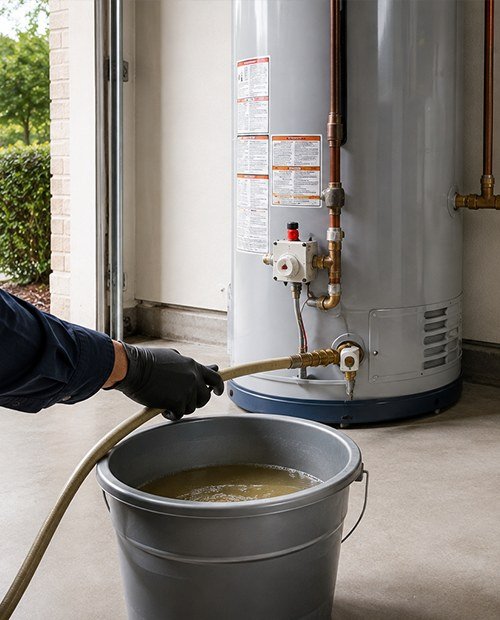
Tie the routine to the same season each year so it becomes automatic. Many households pair heater care with autumn work around the home, the same round that includes winterising outdoor faucets before cold weather arrives, since both jobs protect plumbing against the season ahead. Begin by cutting energy to the unit, turning a gas control to its pilot setting or switching an electric model off at the breaker, and closing the cold water inlet. Attach a hose to the drain valve at the base, run it somewhere the hot water can discharge safely, open a hot tap elsewhere in the home to admit air, and open the drain valve to let several gallons out, or the whole contents when sediment runs heavy.
Understanding the appliance in front of you sharpens every step of that routine, and the water heating methods and tank systems overview on Wikipedia explains how storage designs hold and reheat their reservoir, which is why standby losses and sediment behave as they do. While the tank drains, watch what leaves. Clear water after an initial cloudy flush suggests a light year, while grit, flakes, and rusty colour argue for a fuller flush and a shorter interval before the next one. Refill only after closing the drain valve, and let water run from an open hot tap until air clears and the flow steadies, because heating a partly filled tank can destroy an exposed electric element almost at once.
Inspect the anode rod during the same visit, since the tank is already cool and depressurized. Loosen it from its port on top of the vessel, draw it out, and judge what remains. A rod eaten to a thin wire, or coated so heavily that little active metal shows, has finished its work and should be replaced before the tank goes back into service. The science behind that judgment is set out in the sacrificial anode corrosion protection explained resource on Wikipedia, which describes how a more reactive metal corrodes first and shields the structure around it. Finish the routine by lifting the relief valve lever briefly so a small burst of water confirms the valve still moves and reseats, then restore water, confirm the tank is full, and only then restore heat.
Temperature Settings Balancing Safety, Comfort, and Running Costs
Thermostat setting pulls three concerns in different directions. Stored water must stay hot enough for comfortable showers, effective washing, and basic hygiene, yet every extra degree held around the clock increases standby heat loss through the tank walls and speeds both sediment formation and internal corrosion. Higher settings also raise the severity of any scald at a basin or bath, a risk that matters most in homes with young children or older relatives whose reactions and skin leave them more vulnerable. Energy guidance from the United States Department of Energy supports lowering the setting as a straightforward saving, since a tank kept slightly cooler loses less heat while it waits between uses.
Adjust in small steps rather than one large change. Lower the dial slightly, live with the result for several days of normal bathing and washing, and judge comfort honestly before lowering again. Homes with dishwashers that heat their own water tolerate lower settings more easily than homes relying on tank temperature for washing up by hand. Mark the final chosen position on the dial with a pencil line so an accidental knock or a curious hand does not quietly return the tank to its former wasteful setting. Recheck the setting during the yearly routine, because dials drift from their marks as tanks are serviced, moved, or simply brushed past in tight spaces.
Warning Signs That Maintenance Can No Longer Save the Unit
Some signs announce that the routine has arrived too late. Water pooling beneath the tank that returns after fittings and the drain valve have been checked and dried points toward a vessel wall that has rusted through, and a perforated tank cannot be repaired back into pressure service. Rusty hot water flowing even after a thorough flush, metallic tastes that persist, and rumbling that survives draining all suggest advanced internal decay. Age frames every judgment, because a heater well into its second decade that develops any of these symptoms deserves replacement planning rather than heroic maintenance spending.
Other warnings concern safety rather than longevity. A relief valve that will not move, or that weeps constantly after testing, needs prompt professional attention. Soot marks around a gas burner, a pilot that repeatedly dies, or a smell of exhaust in the room call for the energy supply to be shut off and a qualified engineer to attend before the unit runs again. Treat those signs with urgency and keep the area around the heater clear and dry while waiting. When replacement does become necessary, choosing it calmly, with measurements and fuel type already noted during routine visits, beats choosing it in a panic with water spreading across the floor and the household queuing for a working shower.
Record keeping closes the yearly loop. Write the date of each flush, the condition of the rod, and the thermostat position on a card taped to the side of the tank, facing outward where the next person to service the unit will see it at once. That small history tells a story no single inspection can, showing whether sediment is building faster, whether rods are lasting as long as they should, and whether settings have crept upward between visits. A heater with a written history rarely dies unnoticed, because its keepers have been watching its slow changes all along and acting while action was still cheap and easy.


