
Pizza dough rewards beginners quickly because four ordinary pantry ingredients, a little kneading, and unhurried fermentation do nearly all of the work between them. Understanding what happens inside the dough at each stage makes shaping and baking feel straightforward rather than mysterious. A first attempt rarely needs special equipment, exotic flour, or a wood fired oven to succeed, because the fundamentals travel well from a professional bakery to a small home kitchen. Flour hydrates, yeast wakes, gluten organises, gas accumulates, and heat transforms a pale, pliable disc into a blistered, fragrant crust. Each stage announces its progress through sight and touch, so a beginner who learns to read elasticity, relaxation, and bubble structure gains a skill that improves every subsequent batch far more than any single recipe adjustment could.
Four Pantry Ingredients and the Gluten Network They Build Together
Flour forms the body of the dough, and bread flour earns its preference through higher protein, because protein is the raw material from which gluten is built. When flour meets water, two proteins link into an elastic network that stretches around gas bubbles instead of letting them escape, giving the finished crust its chew and its structure. Water hydrates that flour and activates the yeast, and its proportion decides whether the dough feels firm and tidy or soft and extensible. Wetter doughs demand a little more confidence in handling yet reward it with a more open crumb, while drier doughs shape easily and suit a very first attempt where control matters more than airy holes.
Yeast brings the dough to life by consuming sugars present in flour and releasing carbon dioxide, and that gas is what inflates the network during fermentation. Alongside the gas, yeast activity produces compounds that deepen flavour far beyond the taste of plain baked flour, which is why a slowly fermented dough smells rich before it ever meets the oven. Salt seems humble beside them yet works constantly, tightening the gluten so the dough holds its shape, seasoning the crust from within, and slowing yeast activity just enough to keep fermentation orderly rather than frantic and exhausted. Four ingredients, each plainly understood, explain nearly every success and failure that follows, from tearing dough to flat flavour to a rim that refuses to puff.
Kneading Until Smooth, Elastic, and Able to Stretch Thinly
Kneading organises loose, shaggy proteins into a coherent elastic network, transforming a rough mass that tears at a touch into a smooth ball that stretches willingly. Hands push the dough away, fold it back, turn it, and repeat, and within minutes the surface changes from matte and ragged to satiny and taut. A well kneaded dough passes a simple test: a small piece pulled gently between the fingers stretches thin enough to let light glow through without ripping straight away. Dough that tears immediately asks for more work or a short rest, since gluten sometimes needs pauses as much as effort, relaxing during stillness in a way that makes the next spell of kneading noticeably more productive.
Resting belongs inside the kneading stage rather than after it, because a covered pause lets flour finish absorbing water and lets tight gluten loosen before shaping begins. Resist drowning the work surface in extra flour while kneading, since every handful worked into the dough quietly lowers its hydration and firms the eventual crust toward toughness. A light dusting, a bench scraper for lifting sticky patches, and patience with an initially clinging texture carry most doughs to smoothness intact. Judge readiness by feel as much as by elapsed time, looking for a ball that springs back slowly when poked and holds a smooth skin when drawn down around itself into a tight, seamless sphere ready for fermentation.
Slow Cold Fermentation and the Blistered Crust It Produces
Fermentation offers a genuine choice of temperament. A quick warm rise, with the dough resting in a cosy spot until doubled, produces pizza on the same day with mild flavour and a soft, pleasant crust that satisfies a spontaneous evening. Slow cold fermentation takes the opposite path, sending portioned dough to the refrigerator for a day or several days, where chilled yeast works at a crawl while flavour compounds accumulate steadily. Cold fermented dough develops a deeper, more complex taste and bakes into a crust freckled with blisters and open, airy pockets, the qualities many home bakers chase once their first simple pizzas succeed. Troubleshooting belongs in this section too, and anyone puzzling over pizza dough that never rises usually finds the answer among tired yeast, a chilly room, or salt and yeast mishandled at mixing.
Reading a broad survey of pizza styles and baking background shows how widely fermentation habits vary between traditions, from rapid everyday doughs to long matured bases prized for digestibility and flavour. The biological engine underneath every style is examined in the entry on bakers yeast and fermentation behaviour, which explains how the organism feeds, multiplies, and generates the gas that a strong gluten network must be ready to hold. Cold dough needs kindness on its return, resting covered at room temperature until it relaxes and loses its chill, because cold, tight dough springs back stubbornly under the hands and tears at the centre. Plan that warming rest into the evening schedule rather than fighting the dough, and shaping becomes the calm stage it should be.
Hand Stretching Dough Balls While Protecting the Puffy Outer Rim
Shaping begins before hands touch the dough, with a ball rested, relaxed, and lightly floured on its surface. Press fingertips into the centre and work outward, pushing gas toward the edges where it gathers in the rim that will puff into a proud, airy border in the heat. Turn the disc as it grows, letting gravity assist by lifting it over the backs of the hands and allowing its own weight to stretch it evenly, always guarding the outer edge from being flattened. Hand shaping preserves the bubble structure built during fermentation, while a rolling pin rolled across the whole disc presses those bubbles out and leaves a rim that bakes dense and cracker like, which is why the pin stays in the drawer for this style of pizza.
Thickness is a preference negotiated between base and rim. A centre stretched thinly, almost translucent at its heart without tearing, crisps beneath the toppings, while the untouched border stays thick enough to blister and chew. Small tears forgive easily, patched by pinching neighbouring dough across the hole and resting the disc briefly so the repair relaxes. If the dough resists and springs back repeatedly, walk away for a short covered rest rather than forcing it, because gluten under tension always wins an argument conducted in haste. A relaxed disc that keeps the size it was given signals readiness for sauce, and that patience at the bench directly shapes the eating pleasure waiting at the table.
Baking on Stones, Steels, and Inverted Trays at Maximum Oven Heat
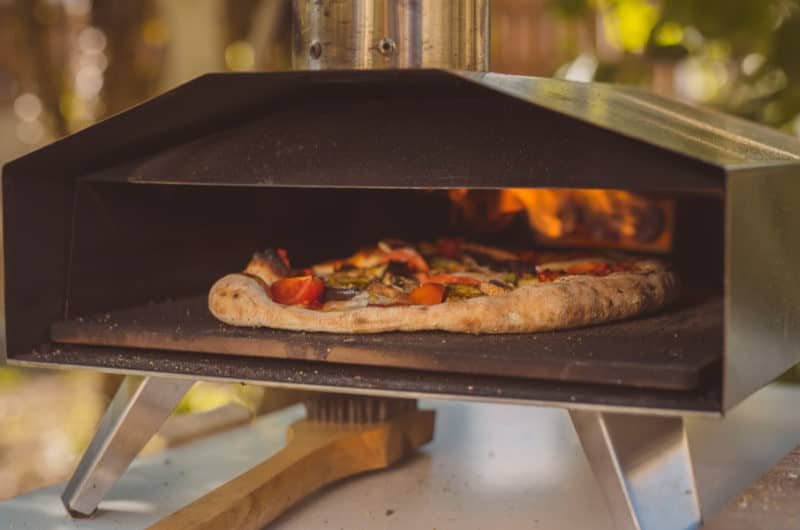
Home ovens reach only a fraction of bakery oven heat, so stored heat becomes the home baker’s compensation. A stone, a steel, or a heavy inverted tray preheated thoroughly at the oven’s highest setting delivers a surge of heat into the base the moment the dough lands, setting the underside before toppings can soak it and driving the rim upward in a final burst of expansion. Preheat longer than impatience suggests, because a surface that feels hot to a hovering hand may still hold uneven heat in its core, and the first pizza pays for any shortcut with a pale, flabby bottom. Launch the topped disc swiftly from a floured peel or an upturned sheet, minimising the seconds the oven door stands open.
Watch the bake rather than timing it blindly. The rim should colour deeply in patches, the cheese should bubble across its whole surface, and the underside, lifted with tongs for a glance, should show firm, spotted browning rather than limp pallor. Rotate the pizza partway where an oven heats unevenly, a habit learned from a single pie that emerges bronzed on one side and shy on the other. Rest the finished pizza briefly on a rack so steam escapes from beneath instead of softening the base that the preheated surface worked so hard to crisp, then slice and serve while the crumb inside the rim still shows its open, glossy structure.
Freezing Extra Dough Balls and Keeping Toppings Deliberately Light
Extra dough balls freeze gracefully, rewarding anyone who doubles a batch on a quiet afternoon with pizza nights that begin halfway finished. Freeze each portion after its rise, sealed against drying, then thaw it in the refrigerator overnight and give it the same relaxed warming rest as cold fermented dough before shaping. Frozen dough loses a whisper of its liveliness across long storage yet still outperforms any hurried same hour dough for flavour, and keeping a small reserve transforms pizza from a project into an ordinary weeknight possibility. Label each parcel with its making date in plain words on tape, so the oldest dough gets used first and nothing lingers forgotten behind the peas.
Restraint governs toppings as firmly as technique governs dough. A thin film of sauce, a modest scattering of cheese, and a few well chosen additions let the base cook through and the rim dominate, while a loaded pizza steams under its own weight and leaves the centre sodden no matter how fierce the surface beneath it. Wet ingredients benefit from draining or a brief preliminary cooking, and fresh greens belong on the pizza after baking, where residual heat wilts them without flooding the crust. Finish with confidence in the dough itself, because a blistered, well fermented crust needs little decoration, and the baker who trusts it discovers that the simplest pizzas are usually the ones remembered longest.
Confidence grows quietly across batches when notes accompany the eating, recording how long the cold rest lasted, how relaxed the dough felt at shaping, and how deeply the rim coloured in the heat. Small adjustments follow naturally from those notes, a touch more water for openness, a longer warming rest for manageability, or a hotter surface for a firmer base, and each change can be judged on its own because only one element moved. That steady habit of observation turns a promising first pizza into a dependable household ritual, with dough mixed days ahead, toppings kept light, and a crust whose blistered rim and tender chew reflect choices the baker now understands rather than luck the baker merely enjoyed.
One comment