
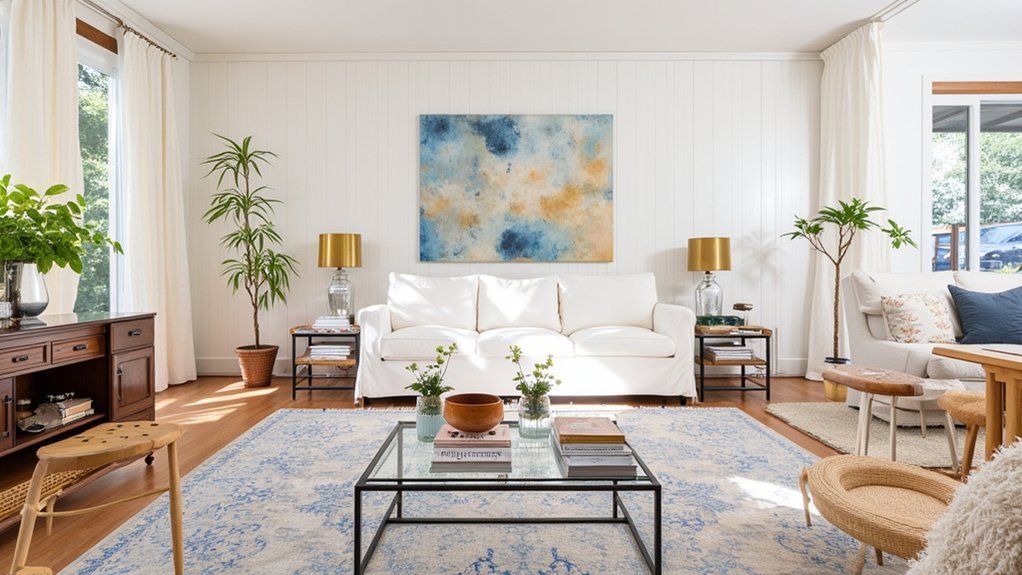
A living room can feel tired for surprisingly humble reasons: harsh light, crowded surfaces, furniture pressed against walls and colours that never agreed with each other. Expensive sofas are seldom the cure people imagine. Paint, warmer bulbs, softer fabrics and a braver layout deliver most of the transformation at a fraction of showroom prices. Working route by route inside a modest two hundred budget shows exactly where each small sum earns its keep.
Route One Rearranging and Clearing Before Spending Anything
The rearranging route costs nothing, which makes it the honest starting point for any two hundred transformation. Most tired rooms suffer from layout before they suffer from shabby belongings. Sofas and chairs drift against walls over the years, the rug shrinks into an island, and every surface collects objects that were never chosen as decoration. Pulling furniture away from the walls, grouping seating around a clear focal point, and removing a third of the objects on display can change the character of a room in a single afternoon.
The advantages of this route are formidable. It is free, reversible, and diagnostic, because it reveals what the room actually lacks once clutter stops shouting. Many people discover that the sofa is fine, the chairs are comfortable, and the real problems are glare, crowding, and a colour scheme fighting itself on every wall. The disadvantage is equally plain: rearranging cannot repair peeling paint, warm up cold light, or add the softness that bare rooms desperately need. It earns its place as the foundation, not as the whole renovation.
Work through the clearing stage with unusual honesty. Box up everything that earns no place, live with the emptier room for a few days, and return only objects that add beauty, comfort, or daily use. Design writers at outlets such as Apartment Therapy regularly show that rearranging existing furniture and editing belongings changes a room before any purchase happens, and lived experience supports the claim. Rooms breathe again once sightlines open, and the money saved here becomes the paint and lighting fund for the routes that follow.
Route Two Paint as the Boldest Single Change
Paint offers the largest visible transformation per small sum spent, and within a two hundred budget it deserves the largest single share. One wall in a deeper shade, or every wall in a warm and forgiving neutral, redraws the room completely. Paint also forgives a multitude of older sins, covering scuffs, patchy previous colours, and the faint outlines where pictures hung for years. No cushion, lamp, or ornament can compete with that scale of change for the same outlay.
The route succeeds only when preparation and application receive proper respect. Walls need washing, filling, sanding, and careful masking, and rushed rolling leaves streaks that catch the light cruelly. Anyone tackling the job for the first time should study how to paint a room like a pro for the first time before opening a tin, because sound room painting tips on preparation, cutting in, and rolling in steady sections prevent the amateur finish that makes a cheap refresh look cheap. Time is the hidden price of this route, and the budget must respect it.
Weighed honestly, paint carries drawbacks alongside its drama. It is disruptive for a weekend, unforgiving of poor colour choices, and wasteful when applied over problems such as damp that need repair rather than covering. Renters may need permission, and dark shades can shrink a small or north facing room if used without thought. Even so, a tested sample, a borrowed ladder, and a single well chosen colour usually deliver the moment visitors walk in and ask what changed, which is precisely the reaction a refresh is meant to produce.
Route Three Layered Lighting on a Shoestring
Lighting is the route most often starved of funds and most responsible for whether a room feels welcoming after dark. A single harsh ceiling fitting flattens faces, greys colours, and turns even good furniture shabby. Layered light from several softer sources does the opposite, pooling warmth where people sit and leaving gentle shadow where the eye rests. Within a two hundred budget, two or three lamps with warm bulbs, moved to the corners where people actually gather, transform evenings entirely.
The principles behind the effect are well established. The Wikipedia entry on interior design and the shaping of pleasing interiors presents the field as the art and science of enhancing interiors so spaces become healthier and more pleasing for the people using them. Lighting sits at the heart of that mission in practice. Colour specialists note that warm light tends to flatter skin and furnishings, which is why layered lamps soften a room more than brighter overhead fittings ever manage, however efficient those fittings may be.
The disadvantages of this route are modest but real. Cheap lamps can look flimsy, trailing cables create clutter and hazards, and warm bulbs vary enough that mismatched shades can jar. Borrowed or second hand lamps solve most of the cost problem, provided shades are clean and fittings are safe. Position matters more than price: a lamp beside the reading chair, another washing light across the painted wall, and a low glow near the bookcase will outperform one expensive statement piece placed where nobody sits.
Route Four Textiles Plants and Borrowed Treasures
Textiles supply the softness that hard rooms lack, and they do it at prices a two hundred budget can absorb when choices stay disciplined. A washed and mended throw over a worn sofa arm, cushions recovered in a fabric that echoes the new paint, and curtains hung higher and wider than the window all add generosity to a room. Texture matters as much as colour here, because knitted, woven, and brushed surfaces invite touch and signal comfort before anyone sits down.
Plants and borrowed treasures complete the route at little or no cost. A thriving plant on a bare shelf, cuttings rooting in a jar on the sill, and a stack of beautiful books borrowed from another room all bring life and personality that shops cannot package. Swapping ornaments, pictures, and spare lamps with friends refreshes two homes at once. The risk is taste drifting into clutter, so every addition should displace something weaker rather than simply joining the crowd on already busy surfaces.
Weighed against the other routes, textiles and treasures offer charm rather than transformation. They cannot rescue a bad layout, dull paint, or cruel lighting, and money scattered across many small pretty objects evaporates without changing how the room feels. Their strength appears after the structural routes have done their work, when softness and personality become the missing ingredients. Spent last and spent sparingly, a small share of the budget here gives the finished room its warmth, its sense of welcome, and its lived in ease.
Weighing the Routes Against Small Room Realities
Small rooms punish waste and reward precision, so the four routes rank differently there than in a generous space. Rearranging comes first by an even wider margin, because every piece of furniture must justify its footprint and walkways must stay clear. Paint follows, favouring lighter and warmer shades that borrow brightness, with a deeper colour reserved for one wall or an alcove. The Wikipedia entry on the living room as a shared domestic space describes it as a room set aside mainly for relaxing and receiving guests, and a small room must protect both duties fiercely, seating guests without swallowing the floor and relaxing its owners without feeling like a corridor.
Lighting in a small room must be layered without multiplying objects. Wall mounted or slim floor lamps earn their keep, while bulky table lamps steal surface space that small rooms cannot spare. Textiles should be fewer and larger rather than many and small, because one generous throw reads as calm while a scatter of tiny cushions reads as clutter. Across all four routes, the weighing rule stays constant: spend where the eye lands and where bodies rest, and let corners that nobody notices wait for a richer season.
There is also a fair argument for spending the entire two hundred on a single route when one flaw dominates the room. Peeling, nicotine stained walls will defeat every cushion ever sewn, and a room lit by one bare bulb will waste beautiful paint after dark. Diagnose the dominant flaw during the free rearranging stage, fund its route properly, and let the remaining routes run on borrowing and ingenuity. A two hundred budget spread too thinly across four fronts can finish with four half improvements and no transformation anywhere.
Verdict Spending Two Hundred Where Eyes Land First
The verdict is straightforward. Keep the rearranging and clearing route free and ruthless, then divide the two hundred unevenly rather than fairly. Paint earns the largest share, because it redraws every surface the eye touches. Lighting earns the second share, because it decides whether the painted room glows or glares each evening. Textiles, plants, and borrowed treasures share what remains, gathered slowly and chosen against the finished colours rather than bought in hope at the beginning.
Sequence matters as much as the split. Rearrange first and live with the layout, paint second while the room stands emptier than usual, place lighting third against the true colours, and add softness last of all. Working in that order prevents the classic waste of a small budget, where cushions are bought to match walls that paint later changes and lamps are chosen for corners that furniture later occupies. Each stage also reveals whether the next stage still needs its full share or can surrender funds to a better use.
A tired living room rarely needs rescue by expensive furniture. It needs its layout believed in, its walls given one confident colour, its light softened and layered, and its surfaces edited until the remaining objects look chosen. Two hundred, spent in that order and aimed where eyes land first, delivers exactly that transformation. The room that greets you afterwards will feel calmer, warmer, and unmistakably yours, and the discipline of the small budget will deserve much of the credit for its coherence.


One comment