
Parking outside while boxes claim the bays inside is frustrating, yet buying more storage rarely solves the underlying muddle. Garages fail when every object competes for floor space and nothing has an assigned home based on how often it gets used. Comparing wall, rack, and ceiling options honestly shows where each type earns its keep. Choose a blend matched to your household, and the car can finally come back indoors. The comparison only works after an honest sort, because no rail, rack, or platform can organise possessions that should have left the household entirely.
Wall Rails and Peg Panels Compared for Tools Used Every Week
Wall systems suit the tools reached for most often, because they keep handles visible, off the floor, and within a single step of the workbench. Peg panels offer endless rearrangement, with hooks moving as collections change, and they reward households that enjoy seeing every outline at a glance. Rails with sliding holders grip handles of varied thickness more firmly and often look tidier, though they cost more thought at installation and accept fewer improvised arrangements. Either option beats a deep toolbox drawer for daily gear, since visibility prevents duplicate buying and speeds putting things away, which is the habit the whole garage depends on.
Deciding honestly what deserves to remain in the garage at all comes before any rail is screwed to a stud. Owning fewer neglected possessions reduces the storage any household needs to build, and reading about minimalism worth trying can sharpen that judgement without demanding an empty or joyless home. Keep tools that earn their place through regular use or clear seasonal purpose, pass duplicates to neighbours or charity collections, and recycle broken items that have waited years for repairs nobody will schedule. Sorting before buying storage is a standard organising principle, since discarded items need no container, label, or shelf space at all.
Mounting quality decides whether wall storage stays trustworthy. Fix rails and panels into structural framing wherever loads are meaningful, never relying on plasterboard alone to carry hammers, spades, or powered equipment. Spread heavier tools across a wider area rather than clustering them on one stud, and leave working clearance so items can lift free without dragging neighbours off their hooks. Outline shapes on peg panels if memory needs help, and reserve the lowest, easiest reach for the heaviest daily tools, keeping lighter and rarer items higher. A wall planned this way stays usable for years instead of sagging into a second muddle hung vertically.
Freestanding Racks and Clear Boxes Compared for Bulky Family Gear
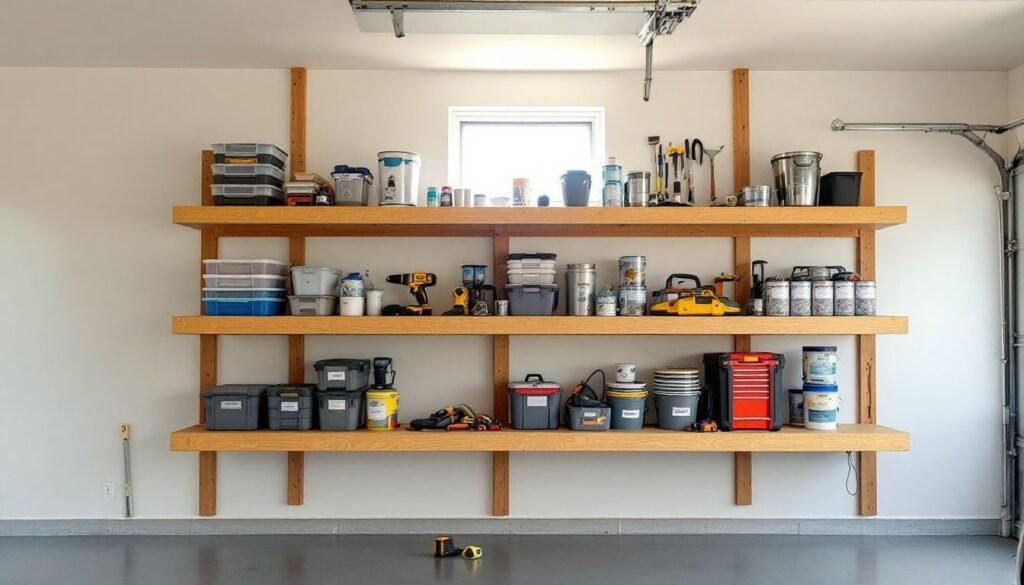
Freestanding racks answer a different problem, the bulky and awkward possessions that walls handle poorly. Camping equipment, sports bags, coolers, and stacks of household overflow sit naturally on open shelves where depth is useful rather than wasted. Metal racks adjust as needs change and tolerate heavier loads in general terms, while lighter plastic units move easily but flex under sustained weight and suit gentler duty. Clear boxes on those shelves outperform cardboard in every respect, showing contents at a glance, resisting damp, and stacking predictably instead of collapsing into each other as seasons pass and corners soften.
Context helps when judging how much rack space a garage can spare. The Wikipedia overview of residential garages presents a residential garage as a walled and roofed structure intended mainly for storing vehicles, often with space pressed into service for tools and household overflow, and that overflow role is exactly what racks must discipline. Measure the car first, with doors open and room to walk around, then give racks only the floor that remains after that honest allowance. A rack that steals door swing or forces occupants to squeeze past will be resented daily, however neatly its boxes are labelled.
Box discipline matters as much as the rack itself. Standardise on a small number of sizes so stacks stay stable, label every box on the side that faces the aisle, and group by activity rather than by the year things arrived. Heavy boxes belong low, light and seasonal boxes high, and anything needed weekly belongs at waist height where lifting stays easy. Leave one shelf partly empty on purpose, because a garage with no slack absorbs every new arrival by spilling onto the floor. That deliberate breathing room is the difference between a system that survives real family life and one that collapses at the first holiday.
Ceiling Platforms and Bike Hoists Compared for Seasonal Overflow
Ceiling storage claims the volume most garages waste completely, the high air above car roofs and door tracks where nothing else can usefully live. Fixed platforms suit flat, stackable loads such as decoration boxes, spare bedding in sealed bags, and camping gear that appears for a few weeks each year. They demand careful fixing into joists and honest respect for whatever general load guidance the maker states, described here only in broad terms because capacities vary widely between products and ceilings. Loading them is a ladder task for two people, which alone makes them wrong for anything needed often or at short notice.
Hoists answer the narrower question of bicycles, lifting each machine flat against the ceiling on straps or hooks worked by a pulley line. A hoist keeps one or two bikes beautifully clear, yet a household fleet multiplies lines, fittings, and ceiling clutter quickly, and lowering a bike for a spontaneous ride takes longer than lifting it from a wall hook. Compare honestly: platforms swallow varied seasonal bulk, hoists excel at a specific awkward shape, and wall hooks beat both for a bicycle ridden several times a week. Seasonal overflow by definition tolerates slow access, while daily transport never does, so frequency should settle the argument.
Safety rules govern everything overhead. Keep platforms clear of the garage door mechanism and its travel, confirm joist direction and condition before drilling, and never store anything overhead that would injure someone if a fixing failed, such as loose heavy tools or unsecured paint tins. Household hazardous leftovers such as old fuel and solvents belong at local collection points rather than in ordinary refuse, a point the Environmental Protection Agency makes in its household waste material, and they certainly do not belong stored above a car. Mark what lives on each platform on a simple list fixed near the ladder, so nobody climbs up speculatively and disturbs a careful stack.
Floor Space Zoning That Keeps Cars and Work Areas Separate
Zoning turns a collection of storage into a garage that functions. Sketch the floor, mark the car bays with their door swing included, then assign the remaining walls and corners to work, sport, garden, and household roles according to how each activity reaches the space. Tools gather near the bench, sports gear near the main door for quick loading, and household overflow near the house entrance where trips are shortest. Paint or tape can mark bay edges on the floor itself, giving every driver a visible target and giving stray boxes an obvious line they have crossed when clutter begins creeping back.
Reference material on shelving clarifies why fixed zones hold their shape over time. The Wikipedia page about shelving describes shelving as horizontal surfaces supported for storage, and wall mounted systems move weight off floors onto structural framing when fixed properly, which is the principle zoning relies on throughout. A zone is really a promise about where a category sleeps, and promises survive when returning an item takes seconds rather than a decision. Keep aisles wide enough for bins, bikes, and people to pass without shuffling sideways, and resist filling the last clear corner, because circulation space is what makes every other zone reachable.
Work areas need special protection within the plan. A bench zone should include nearby storage for its own tools, lighting that does not depend on the car leaving, and floor space kept permanently clear for standing and moving materials safely. Sawdust, offcuts, and project pieces in progress need a defined temporary home with a time limit, agreed honestly, after which unfinished projects move, finish, or leave. Children and pets passing through benefit from the same clarity, with sharp and chemical items locked or lifted well beyond casual reach. When zones are respected weekly, the garage stays a working room rather than reverting to a dumping ground with a door.
Recommendation: Combine Walls for Daily Items With Height for Rare Ones
The strongest arrangement blends all three families according to frequency. Walls carry daily tools and weekly sports gear where hands reach them without ladders or shifting stacks. Racks carry bulky family equipment in clear labelled boxes along one disciplined wall. Ceiling platforms and hoists carry the seasonal overflow that can tolerate slow retrieval a handful of times each year. Floor space, by this settlement, belongs to cars, movement, and work, and to nothing else without a temporary and stated reason. No single product achieves that balance alone, which is why honest comparison at the start beats brand loyalty or a single expensive system bought in hope.
Sequence the work to protect enthusiasm. Sort and remove first, clean the empty space, fix wall systems while access is easy, then place racks, and only then load ceiling storage with the items that survived every earlier filter. Photograph the finished arrangement for reference, label generously, and keep a permanent donation box near the door so departures continue as a habit rather than an annual event. Review the garage briefly each season, returning strays, questioning newcomers, and adjusting one small area at a time before disorder spreads. Small corrections applied early cost minutes, while a full rescue repeated yearly costs weekends.
Judge success by use rather than appearance. The car comes indoors without negotiation, a familiar tool is found in seconds, a bicycle leaves without moving three other possessions, and a seasonal box comes down safely when its moment arrives. Those ordinary victories mean the comparison was settled correctly for this household, whatever a catalogue might recommend instead. Households differ in hobbies, vehicles, and storage pressure, so copy principles rather than layouts, frequency rather than fashion, and honesty about possessions rather than optimism about space. A garage arranged on those terms stays arranged, and the driveway returns to being a place cars merely visit.


