
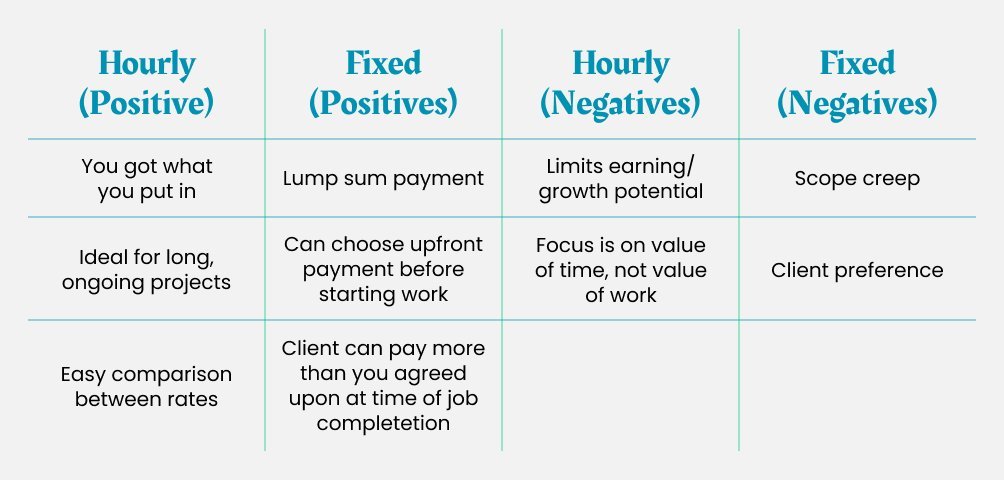
Ask a room of freelancers about pricing and two camps form almost instantly. Hourly billing feels fair because effort gets measured openly, while a single set price feels clean because clients know the full commitment upfront. Each model quietly shifts risk between you and the buyer, and each rewards a different kind of project. Choosing well depends on scope, certainty, trust, and how predictable your own working pace really is on ordinary weeks.
How Hourly Charging Plays Out in Practice
Hourly billing is the easier model to explain. You agree a rate, track the time honestly, and invoice for the hours the work actually took. When a project grows, the payment grows with it, so you are not quietly absorbing extra rounds of revision or unexpected complications. For exploratory work, where neither side can describe the finish line clearly at the start, that openness protects you from guessing badly and protects the client from paying for padding they never needed.
The same openness creates friction. Clients watching a running clock may hurry decisions, question every hour on an invoice, or feel uneasy because the final total stays unknown until the end. Some clients also worry, fairly or not, that hourly billing rewards slowness. Clear habits soften most of this. Agree how time gets recorded, send brief progress notes as hours build, and flag early when a task is running longer than expected. Surprises damage trust far more than hours themselves.
Hourly thinking becomes concrete once a freelancer sees hourly pay converted to yearly income and understands what a steady rate builds across a working year. That wider view matters because a rate must cover far more than the hour in front of a client. Federal small business pricing guidance encourages freelancers to count overheads, unpaid admin time, and taxes inside any rate, rather than pricing from the billable hour alone. Marketing, invoicing, chasing payment, and quiet days between projects are all real costs of freelancing, and an hourly rate that ignores them looks healthy on paper while leaking money in practice.
Consider a purely illustrative example, offered as arithmetic rather than market data. Suppose a project was expected to take ten hours and instead takes fifteen because the client keeps adding detail. Under hourly billing, the invoice reflects those fifteen hours, and the conversation is about whether the extra work was worthwhile. Under a set price agreed at the start, those extra five hours come out of your own pocket unless the agreement allows changes to be charged separately. Neither outcome is automatically fair. The question is who agreed to carry the uncertainty before the work began.
How a Single Set Price Changes the Risk
A single set price flips the arrangement. The client knows the full commitment before work starts, can budget without anxiety, and never has to wonder whether a task is being stretched. That certainty is genuinely valuable, and for many buyers it is the main reason they prefer this model. A clear price also makes comparing providers easier, which pushes freelancers to describe exactly what is included rather than hiding behind open ended estimates.
The Wikipedia entry on fixed price contract describes an agreement where the buyer pays a set amount regardless of hours spent, placing efficiency risk largely on the provider. That sentence captures the trade honestly. If you work faster than expected, you keep the benefit and the effective hourly return rises. If the job swells, you absorb the loss. Experienced freelancers price that risk in, building a margin for the unknowns, which means set prices often look higher than a hopeful hourly estimate for the same work.
Set pricing rewards preparation. A careful freelancer defines the scope in writing, lists what is excluded, states how many revision rounds are included, and describes what happens when the client asks for something beyond the agreement. Without that written frame, a set price becomes an invitation to endless small additions, each one too minor to argue about and collectively large enough to ruin the project economics. The price itself is rarely the problem. The undefined edges around the price usually are.
There is also a trust effect running the other way. Some clients relax under a set price because the meter is not running, and relaxed clients often communicate better, share context earlier, and make decisions without clock anxiety. Others test the boundaries precisely because the total feels fixed. Which client you have matters as much as which model you choose, and a written scope with a fair change process protects the relationship under either temperament.
Matching Each Job Type to the Safer Model
Open ended work suits hourly billing. Research, troubleshooting, consulting, early stage design exploration, and support arrangements all involve questions that cannot be fully scoped in advance. Charging by the hour lets the work follow the discoveries, and lets the client stop or redirect at any point without unwinding a large fixed agreement. For these jobs, trying to name one set price usually means either overcharging for safety or undercharging and resenting the work by the second week.
Well defined deliverables suit a set price. When the output can be described precisely, the inputs are stable, and you have done similar work many times, you can estimate with confidence and the client gains welcome certainty. Repeat work is the strongest case of all. The second and third time you deliver the same kind of project, your pace is known, the pitfalls are familiar, and a set price becomes both fair to the client and comfortable for you.
Project length pulls the decision too. Short tasks rarely justify the admin of detailed time tracking, and many freelancers simply quote one price for anything brief. Long engagements, by contrast, expose both sides to drift, changing staff, and shifting priorities, so hourly or staged arrangements often age better than one price named months earlier. Client behavior matters as well. A decisive client with a stable brief is a safe set price partner. A client known for changing direction midstream will make any fixed agreement painful unless changes carry their own clear price.
Your own predictability is the final lens. Some freelancers work at a remarkably steady pace and estimate their hours with real accuracy. Others vary widely depending on the week, the subject, and interruptions. Be honest about which description fits you. A model that works beautifully for a steady estimator can punish someone whose pace swings, and copying the pricing of a freelancer with different habits is a quiet route to undercharging.
Blending Both Models Without Confusing Clients
Many experienced freelancers stop choosing between the two models and combine them deliberately. A common pattern sets a fixed price for a clearly defined core deliverable, then bills any extra work beyond that core by the hour at a rate named in advance. The client gets budget certainty for the main job, you get protection against scope creep, and both sides know the rules before emotion enters the conversation. The blend only works when the boundary between core and extra is written down in plain language.
Another pattern caps hourly work. You bill by the hour but promise the total will not pass an agreed ceiling without fresh approval. The client gains a worst case figure for budgeting, while you keep the fairness of being paid for actual effort. The Wikipedia entry on time and materials explains the underlying arrangement where the client pays for hours worked plus expenses, carrying more of the uncertainty around duration, and a capped version simply trims that uncertainty at the top end. Mention expenses openly too, since materials and travel added late can sour an otherwise smooth arrangement.
Staged pricing offers a third blend. A discovery stage runs hourly or at a small fixed fee, producing the clarity that makes the main stage safe to price firmly. Clients often welcome this because they are not committing to a large total before anyone understands the work. Freelancers welcome it because the second price rests on evidence instead of optimism. Whichever blend you use, name it in one short written summary before starting, and repeat the terms on the invoice so nobody has to rely on memory.
Confusion, not combination, is the real danger. Two models running at once with fuzzy borders will produce disputes about which hours belonged where. Keep the split simple, keep records as you go, and review the arrangement at natural pauses in the work. A hybrid that both sides understand beats a pure model that one side quietly resents.
A Recommendation Based on Predictability and Trust
After weighing both models honestly, the recommendation follows from two questions. How predictable is the work, and how much trust exists between you and the client? When scope is fuzzy, the project is exploratory, or the client expects to keep shaping the work as it develops, hourly billing with regular progress notes and an agreed ceiling is usually the safer and fairer choice. It keeps the uncertainty visible and shared rather than hidden inside a price that one side will regret.
When the deliverable is precise, you have delivered similar work before, and the client values budget certainty, a set price with a written scope, stated revision limits, and a clear charge for changes is the stronger offer. It rewards your experience, gives the client peace of mind, and turns your growing speed into income rather than shorter invoices. For many freelancers, the healthiest long term position is offering both, choosing per project, and explaining the reasoning to the client in plain terms.
Neither model is inherently fairer, and any freelancer claiming one always wins is selling something. Suitability depends on scope clarity, project length, and how much change a client typically requests once work is underway, exactly as the underlying guidance on both arrangements suggests. Revisit your choice after each project. Note whether estimates held, whether the client behaved as expected, and whether you finished feeling fairly paid. Pricing is a skill that improves with honest records, and the model matters less than the clarity and trust surrounding it.


One comment