
Every morning the mirror performs the same disappearing act the moment the shower stops. One wipe with the towel leaves smears, the hairdryer treatment works but nobody has time for it, and shaving through a clearing porthole gets old fast. Fog feels like a fixture of bathroom life, yet it obeys simple physics that can be worked with instead of against. Warm the glass, dry the air, or shield the surface, and the reflection stays where it belongs. The trick is matching the fix to the reason your particular bathroom fogs so hard.
A mirror that stays clear through a steamy shower is exactly the kind of small daily pleasure people mean when they talk about simple luxuries worth splurging on, and the fixes divide neatly into three families. You can dry the air before its moisture ever reaches the glass, you can coat the glass so moisture spreads invisibly instead of beading, or you can warm the glass so moisture refuses to settle there at all. Every product and habit that follows belongs to one of those families, and the cheapest family, dry air, deserves first attention in most homes.
The Physics of Why Warm Air Surrenders Its Moisture on Glass
Air holds water as an invisible vapour, and warm air holds far more of it than cold air can. A hot shower loads the small volume of a bathroom with vapour quickly, from the spray itself, from wet skin and hair, and from every soaked surface in the room. That laden air drifts until it meets something cooler than the temperature at which its vapour must turn back into liquid, a threshold called the dew point. At that meeting, vapour condenses, becoming countless tiny droplets sitting on the cold surface, and a clear sheet of glass turns milky in moments.
The reference entry on condensation explains that water vapour in warm air turns back to liquid when that air meets a surface cooled below its dew point, and the entry on condensation describes the same meeting that plays out on your mirror each morning. The warmer and wetter the air, the higher that threshold sits, which is why a long hot shower fogs a room far faster than a short cooler one. The mirror is rarely doing anything wrong. It is simply the surface in the room that crosses the threshold first and most visibly.
Ventilation Habits That Starve the Fog at Its Source
The extractor fan is the hardest working defence most bathrooms already own, and habit decides whether it earns its place. Switch it on before the shower starts rather than after the mirror has already vanished, so moist air leaves the room from the first minute instead of the last. Leave it running for a good while after you finish, because the walls, towels, and shower tray keep releasing vapour long after the water stops, and a fan silenced at the door abandons the room at its wettest moment.
Energy Star advice for household ventilation fans supports running the extractor during a shower and for a period afterwards, since removing moist air lowers the amount of vapour available to condense, as its ventilation fan guidance explains for household bathrooms. A fan only works as well as its upkeep allows, though. A grille choked with dust and a sluggish flap outside can cut its pull to a whisper, so clean the cover, confirm the fan actually draws air by watching a tissue lean toward it, and treat a fan that rattles without pulling as a fault to fix rather than background noise.
Homes without a fan, or with one that died years ago, still have levers to pull. Cracking a window open a little during and after the shower gives vapour an escape route, and even leaving the bathroom door ajar once you are dressed lets the damp air dilute into the rest of the home instead of condensing on the coldest surface it can find. Neither habit matches a working extractor, yet both visibly thin the fog, and both cost nothing beyond remembering them on mornings when the routine runs on autopilot.
The shower itself is the source, and small changes there pay twice. Shortening a long soak by a few minutes cuts the total vapour load the room must shed. Turning the heat down a notch lowers it further, since slightly cooler water throws off noticeably less steam while still feeling properly warm. None of these habits asks for sacrifice worth naming, and together they can move a bathroom from total whiteout to a light misting that clears while you brush your teeth.
Films, Sprays and the Old Shaving Foam Treatment Tested Honestly
Surface treatments fight fog by changing how condensed water behaves on glass. Left alone, vapour beads into millions of separate droplets, and each droplet scatters light, which is what fog actually is. A treatment leaves a thin film that persuades the water to spread into one flat, transparent sheet instead, so the mirror stays readable even while it is technically wet. The physics is sound and the effect is real. The honest weakness of every treatment in this family is endurance, because films wash away and must be renewed to keep working.
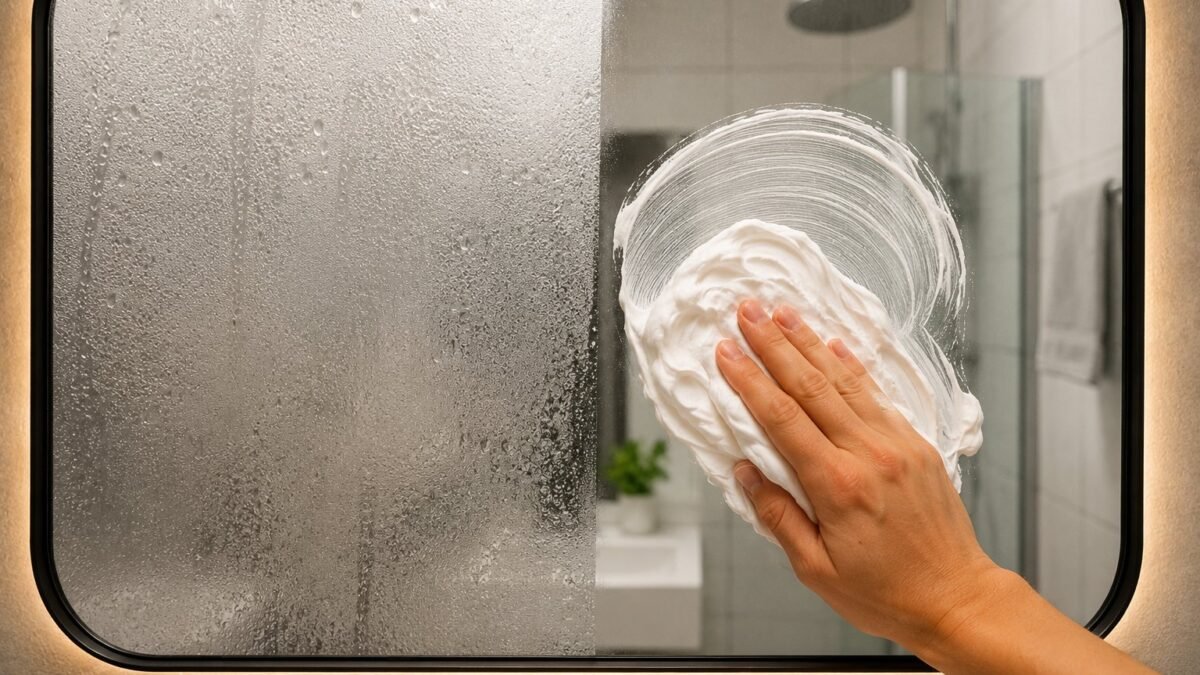
Shaving foam is the folk favourite, and tested fairly, it earns its reputation within limits. Spread a thin layer of ordinary foam across a clean dry mirror, let it sit briefly, then buff it off until the glass looks bare and clear. The invisible residue left behind keeps the mirror largely fog free for days to a couple of weeks of showers, depending on how hot and long they run. It costs almost nothing, risks nothing, and fades gracefully rather than failing overnight. Gel products behave less predictably, so plain white foam is the version worth trying first.
Dedicated anti fog sprays and wipes work on the same principle with a more even finish, and they suit people who want the job done in one quick pass. Their protection tends to last a similar span to the foam treatment before the beading creeps back at the edges. Soap based tricks sit at the weak end of the family. A bar of soap rubbed on and buffed can leave streaks and a smeared haze that looks worse than honest fog, and liquid soap films often wash off within a shower or two, so treat those as experiments rather than solutions you can rely on.
Adhesive anti fog films are the durable member of the family, a clear sheet applied once to the glass that resists fogging for far longer than any coating. Fitting one well takes care, since trapped bubbles and lifted corners undo the neat effect, and the film must be sized and trimmed to the mirror with patience. Over time, hard water spots and cleaning can dull any film or coating, so wipe treated glass gently with a soft cloth and skip abrasive cleaners. Renewal, in short, is the standing price of this whole approach, cheap in money and regular in effort.
Heated Demister Pads and Mirrors That Warm Themselves
Heat attacks the problem from the other side. A demister pad takes the form of a slim heated sheet fixed behind the mirror, and it holds the glass a little above the dew point of the room air, so vapour drifting across it finds no cold surface to settle on and simply passes by. The cleared area matches the pad, which is why pads are sized to the mirror and centred behind the part of the glass you actually use. The effect feels like a luxury the first week and like plain normality by the second, which is the mark of a fix that fits daily life.
Fitting a pad behind an existing mirror suits bathrooms where the mirror can be lifted away from the wall cleanly. The pad bonds flat against the rear face of the glass, its wiring joins the lighting circuit through the work of a qualified electrician, and the mirror returns to its place looking untouched. Replacement mirrors with heating built in suit a refit better, folding the same trick into a new unit that may also carry lighting. Either route should respect the strict rules that govern electrical work near water, and bathroom zones are no place for improvisation with wiring.
Running costs stay very low, which surprises people who picture a heater burning all day. A pad draws modest power, in the same rough territory as an old style bulb, and it draws that only while switched on, usually alongside the bathroom light during the morning routine. The glass clears as the room steams and stays clear for the shave, the teeth, and the mirror checks that follow. Weigh that modest cost against years of clear glass and the pad earns its keep in the same quiet way as the other small comforts that never announce themselves once installed.
Cold Walls, Exterior Glass and Bathrooms That Fog Worse Than Most
Some bathrooms fog harder than identical rooms in the same house, and the wall behind the mirror is usually the reason. A mirror mounted on an outside wall starts the morning colder than one on an internal wall, because the wall itself is chilled from outdoors all night. Colder glass crosses the dew point sooner, holds fog longer, and clears last even after the fan has done its work. If your mirror hangs on an exterior wall, that single fact explains more than any failing of your fan or your habits.
Where a mirror is being refitted anyway, a little insulation behind it can soften the problem. A thin insulating layer between glass and cold wall keeps the mirror nearer room temperature, and simply standing the mirror slightly off a bitterly cold wall on proper fixings helps more than expected. Nothing here matches the certainty of a heated pad on such a wall, yet the combination of insulation, decent ventilation, and a surface treatment often brings an exterior wall bathroom back into line with the rest of the house at modest cost and no wiring at all.
Finally, learn the point where fog stops being a mirror problem. A bathroom that stays damp for hours, grows dark specks along the sealant, or smells musty on dry days is telling you its ventilation has failed at a deeper level than any coating can answer. Fix the extraction first in such a room, with a fan repaired or properly fitted, and let the mirror treatments and heated glass return to their proper role afterwards, polishing a room that already dries itself out as a healthy bathroom should.


