
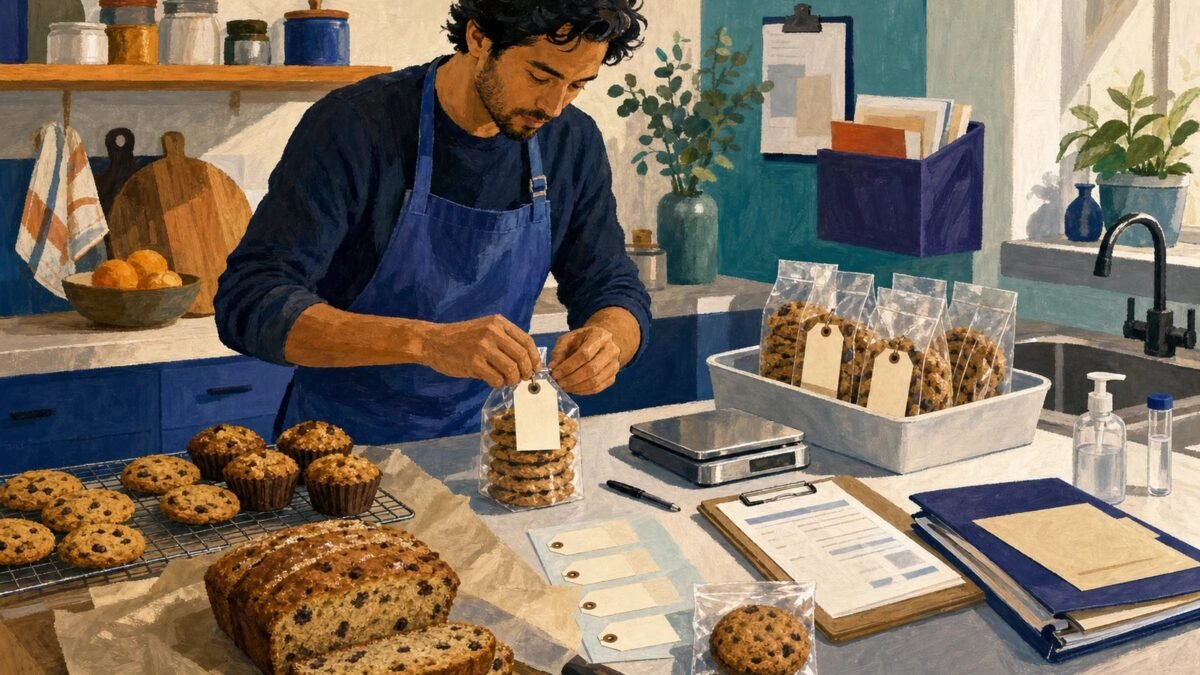
Your kitchen already holds the oven, the mixing bowls, and probably a queue of friends insisting your bakes deserve paying customers. Whether you may legally sell from home depends heavily on where you live, because rules covering home produced food differ sharply between states and sometimes between neighbouring counties. Some foods travel safely through a market day, while others belong firmly in licensed premises. Understanding those boundaries before printing labels protects both customers and the business you hope to build.
Your Starting Checklist Before Selling a Single Bake
Begin with a plain checklist written down rather than held in your head. First, confirm that your state allows home food sales at all and find the official list of foods it permits. Second, check whether your county or city adds its own permit, registration, or kitchen rules on top of the state position. Third, list the exact products you hope to sell and test each one against the allowed list. Fourth, work out where you may sell, since some places allow only direct sales at markets or from home, while others allow wider channels. Fifth, plan your labels, your ingredient records, and your basic food hygiene habits before the first order arrives.
That checklist sounds unglamorous, yet it prevents the most common early heartbreak in home baking, which is developing a product, packaging it beautifully, and then discovering it was never allowed from a home kitchen in the first place. Rules vary widely by state, and the differences are not minor variations on one theme. States take genuinely different positions on which foods qualify, which venues are acceptable, and what paperwork a seller needs, so advice from a seller in another state is background reading, not a rulebook for your kitchen.
Product first thinking helps the checklist stay concrete. Many home sellers start with simple homemade staples such as lemonade for a market stall, so a beginner friendly look at homemade lemonade for beginners and the habits involved in making a drink from scratch shows the product first thinking a new cottage food seller needs. Start with one or two items you make consistently well, confirm they are allowed, learn their true cost, and only then widen the range. A short menu done legally and reliably beats an ambitious menu built on assumptions.
Add two practical items to the checklist that beginners often skip. Keep a notebook or simple file recording recipes, ingredient suppliers, and batch dates, because traceability matters if a customer ever reports a problem. A calm, organised start signals to customers that this is a real small business, not a casual favour with a price attached.
Which Foods Home Kitchens May Usually Offer
Cottage food rules exist to let people sell lower risk foods from home while keeping higher risk foods inside inspected, licensed premises. Coverage of cottage laws on reference sources explains that such rules let people prepare certain lower risk foods at home for sale, while each state decides which products qualify and what conditions apply. The pattern across many states is broadly similar even though the details differ. Foods that are shelf stable, baked, or high in sugar or acid tend to appear on allowed lists far more often than foods needing constant refrigeration.
Breads, plain cakes without perishable fillings, biscuits, many jams and preserves, and dry mixes are the kinds of items many state agriculture pages describe as commonly allowed, because they travel well and carry lower risk when stored without chilling. By contrast, cream filled goods, custards, cheesecakes, fresh filled pastries, and items built around meat or soft cheese frequently sit outside home permissions, since temperature control becomes central to their safety. Treat any such general picture as a starting point for your own checking rather than a promise, because your state list is the only list that governs your kitchen.
Where and how you sell can be limited as tightly as what you sell. The SBA guidance on licences and permits underlines that local permission shapes small food businesses from the outset, and cottage food rules in many states restrict sales to direct channels such as farmers markets, roadside stalls, and collection from home, rather than wholesale supply to shops or cafes. Some states also cap the total sales a home food business may make under cottage rules, while others set no cap at all, which is another reason general advice must always be checked against your own state position.
When a favourite recipe falls outside the allowed list, resist the temptation to sell it quietly anyway. Customers trust home sellers precisely because the arrangement feels honest and local, and one illness or one complaint investigated by officials can end the business and create serious personal consequences. A better response is adapting the range. Working within the permitted list is not a creative limitation so much as the foundation the whole venture stands on.
Labels Allergens and Honest Ingredient Information
A clear label handles three jobs together. It tells the customer what the product is, it lists what went into it, and it carries your name and contact details so the food can be traced back to its maker. Many states require home sold food to state plainly that it was made in a home kitchen that is not inspected in the same way as licensed premises, although the exact wording required differs by state. Check your state template if one exists, and follow its wording rather than inventing your own version.
Allergen honesty deserves particular care. The Wikipedia entry on food labelling explains how labels carry ingredient and allergen declarations, and food safety authorities stress that major allergens must be declared clearly when packaged food is sold, because undeclared ingredients can seriously harm sensitive customers. In a home kitchen the risks are easy to underestimate. Flour dust, shared trays, and a splash of milk or nut oil can transfer traces between products, so a claim that something is free of an allergen should only be made when your process genuinely supports it.
List ingredients in a sensible, complete way, in descending order of weight where your rules require it, and name allergenic ingredients plainly rather than hiding them inside technical terms. If a customer asks whether a bake suits their allergy or dietary needs and you are unsure, say so clearly and let them decide with full information. That honesty occasionally costs a sale. It protects people, and it protects the trust your whole business depends on, which is worth far more than any single order.
Keep label information consistent with what is actually in the packet. If you change a supplier, a brand of chocolate, or a recipe detail, update the label rather than using up old stock of printed labels and hoping nobody notices.
Pricing Bakes Without Undervaluing Your Hours
Home bakers chronically underprice, usually because they count ingredients and forget everything else. A realistic price starts with ingredients, then adds packaging, labels, energy for the oven, market stall fees where they apply, and what your hours are worth across shopping, baking, cooling, packing, cleaning, and selling. Cleaning alone can swallow a surprising slice of a baking day, and a price that ignores it quietly pays you less for every hour the business grows.
Work out the true cost of one batch, then divide it honestly by the number of saleable items that batch actually produces, allowing for the occasional cracked top or uneven bake that cannot be sold. Compare the result with what similar items fetch locally, not to copy those prices blindly, but to understand where your bake sits. If your honest cost leaves almost nothing after time is counted, the answer is rarely to charge an unrealistic figure. It is usually to simplify the product, buy ingredients more sensibly, batch work more efficiently, or drop the item from the range.
Friends and family complicate pricing because they expect warmth to come with a discount. Decide your policy early and apply it evenly. Many sellers give close supporters an opening treat, then charge everyone the standard price with gratitude rather than apology.
Review prices as costs move. Ingredient prices rise and fall, packaging suppliers change their terms, and your own speed improves with practice, which changes the time cost hidden in every batch. A short pricing review every few months keeps the business genuinely worthwhile rather than busy and broke. Selling out quickly every week can be a warning sign as easily as a triumph, since it may mean the price is too low for the hours involved. The aim is a fair return that lets the venture continue, not the lowest price on the market table.
Knowing When to Move Into Licensed Premises
Cottage food rules are a starting framework, not a permanent home for every business. Several signs suggest a move toward licensed premises may be approaching. Your product range may be pressing against the allowed list, with customers asking for filled, chilled, or celebration items your home permission cannot cover. Your sales may be approaching a state cap where one exists. Wholesale enquiries from cafes or shops may arrive even though your current rules allow only direct sales. Each of these is a sign of success creating its own next problem.
Volume itself can force the question. A home oven, one pair of hands, and a family kitchen shared with ordinary life all have limits, and quality starts to suffer when orders regularly outgrow the space. Mistakes multiply when a tired baker works late into the night around household routines. Licensed premises, whether a rented commercial kitchen used by the hour, a shared food unit, or eventually a small premises of your own, bring inspected facilities, proper storage, and room to separate business from family life.
Make the move with the same checklist discipline you started with. Research what licence the new setting requires, what inspections apply, and what the honest monthly cost will be, including rent, utilities, insurance, and travel. Some bakers test the water by renting commercial kitchen hours for larger orders while keeping cottage sales for their standard range, which spreads risk while demand proves itself.
There is no failure in staying small, either. Many home bakers deliberately remain within cottage rules because the scale suits their family, their income goals, and the pleasure they take in the work. The right size for a food business is the size that stays legal, safe, and enjoyable while paying fairly for the hours it takes. Whether you stay at the kitchen table or move into licensed premises, the habits that made the home venture trustworthy, clear labels, honest ingredients, fair prices, and respect for the rules of your state, travel with you.


