
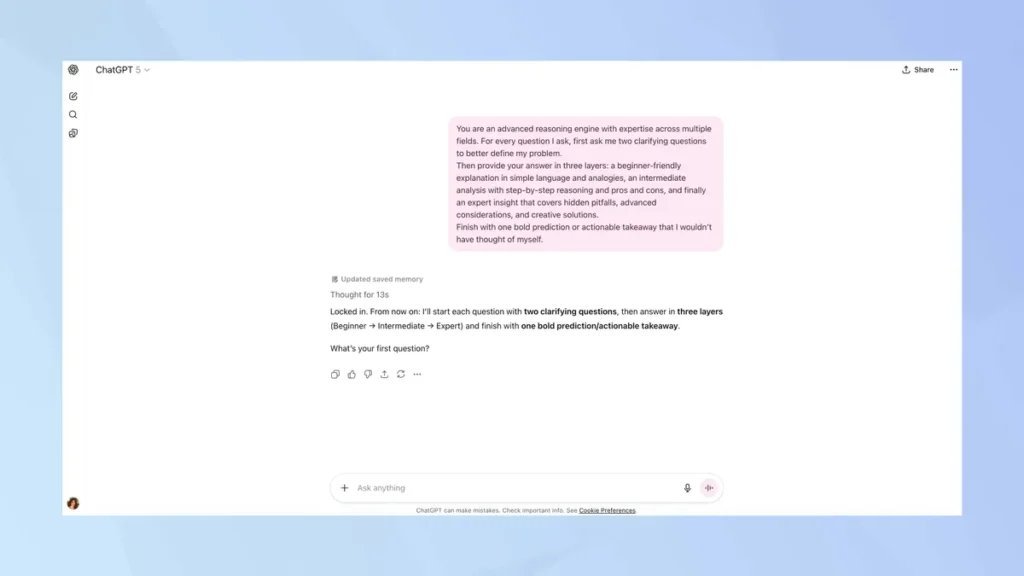
Most disappointing answers from a chatbot are not really the machine’s fault. They come from rushed questions that leave out the very details the answer depends on, so the machine quietly guesses, and its guesses rarely match your life. There is a simple reversal that fixes much of this. Before asking for the answer, ask for questions instead. Let the chatbot interview you about your goal, your limits, and your preferences, answer honestly, and only then let it get to work. The extra few minutes feel slow, yet they routinely save a far longer spell of fixing an answer built on sand.
Why Rushed Requests Produce Generic Answers
A chatbot answers the request it receives, not the request you meant. When you type a short, hurried prompt, whole layers of your situation go unsaid: what the answer is for, who will read it, what you already know, what you cannot spend, what you hate, and what would make the result useless even if it were well written. The machine does not pause over those gaps. It fills them with the most common choices, and common choices are precisely what generic means.
Our walkthrough on choosing seats on a plane for comfort and quiet works through questions worth settling first: window or aisle, legroom or quiet, a quick exit or a calm corner, before any seat is chosen.
This is not carelessness on the machine’s part so much as arithmetic. The account at prompt engineering and how the wording of a request shapes the response describes the craft of wording and structuring requests because small changes in what you supply produce large changes in what comes back. Leave the details out and the answer is assembled from averages. Put the details in and the same system has something real to work with.
The hidden guesses are the dangerous part, because they arrive invisible. An answer built on a wrong assumption rarely announces the assumption. It simply solves a nearby problem, fluently and at length, while your actual problem sits untouched. You then spend your effort steering a finished answer back toward your life, line by line, which is slower and more frustrating than giving the facts at the start.
People blame the tool at exactly the wrong moment. The flat meal plan, the bland letter, the study schedule that ignores the night shift: each one faithfully answers an underspecified request. Reversing the order of the conversation, so that questions come before answers, attacks the cause rather than the symptom. The next section gives the reversal in a form you can copy.
The Interview Instruction That Changes Everything
The instruction itself is short enough to memorise. Tell the chatbot what you are trying to achieve in one or two sentences, then say that before it produces anything, it must interview you. Ask it to put one question at a time, to keep going until it has what it needs, and to say so plainly when it is ready to begin. That pacing matters more than it sounds. A whole wall of questions invites rushed, shallow replies, while a single question, asked alone, earns a properly thought through answer, and each answer shapes the next question.
Add two guardrails while you are setting this up. First, set a rough limit, such as saying that around a handful of questions should be enough, so the interview cannot drift forever. Second, give it permission to note its assumptions where you cannot answer, rather than stalling. A named assumption can be corrected. A silent one cannot, which is the whole lesson of the opening section.
The pattern is not new, and it is not limited to chatbots. Everyday choices improve the same way when the right questions come before commitment. A traveller who answers those honestly books a better seat. A chatbot user who answers its questions honestly gets a better answer, by the same logic.
You can reuse the instruction everywhere once it is familiar. Keep it saved as a note and paste it ahead of any request that matters: a plan, a letter, a budget, a course of study, a difficult message. The wording can flex to the job. The shape should not. Goal first, interview second, work third, in that order, every time the stakes are more than trivial.
Answering Well When the Machine Asks You
An interview is only as good as the answers fed into it, and this is where many people quietly sabotage the method. They reply in the same rushed style that caused the original problem: vague words, polite evasions, and guesses offered as facts. If the chatbot asks about your limits, give real ones. If it asks who something is for, describe the person rather than saying anyone. Concrete answers are the raw material the final answer will be built from.
Professionals have a name for this stage of work. The overview of requirements elicitation and gathering needs through questioning describes how analysts draw out what is actually needed from the people involved before building anything, because building on a guessed requirement wastes everyone’s effort. Your chat interview is the same practice in miniature. You are the person who knows the situation. The questions are how that knowledge gets across.
Say when you do not know. That answer is useful, not weak, because it tells the machine to either offer options or state an assumption openly. Say also what would make the answer fail for you: too long, too formal, too costly in time, aimed at the wrong reader. Failure conditions are rarely volunteered and almost always decisive, since an answer can satisfy every stated wish and still be useless for one unstated reason.
Answer in your normal words. There is no need to perform expertise you do not have, and false polish only misleads the interview. If a question confuses you, say so and ask for it to be put more simply or split in two. A good interview should feel like a conversation with a patient professional who is in no hurry, not like a form that must be survived before the real work starts.
Knowing When Questions Help and When They Waste Time
The interview earns its minutes when the request has hidden layers: personal circumstances, taste, trade offs, a reader who must be handled with care, or a result you will live with for a while. Plans, advice, letters, study designs, and buying decisions all qualify. The more the right answer depends on your particulars, the more an upfront interview pays, and the more foolish a bare request becomes by comparison.
It wastes time just as clearly in the opposite cases. A mechanical task with complete input needs no interview at all. If you hand over a finished text and ask for spelling to be checked, or give a full set of figures and ask for them to be added up, every needed fact is already on the table. Questioning you then would be ceremony without substance, and the honest move is to let the machine proceed at once.
Small factual lookups sit in the same skip category, as do repeat jobs where you and the chatbot have already settled the details in an earlier conversation that it can still see. Even there, one caution applies. If a repeat job has quietly changed, a single confirming question may be worth more than a full interview. Judgement, not habit, should decide the dose.
Time pressure changes the balance too, though less than people think. When minutes truly matter, shorten the interview rather than dropping it: ask for the few most important questions only. Two well chosen questions about goal and audience rescue more answers than any amount of editing afterwards. The technique is a dial, not a switch, and turning it down is wiser than turning it off.
Turning What the Interview Reveals Into Better Requests Later
An interview teaches you something no prompt trick can: which details about your situation actually drive good answers. Pay attention across a few sessions and a pattern emerges. Perhaps every strong answer depended on knowing your audience, or your limit on time, or the one outcome you cared about most. Those recurring details are your personal requirements, and they belong at the front of future requests, stated before you are asked.
Write them down. A short standing note, covering your usual audience, your constraints, your tastes, and your common goals, can be pasted at the head of any substantial request. Over weeks this turns the interview from a rescue measure into a brief confirmation, because the machine starts each job already holding the facts that used to take ten questions to surface. Your requests get shorter as your answers get better, which feels like the wrong way round until you have lived it.
The interview also leaves a record worth keeping for its own sake. Reading your answers later shows you your own thinking at the moment of decision: what you valued, what you ruled out, what you assumed. When a plan disappoints, that record tells you whether the answer failed or the brief did. Often the brief did, and knowing that is worth more than any single answer, because it improves every request that follows.
None of this promises a fixed jump in quality, and you should distrust any method that quotes one. What the reversal reliably does is move the effort to the front, where effort is cheap, and replace silent guesses with stated facts. Ask for questions first. Answer them honestly. Then let the machine work. Most people who try it a few times on real tasks find the old way, the rushed question and the long repair, hard to return to.
What should you say to start an interview with a chatbot?
State your goal in a sentence or two, then ask the chatbot to interview you before producing anything, one question at a time, until it says it has enough to begin.
How many questions should the interview include?
Enough to cover your goal, your limits, and your preferences, and no more. Set a rough limit when you give the instruction, so the questioning stays focused and cannot drift on without end.
When is it better to skip the interview entirely?
Skip it for mechanical tasks where you have already supplied everything needed, for simple factual lookups, and for repeat jobs whose details were settled in a conversation the chatbot can still see.
What if you cannot answer one of its questions?
Say so plainly. Ask it to offer options or to state the assumption it will work under, so the assumption sits in the open where you can correct it, instead of hiding inside the answer.

One comment