
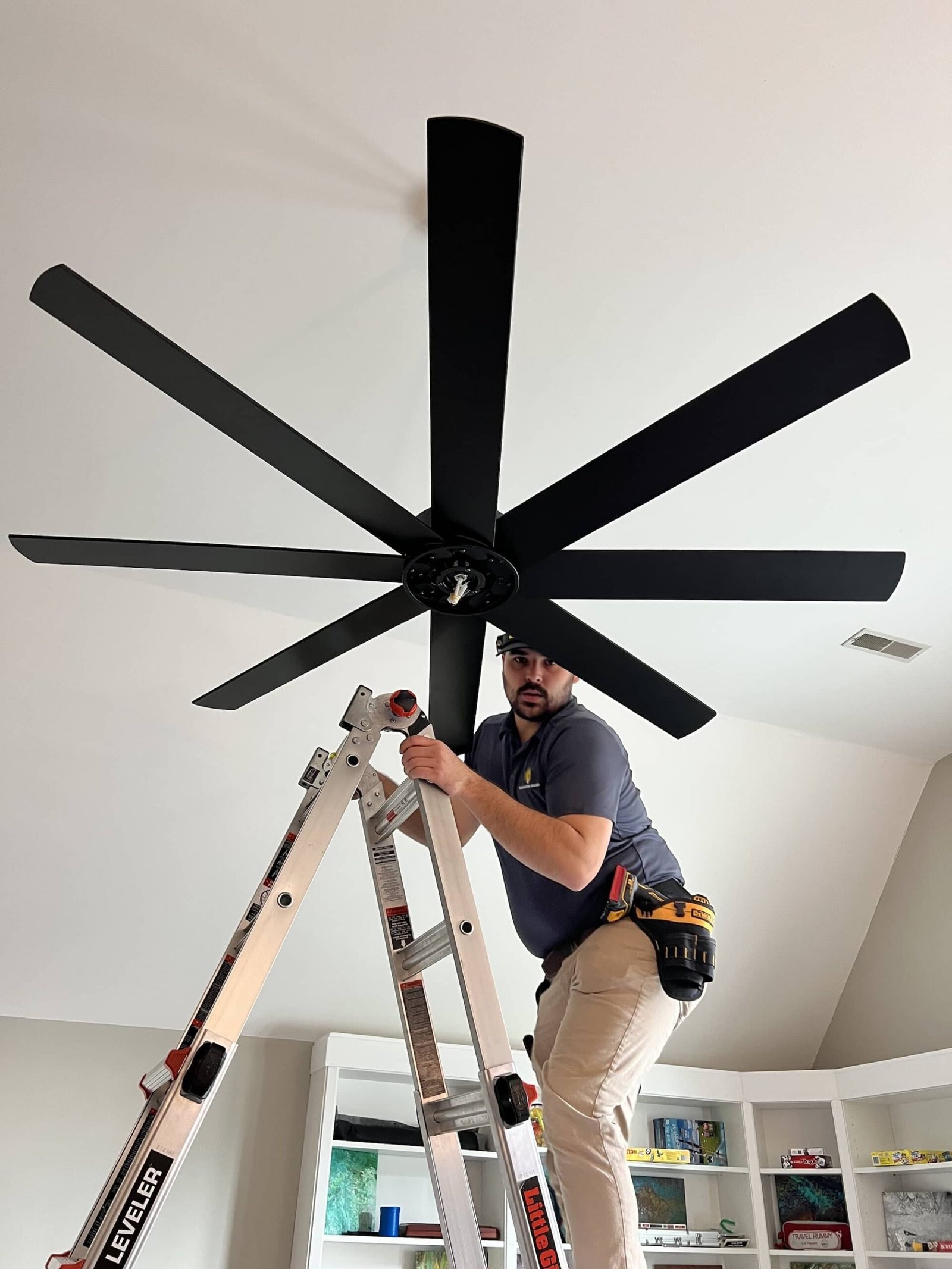
Moving air can make a warm room feel gentle again, and the fitting itself ranges from a simple swap to a fresh wiring run. That range is the whole story behind the bill. Where a ceiling light already hangs, the work is mostly a careful exchange of one fitting for another, and the total stays modest. Where the ceiling is bare, the job grows cables, a switch, plaster repair, and hours of extra labor, and the total grows with it. The sections below take the money question first, then pull the bill apart piece by piece, and finish with sizing, mounting, and the honest line between a confident home swap and work that belongs to a licensed electrician.
What Does the Whole Job Usually Add Up To?
For a standard fitting where a ceiling light already exists, expect the whole job to land somewhere in the low to mid hundreds once the fan and the labor are combined. That figure covers a sensible mid range fan, an hour or two of professional time, and the small parts the work consumes. Homes where the swap proves awkward, with high ceilings or difficult access, drift toward the upper part of that range without anything being wrong.
A position with no existing fitting tells a different story. Running cable through a ceiling and down a wall, adding a switch, fitting a proper support box, and making the plaster good afterward can carry the total well beyond the standard range, sometimes close to double it. Anyone pricing the job should therefore start with one question: what already exists in that ceiling? The answer predicts the bill more reliably than the price of any fan on a shop shelf. Before any work begins, read advice on safe ceiling fan fitting at home and treat the safety steps there as part of the budget, because a tester and a proper box cost little and protect everything.
Which Parts of the Bill Belong to the Fan Itself?
The fan itself spans the widest range of any line on the bill. Plain, honest models sit in the tens, and they move air perfectly well. Well made mid range fans, with quiet motors, balanced blades, and finishes that survive a decade of dusting, sit in the low hundreds, and this is where most households find the sensible balance between price and service life. Premium designs climb higher still, adding efficient direct current motors, remote controls, and lighting built into the unit.
Efficiency deserves a line of its own. Models certified under the Energy Star program move more air per unit of electricity than standard designs, and direct current motors generally run quieter while using far less power than conventional alternating current motors. Running costs stay tiny either way, roughly comparable to a single light bulb across a year of ordinary use, so efficiency alone rarely repays a large price jump. Quietness, build quality, and a motor warranty you believe in are the better reasons to step up a level, and a fan chosen for a bedroom should be judged by its sound at low speed above every other measure.
Why Does an Existing Ceiling Light Keep Labour Low?
An existing light fitting means the hard part is already done. Cable already reaches the ceiling, a switch already controls it, and the electrician’s task narrows to removing the old fitting, upgrading the box where needed, hanging the fan, and testing the result. A straightforward swap of this kind commonly takes an hour or two, and labor stays a modest share of the total bill rather than the largest share.
Access shapes that labor figure further. An attic above the ceiling lets a worker reach the box, the cable, and the mounting point from above, quickly and cleanly. A finished ceiling with no space above it forces the same work through a small opening from below, which is slower, messier, and dearer. Two homes with identical fans can therefore receive noticeably different quotes, and both quotes can be honest. When a price seems high, ask what access the worker expects before assuming the figure is padded.
What Changes When No Fitting Exists Yet?
A bare ceiling turns an exchange into a small building project. Cable must travel from a power source, through the ceiling void or across its surface, and down inside a wall to a new switch. The ceiling may need opening and the wall may need a channel cut, and both need making good afterward, with filler, sanding, and paint that no electrician’s quote for wiring alone will include. The fitting that took an hour or two as a swap now takes the better part of a working day.
This is also where permission and inspection rules may enter, depending on local requirements for new circuits. Treat those steps as part of the job rather than red tape, because a new run of cable will live hidden in your home for decades. If the room is due for redecorating anyway, schedule the wiring first and let the plaster repair blend into work already planned. That single piece of sequencing can remove a surprising slice of the extra spending a fresh position usually demands.
How Do You Match Blade Span to Room Size?
Size the fan to the room and the room will feel the benefit; size it by guesswork and even a fine fan disappoints. Narrow spans suit small bedrooms and studies, where a wide fan overwhelms the space and churns air harshly at close range. Mid sized spans serve average living rooms and larger bedrooms well, and spans approaching four and a half feet earn their place in large open plan areas where the air volume is simply bigger. A fuller account of the ceiling fan and its history sets out how these machines developed and how their sizing conventions settled.
Height matters as much as span. Blades should hang roughly seven to nine feet above the floor. Tall ceilings reach that height with a longer drop rod, which also brings the moving air down to the level where people actually sit. Low ceilings call for a flush mount that hugs the surface instead. Keep a modest clearance between blade tips and walls as well, because a fan starved of space around its edges works harder and moves less air than its rating promises.
Why Must the Ceiling Box Be Rated for a Fan?
The ceiling box is the safety heart of the whole installation, and this point is not a detail to negotiate. An ordinary light fitting box was built to hold a static shade hanging still. A fan is a spinning, vibrating load that pulls and twists at its mounting with every revolution, year after year. Boxes rated for fans are built for that punishment, and they anchor into a joist or hang from a retrofit brace bar that spans the gap between joists and spreads the load properly.
The brace itself is an inexpensive part, among the cheapest lines on the entire bill, which removes every excuse for skipping it. A fan that works loose is not a minor fault. It wobbles, it strains its wiring, and in the worst case it falls. Any installer who shrugs at the question of what the fan will hang from is telling you something important about the rest of the work. Choose the installer who raises the subject before you do.
When Is This a Job to Hand to an Electrician?
A like for like swap, on an existing fitting, with a fan rated box confirmed above the ceiling, sits within reach of a confident and careful homeowner in many places. Even then, safe working is absolute: switch off at the breaker rather than at the wall switch, and prove the circuit dead with a non-contact tester before any wire is touched. A wall switch can be wired in ways that leave the ceiling live, and assumptions about household wiring are how careful people get hurt.
Hand the work over when the job involves a new circuit, a breaker panel, cable runs through walls, or any moment where what you find above the ceiling fails to match what you expected. Hand it over, too, when local rules require licensed work, and whenever doubt appears at all, because doubt around electricity deserves respect rather than bravery. The labor fee on a straightforward fitting is a small part of the total bill. Paying it buys tested work, a guarantee, and a fan that spins for years without a second thought, which is the outcome every section above has been pricing.
How Long Does a Typical Fitting Take?
A swap on an existing fitting usually takes an hour or two from the moment the old light comes down to the moment the new fan passes its first test run. A fresh position, with cable to run and a switch to add, takes the better part of a working day, and plaster repair or painting afterward may stretch the wider project across a weekend. Ask any installer to separate the electrical time from the making good when the quote arrives, so the schedule holds no surprises.
Can a Fan Run in Winter as Well as Summer?
Yes, and the trick is direction. In summer the fan should push air downward so the breeze crosses your skin and the room feels cooler than the thermometer claims, which is why energy advice notes that a fan lets occupants raise a thermostat setting by a few degrees with no loss of comfort. In winter, reverse the direction and run the fan slowly, so the warm air pooled against the ceiling drifts back down the walls instead of staying uselessly above your head.
Does a Porch Need a Different Kind of Fan?
Yes. Indoor fans corrode outdoors, because their motors, finishes, and blades were never built for damp air, rain splash, or wide swings of temperature. Porches and covered outdoor spaces need units rated for damp locations, and fully exposed spots need wet rated units. The rating appears on the box and in the listing, and matching it to the location protects both the fan and the warranty that came with it.
Is a Fan Expensive to Run Each Month?
No. Running costs are tiny beside the cost of cooling a room by air conditioning alone, amounting to roughly the draw of a single light bulb across ordinary use. The real saving arrives indirectly. Moving air makes a warmer room feel comfortable, so the cooling system works less, rests more, and reaches for its highest settings less often through the hottest weeks of the year.


