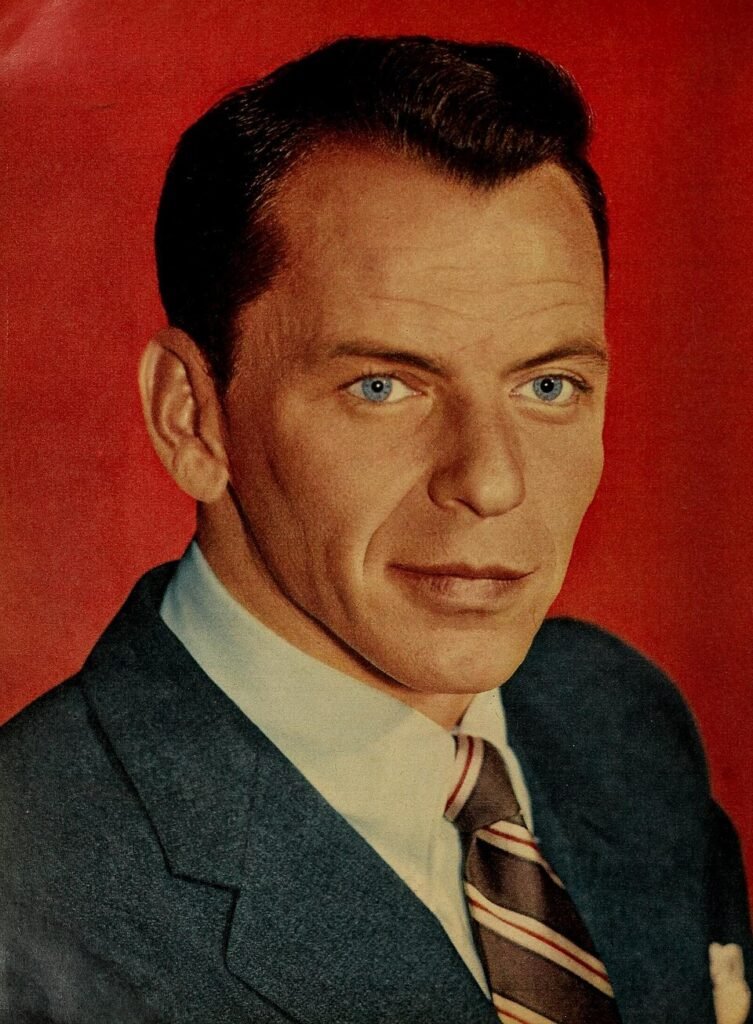
Frank Sinatra Net Worth, Age, Family, Career and Biography
Frank Sinatra had a net worth estimated at $200 million at the time of his death, according to Celebrity Net Worth, with contemporary estimates of his fortune ranging as high as $600 million. He died on May 14, 1998, aged 82, having spent six decades as the most influential popular singer of the twentieth century — a Hoboken tenement childhood behind him, more than 150 million records sold, and a catalog that still earns for his estate today.
This biography covers the full record: his birthday and early life in Hoboken, his parents and family background, his four wives and three children, his songs and albums decade by decade, and the houses that framed his life in Palm Springs, Beverly Hills and Malibu.
Early life
Francis Albert Sinatra was born on December 12, 1915, in an upstairs tenement at 415 Monroe Street in Hoboken, New Jersey. His birthday means he was 82 years old at his death on May 14, 1998. He grew up in Hoboken’s tenement streets during the Depression, a small, slight boy in a tough dockside city across the Hudson from Manhattan.
His parents were Antonino Martino Sinatra, known as Marty, and Natalina Garaventa Sinatra, known as Dolly. Both had emigrated from Italy as children. His father, who had boxed as a bantamweight under the name Marty O’Brien, worked for the Hoboken fire department. His mother was the dominant force in the household and in the neighborhood: energetic, ambitious and politically connected, she ran local affairs with formidable energy, and biographers credit her drive as the template for her son’s self-confidence and will. It was Dolly who encouraged the singing, and Dolly’s ambitions that the young Sinatra first set out to satisfy.
The teenage Sinatra sang with local groups, took work as a singing waiter, and studied the intimate, conversational vocal style of Bing Crosby, whose records taught him that a microphone could be sung to quietly rather than shouted over a band. In 1935 he won a radio talent contest as part of a group, the Hoboken Four, and by the end of the decade he was singing with bandleader Harry James. The voice — light, precise, and already unmistakable — was ready. What it needed was an audience, and the big-band era was about to give him the largest one popular music had ever had.
Career
1939–1942: Harry James, Tommy Dorsey and the first hits
Sinatra joined Harry James’s band in 1939 and made his first records, including “All or Nothing at All,” recorded that year and a number one hit when reissued in 1943. In 1940 he moved to Tommy Dorsey’s orchestra, then the most polished band in the country, and the hits came in a rush: “I’ll Never Smile Again” held the top of the chart for twelve weeks in 1940, followed by “I’ll Be Seeing You,” “Dolores” and a string of others. Dorsey’s trombone phrasing — long, breath-controlled lines — became the model for Sinatra’s singing, a debt he acknowledged all his life. By 1942 he was the most popular male singer in the country, and he left the band that year, on hard-negotiated terms, to go solo.
1943–1952: The Voice, the bobby-soxers and the Columbia years
The solo breakthrough was immediate and hysterical: his appearances at New York’s Paramount Theatre in 1943 and 1944 drew screaming teenage crowds — the bobby-soxers — in scenes that announced a new kind of popular fame. On Columbia Records he cut the defining ballads of the decade, and in 1946 he released his debut album, The Voice of Frank Sinatra, an early example of the album as a sequenced artistic statement rather than a bundle of singles. Christmas Songs by Sinatra followed in 1948, and Dedicated to You and Sing and Dance with Frank Sinatra closed the Columbia run in 1950. The early 1950s then brought a genuine slump: the voice thickened and faltered, tastes shifted, the record sales fell, and by 1952 the career that had defined the previous decade looked finished.
Readers troubleshooting their phones between records may value our guide on how to stop apps from running in the background on Android, a step-by-step fix for a common battery drain.
1953–1960: The Capitol years and the concept album
What followed is generally judged the greatest sustained run in popular recording. Signed to Capitol Records in 1953, and paired with arranger Nelson Riddle, Sinatra reinvented himself as a mature singer of uncommon emotional precision. Songs for Young Lovers (1954) opened the account; In the Wee Small Hours (1955), a suite of late-night songs of loss, is routinely ranked among the greatest albums ever made; Songs for Swingin’ Lovers! (1956) answered it with joy, including the definitive “I’ve Got You Under My Skin.” Come Fly with Me (1958), Only the Lonely (1958), No One Cares (1959) and Nice ’n’ Easy (1960) completed a body of work — moody albums and swinging albums in alternation — that effectively invented the concept album and set the standard every singer after him has been measured against.
1961–1970: Reprise Records, the Rat Pack years and My Way
In 1960 Sinatra founded his own label, Reprise Records, an ownership move that gave him control of his masters and his schedule and underpins much of the fortune discussed below. The 1960s brought the Las Vegas residencies with his Rat Pack circle, bestselling albums including Ring-a-Ding-Ding! (1961), Sinatra at the Sands (1966) — a live document of the Vegas show at its peak — and September of My Years (1965), a reflective masterpiece that won the Grammy Award for Album of the Year. The singles kept coming: “Strangers in the Night” (1966), a number one and Grammy winner; “That’s Life” (1966); “Somethin’ Stupid” (1967), a number one duet with his daughter Nancy; and in 1969 “My Way,” Paul Anka’s lyric set to a French melody, which became his signature song and one of the most recorded standards in the world.
1971–1998: Retirement, the comeback and Duets
Sinatra announced his retirement in 1971 and un-announced it within two years, returning with the album Ol’ Blue Eyes Is Back (1973) and a touring schedule that continued, with pauses, for two more decades. “Theme from New York, New York” (1980) gave him a late signature song, sung at the close of his concerts for the rest of his life. He played to enormous audiences worldwide into his late seventies. His final albums, Duets (1993) and Duets II (1994), paired his voice with younger stars and became the best-selling records of his late career. He gave his last public performance in 1995 and died three years later, his catalog — more than 150 million records sold in his lifetime — passing into the care of his family and, later, a dedicated estate company.
Personal life and family
Sinatra married four times. His first wife was Nancy Barbato, a Hoboken contemporary, whom he married on February 4, 1939, before fame arrived; the marriage ended in divorce in 1951. His second wife was Ava Gardner, married in 1951 and divorced in 1957, a famously intense union that coincided with the most turbulent years of his career. His third wife was Mia Farrow, married in 1966 and divorced in 1968. His last wife was Barbara Sinatra, née Marx, a former dancer and model, whom he married on July 11, 1976, and to whom he remained married for twenty-two years, until his death. Barbara Sinatra died in 2017.
Sinatra had three children, all with Nancy Barbato. Nancy Sinatra, born June 8, 1940, became a star in her own right with “These Boots Are Made for Walkin’” in 1966 and shared the number one duet “Somethin’ Stupid” with her father the following year. Frank Sinatra Jr., born January 10, 1944, became a singer and conductor who led his father’s orchestra in the final performing years; he died in 2016, aged 72. Tina Sinatra, born June 20, 1948, worked in the entertainment business and has been a central guardian of her father’s legacy and family enterprises since his death. All three children were at his side in Los Angeles when he died.
His family story runs from the Hoboken tenement outward: an immigrant fireman father, a formidable mother whose ambition he inherited, three children raised through the most scrutinized private life in show business, and a final, settled marriage of more than two decades. He died at Cedars-Sinai Medical Center in Los Angeles on May 14, 1998, after a heart attack, with his wife and children present. He was buried at Desert Memorial Park in Cathedral City, California.
Net worth and assets
Celebrity Net Worth puts Frank Sinatra’s net worth at $200 million at the time of his death, and that at-death figure is the headline used here. The record needs its complications stated plainly. Contemporary estimates of his fortune at death ranged from $200 million to $600 million; the exact total was never publicly established, because a significant share of his holdings sat in a living trust and did not pass through the public probate process. His finances had also swung dramatically in life: in 1981, in a financial statement filed for a Nevada gaming license, his net worth was put at just over $14 million. His will guaranteed Barbara Sinatra at least $3.5 million and left his three children $200,000 each directly, with substantially larger assets and rights held outside the will in trusts — those will and trust provisions are estate arrangements, reported here as such, and they are not themselves a net-worth figure. Everything the estate has earned since 1998 is likewise kept separate: in 2007, for example, Warner Music Group paid $50 million for a 50 percent interest in Frank Sinatra Enterprises, the company formed to manage his name, likeness and catalog interests. That was a posthumous transaction, nearly a decade after his death, and it is not counted in the at-death estimate.
The houses were a through-line of the life. His Palm Springs residence, Twin Palms, built in 1947 with its famous piano-shaped pool, was the desert base of the early fame years. The Rancho Mirage compound that followed served for decades and was listed for $4.9 million in 1995 as the couple shifted their base. His will left Barbara Sinatra substantial real estate, including residences in Beverly Hills, Malibu and the Palm Springs area, and a mountain retreat above Palm Desert, known as Villa Maggio, was among the desert properties associated with his later years. Together the properties trace the geography of the career: Hoboken to Hollywood, and always back to the desert.
Key facts
| Key Facts | Details |
|---|---|
| Born | December 12, 1915, in Hoboken, New Jersey |
| Age | 82 years old at death (died May 14, 1998, in Los Angeles, California) |
| Height | 5 feet 8 inches (1.73 m) |
| Weight | No reliable published figure exists |
| Wife | Barbara Sinatra, née Marx (married July 11, 1976; his death 1998; she died 2017). Earlier wives: Nancy Barbato (1939–1951), Ava Gardner (1951–1957), Mia Farrow (1966–1968) |
| Children | Three: Nancy Sinatra (born June 8, 1940), Frank Sinatra Jr. (born January 10, 1944; died 2016) and Tina Sinatra (born June 20, 1948) |
| Parents | Antonino Martino “Marty” Sinatra and Natalina “Dolly” Garaventa Sinatra |
| Albums | The Voice of Frank Sinatra (1946), In the Wee Small Hours (1955), Songs for Swingin’ Lovers! (1956), Come Fly with Me (1958), Only the Lonely (1958), September of My Years (1965), Duets (1993) |
| Net Worth | $200 million at the time of his death, estimated by Celebrity Net Worth (contemporary estimates ranged to $600 million) |
Frank Sinatra’s story, stripped to the verified facts, is a Hoboken singer who learned breath control from a trombone, lost his audience at thirty-six, and then made the greatest albums in popular music with the second chance. The $200 million at-death estimate rests on the same foundation as the art: ownership — of a label, of masters, of a name that, decades after May 1998, has not stopped working.