A new office job presents its wardrobe problem backwards, demanding a polished appearance from the very first morning while the income that funds polish has barely begun, so the smartest approach treats those opening weeks as research before committing serious money.
Read the Real Dress Code Before Spending
Every workplace has two dress codes, the one written in a handbook and the one worn in the corridor. They are often different. A handbook may use broad words while the team around you has quietly settled on something more relaxed, or more formal, than the wording suggests. Spending heavily before you have seen the real code risks buying for an office that exists only on paper, and the mistakes are usually expensive ones, such as formal pieces that look overdressed beside everyone you actually work with.
Use the interview, any welcome notes and your first days as observation time. Notice what colleagues at your own level put on, what managers wear and whether client facing days look different from ordinary days. Notice shoes, layers and how often outfits repeat, because repetition is normal in real offices and quietly gives you permission to repeat your own clothes without apology. A small notebook or phone note recording what you actually saw is worth more than any general list written for an imaginary workplace.
New starters also juggle many small unavoidable expenses at once, from travel to lunch to handling costs sensibly when work involves travel, and a sense of proportion about things like tipping properly while travelling on a budget helps keep the wardrobe budget from swallowing money that other parts of starting work genuinely need. The wardrobe is one claim among several in the first month. Treating it as the only claim is how careful people end up well dressed and short of everything else.
Compare Buying New With Secondhand Sources
New and secondhand clothes solve different problems, and the sensible starter wardrobe usually mixes them. Buying new gives predictable sizing, easy returns and matching pieces bought together, which is valuable for the few items that anchor the whole wardrobe. Secondhand sources, from charity shops to resale platforms and clothing exchanges, give access to better fabrics and construction than the same spending buys new, and they forgive experimentation, because a piece that turns out wrong has cost little and taught something.
The middle ground most offices occupy is described in the source used here: the Wikipedia article on business casual describes guidance for dress that is smarter than leisure wear yet short of suits and ties. That middle ground is forgiving territory for mixing sources. Trousers, skirts and simple tops in plain colours look much the same whether they began life in a high street shop or a secondhand rail, provided the fit is good, the fabric is sound and the condition is clean and pressed.
Judge secondhand pieces by strict, practical checks. Look at collars, cuffs, underarms, seams and fastenings, hold fabric to the light for thinning, and try everything on, because older sizing varies widely between brands and eras. Allow a small margin for simple alterations or a proper clean when judging whether a find is truly good value. A piece needing work you will never arrange is not a bargain. It is clutter bought cheaply, which is still clutter.
Choose Core Pieces That Combine Freely
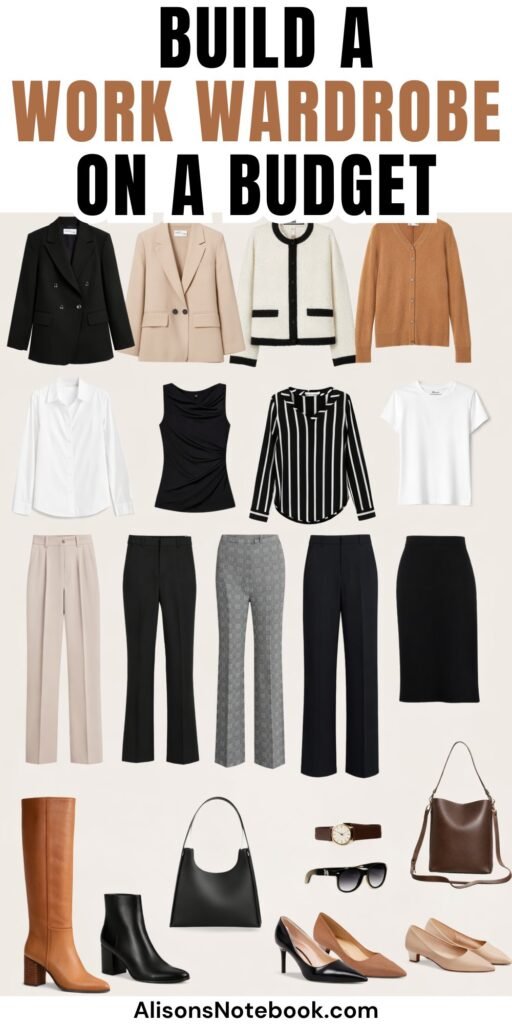
The heart of a starter wardrobe is not quantity. It is combination. A small set of pieces in coordinating colours, each able to pair with most of the others, produces far more outfits than a larger pile of striking pieces that only work one way. Choose a narrow colour family built around deep, plain shades that hide wear and mix easily, then let one or two softer shades provide variety. When nearly everything matches nearly everything else, getting dressed stops being a puzzle and laundry stops dictating your appearance.
The idea has a name and its attribution belongs here: the Wikipedia piece on the capsule wardrobe explains how a small set of interchangeable pieces in coordinating colours multiplies outfit combinations. That multiplication is exactly what a new starter with little money and less time needs. A few bottoms, a few more tops, one or two layers and shoes that suit most combinations can carry a full working week with repeats that look deliberate rather than desperate, because the combinations differ even when the pieces return.
Choose fabrics and cuts that forgive a busy life. Crease resistant cloth, hems that stay put, tops that stay tucked or sit neatly untucked, and pieces that wash without special handling all earn their place. Plain surfaces travel between outfits more easily than bold patterns, which announce a repeat loudly and clash with more of the wardrobe. Save pattern and personality for small, changeable touches until the core is secure. A strong core dressed plainly always looks more polished than a varied wardrobe built on pieces that fight each other.
Weigh Spending More on Shoes and Layers
Some pieces repay extra spending and others plainly do not. Shoes sit in the first group. They are worn daily, they carry your comfort through long days and travel, and poor shoes announce themselves in pain long before they announce themselves in appearance. A sound, plain pair that fits properly, suits most of the core wardrobe and can be repaired is a better use of limited money than several cheap pairs that each hurt in a different place and wear out within the season.
Layers belong near the top of the spending order too. A well fitting jacket or similar layer changes the standing of everything under it, turning simple tops and trousers into something that reads as considered. Offices also vary in temperature from room to room and season to season, so a layer that goes on and off gracefully is practical as well as smart. Choose one versatile layer first, in the deepest colour of your core family, before considering any second layer in a lighter or brighter shade.
By contrast, spend cautiously on pieces that date quickly, appear rarely or hide under layers. Fashion led items bought in the first month often answer a dress code you later discover was imaginary. Basic tops worn beneath a layer need to be clean, sound and the right colour more than they need to be fine. Underwear, socks and the unglamorous supports of a working week deserve adequacy and comfort, bought steadily, rather than a large share of an opening budget spent all at once.
Stage Purchases Around Early Paydays
Sequencing is the quiet skill that makes a small budget behave. Before the first payday, buy only what the first days genuinely require: enough clean, fitting core pieces to rotate without stress, sound shoes and one layer if the office expects it. Everything else is a candidate for later, once real income has arrived and real observation has shown what the job actually demands day by day. A wardrobe bought in stages corrects itself. A wardrobe bought in one anxious weekend locks in every early guess.
Let each payday fund one clear improvement. After the first, fill the most felt gap, perhaps a second pair of trousers so laundry stops ruling the week, or tops in the colours the core still lacks. After the next, strengthen the weaker source, secondhand finds if the new pieces carried the start, or a new anchor piece if secondhand luck has covered the basics. Staging also spreads the fitting and returning work across weeks, which matters when evenings are already full of a new job.
Keep a running priority list so payday spending answers need rather than mood. The first month of work brings invitations, sales and well meant advice, all capable of pulling money toward attractive pieces the core cannot use. A written list, ordered by how often the missing piece would be worn, holds the plan steady. Cross items off as they arrive and resist promoting a treat above a gap that is still making mornings difficult. Treats have their turn later, once the formula below is working without thought.
Hold a small reserve back from every stage for the unplanned: a repair, a replacement for a piece that fails, a sudden formal day announced by a client visit. New jobs specialise in such surprises, and a reserve turns them from crises into errands. Staging, listing and reserving sound unglamorous beside the pleasure of a whole new wardrobe at once, but they are the difference between spending that compounds into a system and spending that evaporates into a cupboard of near misses.
Settle on a Starter Formula That Works
The recommendation that emerges from every comparison in this guide is a compact formula rather than a fixed list. Build a small core in coordinating plain colours, enough bottoms to rotate cleanly, roughly twice as many tops as bottoms, one versatile layer, and shoes bought for comfort first. Source the anchor pieces new where fit matters most, fill around them secondhand where condition and construction allow, and stage the whole build across the early paydays in the order the gaps are actually felt.
Run the formula as a weekly pattern. Rotate the bottoms, vary the tops, add the layer when the day or the room calls for it, and repeat without anxiety, because offices notice cleanliness, fit and appropriateness far more than novelty. Keep each piece washed, pressed where it needs it and repaired while repairs are small. A modest wardrobe maintained carefully reads as polished. A larger wardrobe maintained carelessly reads as rushed, whatever it cost and wherever it came from.
Let the formula stay flexible as the job reveals itself. A team that dresses more formally than expected may call for a second layer and fewer casual tops. A relaxed team may let the secondhand share grow and the formal pieces stay few. The formula survives those shifts because it is built on combination, staging and observation rather than on any single item. Adjust the proportions, keep the principles, and resist rebuilding from zero every time the office shows you something new.
That is the wardrobe problem solved in the order it actually arrives. Research first, because the job demands polish before it provides the means. Comparison second, because new and secondhand each carry part of the answer. Patience throughout, because paydays arrive one at a time and a core built to combine will look complete long before it is finished. The starter who dresses this way spends less, repeats more and, by the second month, usually looks like the person who was never worried at all.