
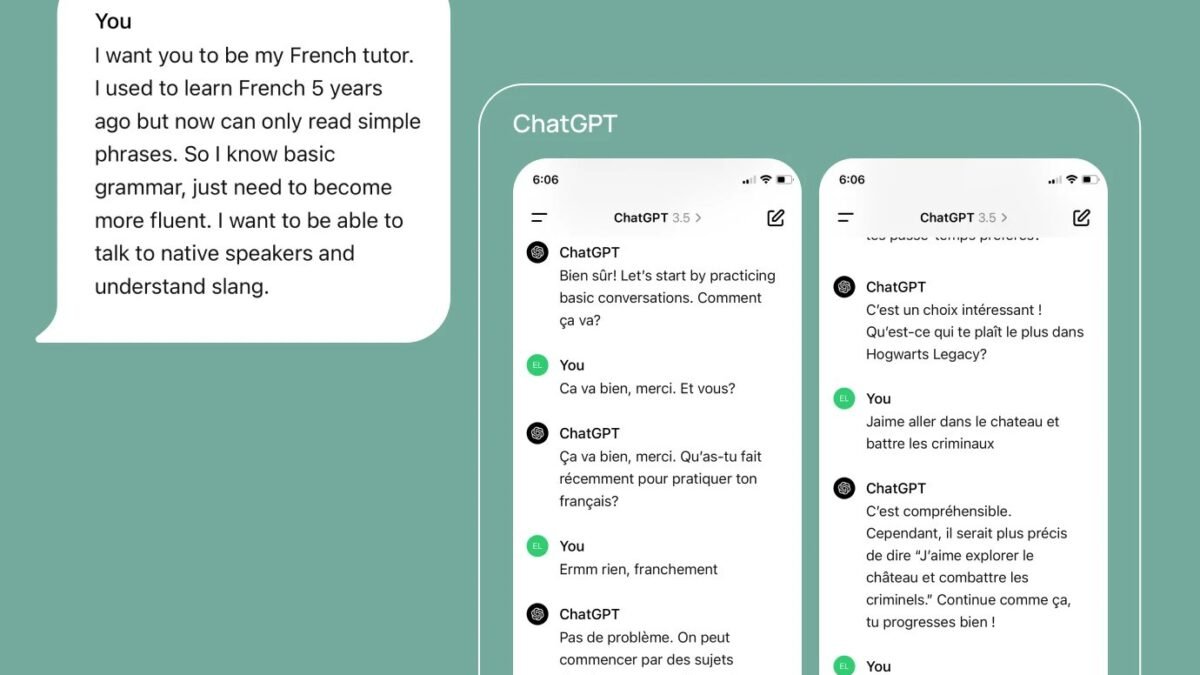
Knowing vocabulary lists and surviving an actual conversation are very different skills, and most learners discover the gap the moment a real person waits for their reply. Practice partners are hard to arrange, tutors keep office hours, and embarrassment does the rest. A chatbot offers an unusual bargain instead: conversation in your new language whenever you want it, pitched near your level, patient through every stumble, and happy to correct you as gently or as firmly as you ask. Used with a little structure, those low pressure chats build exactly the quick recall that real conversations demand from you.
What Tireless Conversation Practice Gives a Learner
The deepest benefit is simple availability. A human partner has a schedule, a mood, and a limit to how many times they will happily hear you struggle through the same request at a station counter. A chatbot has none of those limits. You can practise early in the morning, on a lunch break, or the night before a trip, and you can repeat one awkward exchange until it stops feeling awkward. That freedom changes the maths of learning, because progress in conversation depends heavily on how often you actually open your mouth and try.
Nothing concentrates that practice like a journey already booked. Travel gives conversation practice a deadline and a purpose, and a learner rehearsing hotel and restaurant scenes has usually already thought hard about the trip itself, as our planning walkthrough on budgeting for a trip to Japan without blowing your savings shows.
There is a sound idea underneath the convenience. The Wikipedia overview of second language acquisition describes acquiring a language as developing the ability to use it in real communication, not only studying its rules. That distinction explains why a learner can score well on written exercises and still freeze beside a real speaker. Rules live in memory as knowledge. Conversation needs those rules retrieved quickly, under mild pressure, while also listening to another person. Chat practice trains the retrieval itself, which written drills largely leave untouched.
Level matching adds to the value. A good session is pitched so that most of the reply is understandable and a small part stretches you. Too easy and you rehearse what you already own. Too hard and you spend the session decoding instead of speaking, which turns conversation into reading with extra steps. With a chatbot you can adjust on the spot. Ask for shorter replies, common words only, slower pacing in voice, or one new expression at a time. A human partner can do this too, but few will do it cheerfully for the tenth session in a row.
Privacy matters more than methods usually admit. Many learners stay silent in front of people not because they lack words but because each mistake feels public. Practising with a machine removes the audience. You can attempt a sentence, watch it fail, repair it, and try again without apologising or feeling that you are wasting someone’s time. That safety encourages the one behaviour learning depends on, which is attempting speech before you feel ready. Confidence built in private still has to survive contact with people, but it is a far better starting point than silence.
Scenarios That Turn Small Talk Into Real Training
Open ended chat drifts. After a few pleasant exchanges about the weather and your hobbies, the vocabulary stops growing and the session becomes comfortable repetition. Scenarios prevent that drift by giving the conversation a job to do. Ordering a meal with a complication, reporting a problem with a hotel room, asking for directions after getting lost, returning an item to a shop, booking an appointment, explaining a delay at work: each scene forces different words, different politeness, and different kinds of quick thinking. Rotating scenes is how a learner builds range instead of depth in one narrow corner.
Give the machine a role and a temperament, not just a topic. A patient shop assistant teaches one lesson. A busy waiter who answers briefly teaches another. A landlord who needs persuading teaches a third. Ask the partner to misunderstand you once, to speak a little faster, or to introduce a problem halfway through, such as a dish being unavailable or a train being cancelled. Real conversation is full of these small disruptions, and the skill worth training is recovery: asking for repetition, rephrasing, describing around a missing word, and carrying on without panic.
Tie the practice to the journey itself. Practise the exact scenes your itinerary will demand: checking in late, asking about breakfast times, explaining a food allergy, buying the right ticket, and asking a stranger to take a photograph. A looming real trip turns vague study into preparation, and preparation is easier to sustain than general good intentions.
End each scenario with a short debrief while the scene is fresh. Ask what phrases a natural speaker would have used, which of your sentences sounded stiff, and what the partner found hard to follow. Then run the hardest exchange once more, immediately, with those fixes in mind. That second attempt is where the learning settles. A scenario done once is entertainment. A scenario done, reviewed, and done again becomes training, and the difference shows the next time a real person waits for your reply.
Corrections That Help Without Breaking the Flow
Correction is a dial, and where you set it should depend on the day’s purpose. The gentlest setting leaves the conversation untouched and gathers your errors into a short report at the end. That suits fluency work, when stopping every few seconds would destroy the very confidence you are building. The middle setting places a brief correction after each of your messages, showing the repaired sentence, and then continues the conversation as if nothing happened. Most learners find this the best default, because the error is still warm in memory when the fix arrives.
The firmest setting corrects everything, including word order and small slips, and asks you to repeat the corrected sentence before moving on. It is demanding and a little tedious, and that is exactly why it works before an examination or an important presentation. Use it in short bursts rather than as your everyday mode. A learner who is interrupted constantly will eventually protect fluency by saying less, choosing safe simple sentences over ambitious ones. Ambition is where growth lives, so protect it on most days and accept the strict regime only when precision is the goal.
Level labels make these instructions sharper. Learners commonly describe themselves using the scale set out in the Wikipedia summary of the Common European Framework of Reference for Languages, which describes learner ability in levels from beginner to proficient. Telling the chatbot your level in those terms, and asking it to correct you as a learner at that level rather than as a near native, prevents a common frustration: being corrected for refinements you are not ready to absorb while the basic errors that actually block understanding slip by unmarked.
One caution deserves a place here. A chatbot can correct grammar and word choice in text with reasonable reliability, but its ear for your pronunciation is limited, especially in voice conversation. It may miss sound errors a teacher would catch, or praise speech that a native listener would strain to follow. Treat its comments on your sounds as rough guidance only. If pronunciation matters for your work or your examinations, have a human listener check you from time to time, and use recordings of native speakers as your model for how words should sound.
Where a Patient Machine Falls Short of People
The machine’s greatest kindness is also its biggest gap. It is clear, patient, and accommodating in ways real speakers often are not. It does not mumble, trail off, speak over café noise, use heavy slang without warning, or answer your careful question with an unrelated joke. Real people do all of these things, sometimes in a single exchange. A learner trained only on tidy machine replies can be genuinely shocked by the messiness of a market, a station, or a family dinner, and that shock is not a failure of effort. It is a gap in the training conditions.
Smaller languages expose another limit. Widely spoken languages give the model rich material to learn from, and its replies in them are usually dependable. In a language with far less written material behind it, the machine’s own usage can be shakier, with wrong forms or unnatural phrasing presented smoothly. A learner cannot easily tell which parts are trustworthy, because detecting the error requires the knowledge being learned. For smaller languages, check phrases you plan to memorise against a dictionary, a textbook, or a native speaker before you commit them to memory.
The Verdict on Mixing Chat Practice With Human Voices
The verdict is that chat practice earns its place as a supplement, not a substitute. Practising conversation with a partner who speaks the target language is a long established method for building conversational ability, a tradition described in material on language exchange, and the chatbot is best understood as a new and unusually available member of that family. It gives you unlimited rehearsal, instant correction, and privacy to fail. It cannot give you the noise, unpredictability, and human warmth that make real conversation both harder and worth learning for.
A sensible mix is easy to describe. Use the chatbot most days for short scenario sessions with corrections set to the middle level. Rotate the scenes so your vocabulary keeps widening. Keep your correction lists and review them briefly before you begin. Then, on a regular rhythm that suits your life, talk with a person: a tutor, an exchange partner, a class, or friends who speak the language. Use those human sessions as the test ground. Whatever collapses there becomes next week’s chat material, and whatever survives there is genuinely yours.
Judged that way, the bargain from the opening paragraph holds up well. The chatbot will not make you fluent on its own, and no learner should treat it as their sole source of listening in the new language. But it removes the excuses that stop most learners from practising at all: no partner, no time, no courage. With those gone, the remaining work is the honest kind, showing up regularly and speaking before you feel ready, first to a patient machine and then, increasingly, to people who answer back in the messy, rewarding way only people do.

One comment