Sunday chicken often tastes wonderful straight from the oven, then turns dry and stringy after a night in the fridge, even though nothing about the storage was careless. The loss usually starts earlier, during cooking, and grows worse during reheating. Lean meat gives up moisture quickly once it passes its best point, while fattier cuts forgive small errors and stay pleasant for days. Choosing the right cut, salting ahead, stopping at the right moment and reheating gently with a little liquid can keep prepared chicken worth eating. The sections ahead begin with the mistakes, then rebuild the method properly.
Where the Moisture Actually Goes
Chicken does not hold its juices in pockets that leak out through a cut. The water sits inside the muscle fibres themselves, held there by the proteins around it. As heat builds, those proteins tighten. A gentle tightening holds the meat firm and still juicy. A hard tightening squeezes the fibres like a wrung cloth, and the water that leaves at that stage does not go back in, no matter how long the meat rests afterwards or how much sauce you pour over it later.
That squeeze is why the same chicken can feel so different at different points in cooking. Taken off the heat at the right moment, the fibres have firmed enough to slice cleanly while still holding most of their water. Left a little longer, each extra spell of heat tightens the network further and pushes more juice into the pan. By the time the meat looks very well done and feels stiff under a fingertip, a large share of its moisture is already sitting under it rather than in it.
Cold storage then gets blamed for damage that has already happened. Chilling does firm meat up and makes it taste drier than it did warm, because cool fat feels less rich and cool meat releases its juices more slowly in the mouth. That effect is real but modest next to cooking loss. A piece that went into the fridge juicy tends to eat well cold or gently warmed. A piece that went in overcooked has nothing left to protect, and reheating simply tightens what little structure remains.
Fat changes the picture. Where fat runs through the meat, it coats the fibres, slows the feeling of dryness and keeps each bite tasting rich even when some water has gone. This is the whole reason cut choice, covered next after the mistakes, matters so much for chicken cooked ahead rather than eaten at once.
The Mistakes That Dry Chicken Out First
The first mistake is cooking far past the safe point out of caution. Caution is right, but it has a precise target. Guidance from the United States Department of Agriculture puts the safe minimum internal temperature for chicken at one hundred sixty-five degrees Fahrenheit, and the meat needs to reach that point, not sail far beyond it. Every stretch of cooking past it squeezes out more juice while adding no safety at all.
A meat thermometer is what makes that target usable instead of guessed. Reference material on the tool explains that it reads the internal temperature of cooked meat so the cook can judge doneness without cutting the piece open. Cutting to peek is itself a small mistake, since it opens the meat while it is hot and tight. Guessing by colour is another, because browned skin and clear-looking juices can both appear before the centre is ready, or lag behind it.
The second mistake is skipping any salting ahead, then trying to fix bland, dry meat with sauce at the table. Sauce helps the surface only. The third mistake is slicing everything before it goes into the fridge. Each cut face is a new place for moisture to leave and for cold air to dry, so a tray of neat slices on Sunday is a tray of stiff slices by midweek. The fourth is reheating at full blast, which tightens the proteins a second time. The fifth is crowding hot chicken into a sealed box while it steams, then chilling it in its own condensation, which dulls both texture and flavour.
None of these errors looks dramatic on its own. Together they explain nearly every disappointing batch of prepared chicken, and each one has a simple correction in the sections that follow.
Choosing Thighs or Preparing Breasts Properly
For chicken that must stay good across several days, thighs are the forgiving choice. Their darker meat carries more fat through it, and that fat keeps the meat pleasant across a wider range of cooking times. A thigh cooked a little long is still supple. A breast cooked a little long is not, because there is almost nothing in it to hide the loss.
Planning matters here beyond the meat itself. Batch cooking chicken for the week is how people with long working hours eat properly at all, and a household weighing up adopting a pet when you work long hours is making the same honest judgement about what can realistically fit around a full-time job. A tray of thighs cooked once, cooled properly and portioned calmly is the kind of plan that survives a busy week. A fussy method that needs daily attention does not.
The contrast between the cuts is basic meat knowledge. As set out in the reference entry on chicken as food, breast is lean light meat while thigh is darker meat carrying more fat, and that single difference drives most of the results in prepared cooking. Choose the cut for the job. Thighs for reheating through the week, in curries, soups and grain bowls. Breasts when the chicken will be eaten the same day, or when you are willing to brine them and watch the temperature closely.
If breasts are the preference, prepare them to behave better. Flatten or slice them to an even thickness so the thin end does not overcook while the thick end catches up. Cook them in a single layer with space around each piece. Rest them before slicing, and slice only what the meal needs. Stored whole and sliced cold for salads or sandwiches, a well-cooked breast stays far more pleasant than one sliced hot and chilled in pieces.
Salting and Brining Ahead of Cooking
Salt applied ahead of time does more than season. Given a few hours, or a night, it loosens some of the muscle proteins so they hold water more loosely during cooking and lose less of it, and it seasons the meat all the way through instead of only on the surface. This is true whether the salt goes on dry or the meat sits in salted water.
That soaking and coating is the heart of the method described in the reference entry on brining, where meat is soaked in a salt solution or coated with dry salt to help it hold moisture through cooking. A wet brine suits a whole bird or a large batch of breasts and gives a mild, even result. A dry brine, which is simply salting well ahead and leaving the meat uncovered in the fridge, suits thighs and smaller batches, firms the surface and keeps the flavour concentrated.
Whichever route you take, keep a few points in mind. Salt evenly rather than heavily in patches. Give the meat real time, since salt scattered on at the last moment only seasons the outside. Pat the surface dry before cooking so the meat browns instead of steaming in its own liquid. And if the brine was strong, go gently with extra salt in sauces and sides, tasting before adding more.
Brining is not magic and it cannot rescue meat cooked far past its point. What it does is widen the margin. A brined breast can pass its best moment by a little and still eat well on the third day, which is exactly the margin that cooking ahead for the week requires.
Storing Whole and Reheating Gently
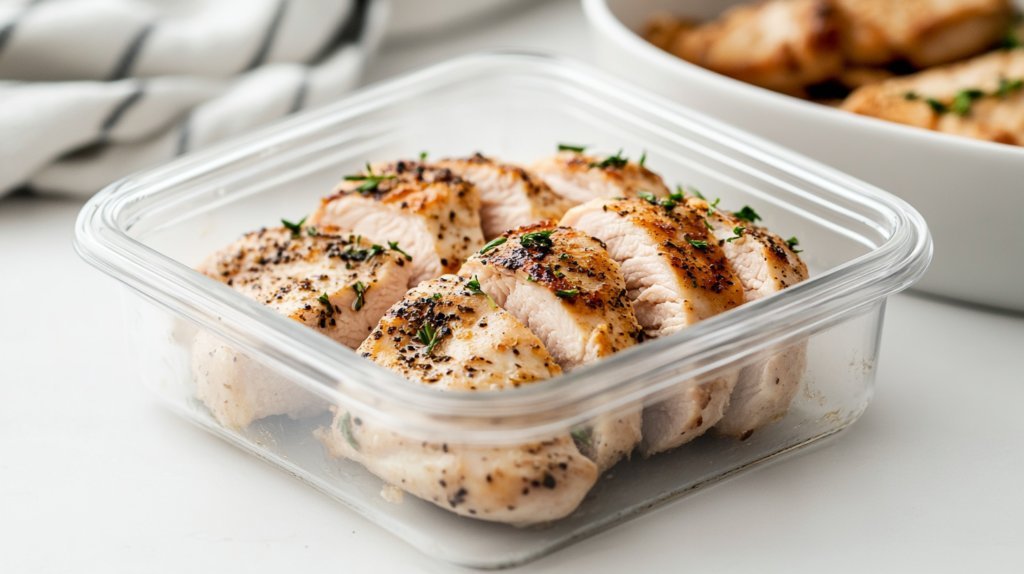
Cool the chicken promptly, but let the first rush of steam escape before the lid goes on, so the box does not rain condensation back over the meat. Store pieces whole wherever you can, in shallow containers that chill quickly and evenly. Keep some of the cooking juices, or a spoonful of stock or sauce, with the meat. That small amount of liquid protects the surface in the fridge and gives the reheating step something to work with.
Reheating should be a warming-through, not a second cooking. A low oven, with the pieces covered and a little liquid in the dish, brings chicken back gently and evenly. A microwave works if the power is turned down and the pieces rest briefly between short bursts, so the edges do not race ahead of the centre. On the stove, a covered pan over low heat with a splash of stock does the same job. The aim is meat that is properly hot all through, steaming lightly, without bubbling hard or tightening again.
A note on the safe point belongs here as well. If you like to take chicken off the heat a touch early, that only stays sound when the rest is part of the plan. Off the heat, the temperature inside a piece keeps rising for a short while and then holds, and that carryover is what carries the meat to the full safe temperature of one hundred sixty-five degrees Fahrenheit. Serve chicken that has reached that point. Never serve it below it, and if a piece was pulled far too early and sat cooling, cook it again properly rather than trusting the rest to have done work it could not do.
Eat the week in a sensible order. Pieces in sauce keep best and can wait until later in the week. Plain chicken is best earlier, sliced cold into salads and sandwiches where its firmness reads as clean texture rather than dryness. Handled this way, with the right cut, salt ahead, a thermometer, whole storage and a gentle reheat, prepared chicken stays worth eating for days instead of becoming the sad lunch everyone expected.