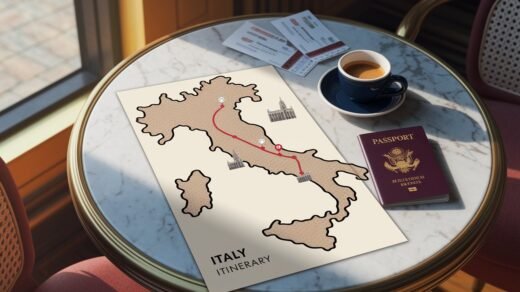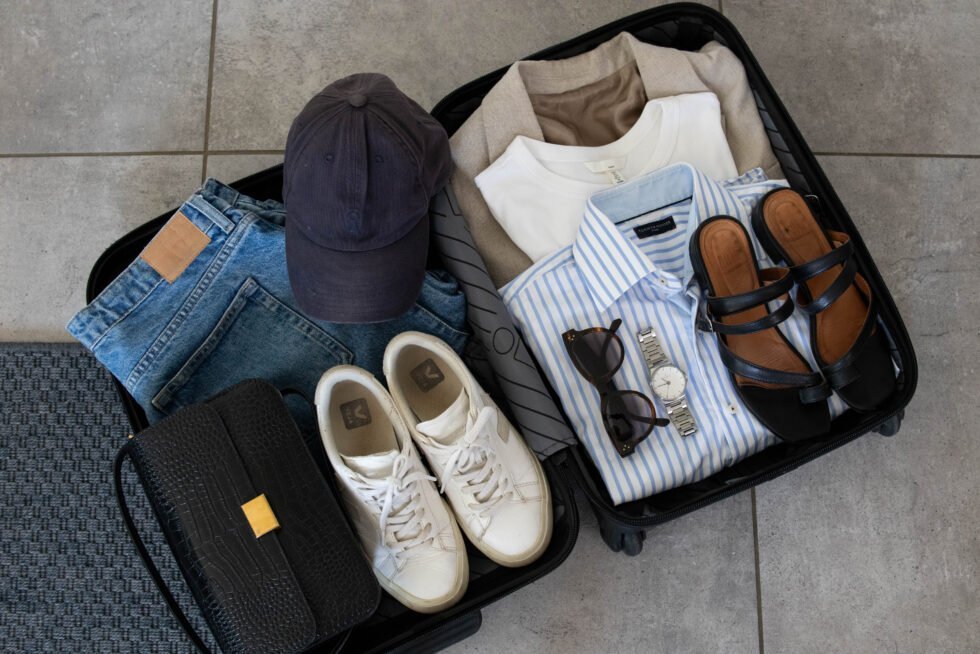
A small bag can hold a wardrobe that looks considered rather than compromised, provided every piece earns its place before the zip closes. The trick lies in combinations rather than quantity, and in fabrics that forgive folding, rolling and long days in transit. Travellers who master that discipline often look sharper than companions dragging cases twice the size.
Combinations multiply faster than individual outfits
The strongest argument for travelling light is simple arithmetic. Garments chosen to work together multiply into outfits far beyond their count, while garments chosen as fixed outfits can only ever be worn one way. A handful of bottoms paired with a slightly larger handful of tops already yields a fresh pairing for every day of a week long trip, and a single jacket or overshirt worn over those pairings changes their character again. Layers, scarves and a change of shoes stretch the count further still. The traveller carrying combinations therefore dresses with more variety than the traveller carrying complete sets, despite owning the smaller pile, because every item in the bag can meet every other item without clashing or looking forced.
The drawback deserves honest naming. Building combinations asks for discipline at the packing stage and restraint at the shopping stage, since any new garment must earn admission by matching what already exists. Some travellers also miss the freedom of dressing on impulse, reaching for whatever mood suggests that morning without planning around a shared palette. Against that, the daily reality of a trip favours the planned wardrobe. Nothing in the bag sits unworn as dead weight, which is the quiet tax that oversized luggage always collects in lifting, hauling and waiting at carousels.
The same outfit logic that carries you through a trip also answers the everyday puzzle of what to wear to a casual dinner without looking underdressed, because a dinner at home and a dinner abroad both reward versatile pieces over single purpose ones. A dark trouser, a clean knit and a structured layer solve both occasions with equal ease. Thinking in combinations also exposes weak purchases quickly. A top that pairs with only one bottom, in one setting, at one temperature, reveals itself as luggage rather than wardrobe. Leaving such pieces behind is not deprivation. It is the mechanism by which a small bag outperforms a large one, trip after trip, without the traveller ever feeling that the same clothes are simply repeating.
One colour family holds the whole wardrobe together
Colour discipline is the foundation beneath the arithmetic. Choosing one dark neutral as the base, whether deep blue, black or charcoal grey, and building every garment around it ensures that tops and bottoms meet without negotiation. An accent shade added deliberately brings variety without chaos, appearing in a scarf, a knit or a single brighter top that still sits happily over the base. Patterns behave well when their ground colour belongs to the family, so a striped shirt in the chosen neutrals counts as a multiplier rather than a gamble. Even small metal choices follow the rule, since keeping jewellery and belt fittings in a single tone removes a dozen tiny mismatches that the eye notices even when the mind does not name them.
The advantage of a single family is freedom inside firm borders. Any top can be pulled out in low light or in a hurry and trusted to work. Packing becomes faster with practice, because the question for each candidate garment is binary and quick. The drawback is a certain sameness that some travellers resist, together with the discipline of passing over a beloved garment in a clashing shade. That loss is real but smaller than it first appears. Accent pieces, texture and accessories supply the variation that colour surrenders, and a wardrobe photographed across a whole trip reads as intentional rather than limited.
Building the family works best from the shoes upward. Footwear in the base shade anchors every pairing, and a belt matched to the shoes closes the circuit. Tops then layer from lightest to darkest within the family, giving shade variety without hue variety. A dress or a single smarter garment in the base colour becomes the hardest working piece of all, dressing upward with the jacket and jewellery or downward with flat shoes and bare arms.
Fabrics decide how clothes survive the bag
What a garment is made from matters more than how many garments travel. Fine wool from merino sheep leads the field for good reason. It regulates warmth across changing climates, resists odour through repeated wear, and releases creases while hanging overnight. Wool blended with synthetic fibres in trousers and jackets springs back from folding and looks tailored soon after arrival. Modern technical fabrics woven for travel weigh very little, dry overnight after a sink wash and shrug off wrinkles almost entirely. Knitted garments of any fibre roll without holding a crease and forgive long days compressed in a cube, which makes them the safest passengers in any bag.
The weaker fabrics fail in predictable ways. Linen looks beautiful for minutes and then records every fold as a permanent map. Heavy cotton shirts and thick denim take up room, dry slowly after washing and arrive creased even when folded with care. The drawback of the stronger fabrics is equally plain. Fine wool and quality technical cloth cost more at purchase than basic cotton, and some travellers dislike the feel of synthetic fibres against skin. Weighed across many trips, though, a garment that can be worn repeatedly, washed in a sink and dried by morning repays its price in space saved and outfits delivered, while a cheap garment that performs badly costs its owner on every single journey.
Grooming choices follow the same material logic, since what survives the bag includes the wash bag itself. The Transportation Security Administration publishes screening limits for liquids, aerosols and gels in hand baggage, gathering them into small travel sized containers inside a single clear bag, and solid toiletries fall outside that restriction entirely. Solid shampoo, solid scent and stick deodorant therefore free space in the clear bag while removing any risk of leaks across folded clothes. That swap suits the fabric philosophy perfectly. Just as the wardrobe favours materials that tolerate compression and quick washing, the wash bag favours forms that tolerate travel without spilling, weighing little and lasting the whole trip without replacement.
Packing order protects collars, creases and shape
How garments enter the bag decides how they leave it. Soft knits and casual pieces roll tightly, compressing well and filling gaps around harder objects. Structured garments such as jackets and collared shirts fold along their existing seams, travel inside out where friction threatens the outer face, and rest near the top where pressure is lightest. A thin layer between folded pieces reduces the rubbing that prints creases into cloth. Grouping garments by kind inside separate cubes means one needed piece can be lifted out without disturbing the rest, and shoes filled with socks or belts sit heel to toe along the walls of the bag where their shape wastes the least room.
The personal item allowed beside the cabin bag deserves treating as part of the wardrobe system rather than an afterthought. Cabin bag size and weight allowances are set by each airline and differ between carriers, so the pairing of a main bag with a generous personal item brings total capacity close to a modest checked case while keeping everything within reach. The bulkiest outfit, including the jacket and the heaviest shoes, travels best worn on the body, where it neither wrinkles under pressure nor consumes packing space. On arrival, hanging the next outfit in a bathroom while a shower runs lets steam relax most travel creases,.
The method behind this order comes from treating clothes as interchangeable parts rather than fixed sets. The Wikipedia entry on capsule wardrobes explains that a small set of versatile garments coordinates across many outfits, a principle popularised by a London boutique owner and later by a designer collection built around pieces designed to combine. Packing order simply protects that principle in transit. Pieces used most often sit most accessibly, formal pieces sit most protected, and small items fill the voids that wasted space would otherwise occupy. Trips longer than a week add one more habit, a brief sink wash every few days for the quick drying pieces, which lets a bag packed for a handful of days serve a journey twice as long without growing by a single garment.
A verdict on travelling light without dressing down
The case for the small bag rests on compounding advantages. Combinations multiply outfits, a single colour family guarantees harmony, forgiving fabrics survive compression and washing, and a deliberate packing order delivers garments ready to wear. Movement through stations and airports turns quick and unencumbered. Nothing waits at a carousel and nothing can be lost by an airline along the way. The case against rests on discipline and on cost, since versatile quality pieces ask for thought at purchase and thought again at packing, and since the method offers no room for garments carried just in case an unplanned occasion appears. Travellers who value spontaneity of dress above all will feel the borders of the system most keenly.
On balance the verdict favours travelling light, and not narrowly. The drawbacks fall mostly at the preparation stage, at home, where time is cheap and choices can be revised. The advantages fall during the journey itself, where time is precious and mistakes cannot be sent back to a wardrobe. Dressing well was never a function of volume. It is a function of fit, condition, harmony and confidence, and every one of those travels better in a considered small bag than in a hasty large one. The sharpest dressed person in a departure lounge is so often the one with the smallest bag because the small bag forced the thinking that good dressing always required.
Adopting the method gradually softens its demands. One trip taken with a colour family and rolled knits teaches more than any amount of planning on paper, and each later trip refines the pile further as failures are retired and successes repeated. What remains is a personal uniform in the best sense, a set of pieces known to work, known to combine and known to arrive looking ready. That knowledge, far more than any single garment, is what lets a traveller step off a long journey, open a small bag and dress for dinner as though a full wardrobe had travelled too.