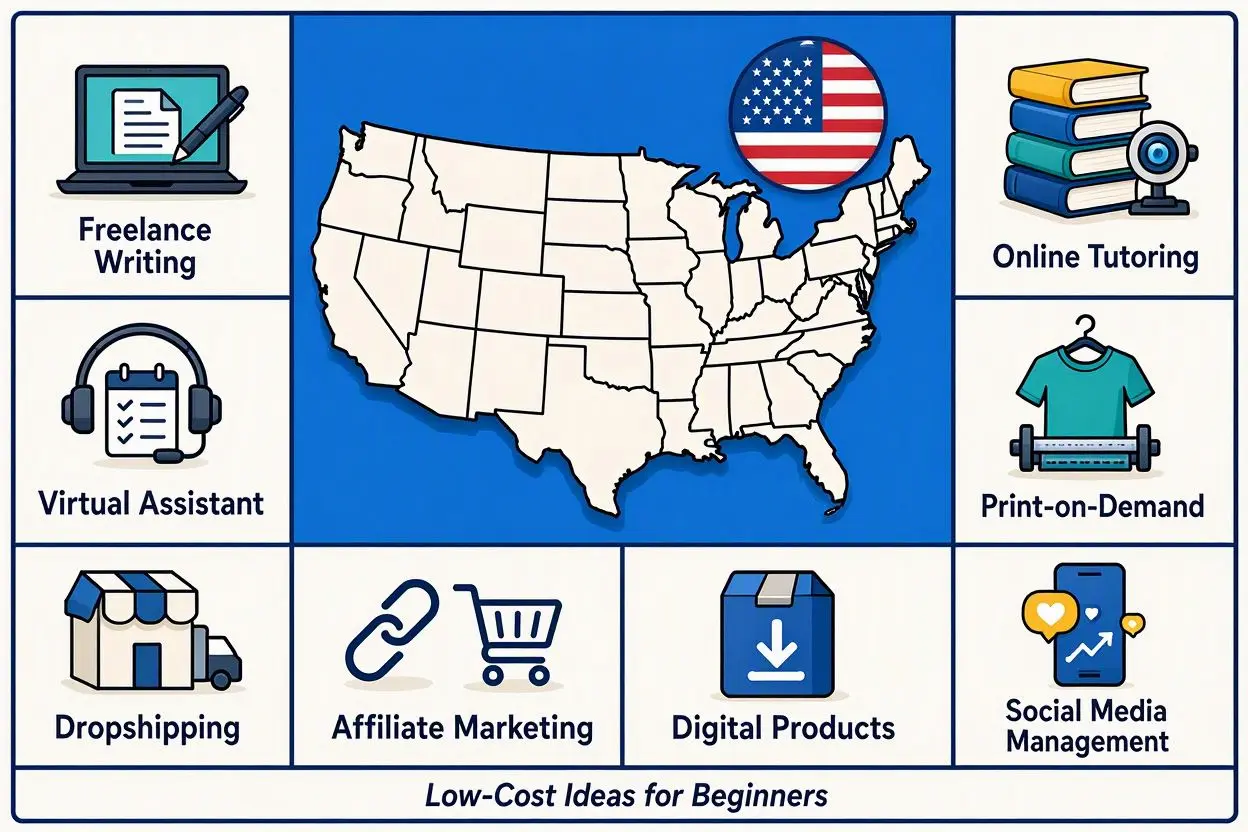
Starting an online business in the USA does not always require thousands of dollars, a physical store, or a large team. Many beginners can start with a laptop, an internet connection, and a useful skill or simple business idea.
If you are wondering what are low-cost online businesses for beginners in the USA, the good news is that there are several options with relatively low startup costs. Some can even be started part-time while you keep your current job.
The key is to choose a business that matches your skills, budget, available time, and long-term goals.
In this guide, we will look at some of the best low-cost online business ideas for beginners in the USA, how they work, what they may cost to start, and what you should consider before choosing one.
Why Start a Low-Cost Online Business?
An online business can be attractive because you can often work from home and reach customers across the country without renting a commercial location.
For beginners, keeping initial expenses low can also reduce financial risk. Instead of investing heavily before knowing whether an idea will work, you can test a small offer and improve it based on customer feedback.
Some online businesses also have flexible schedules, making them suitable for students, parents, employees, and people looking for an additional source of income.
However, low startup cost does not mean guaranteed income. Building an online business still requires time, consistency, marketing, and learning.
1. Freelance Services
Freelancing is one of the simplest online business models for beginners who already have a useful skill.
You can offer services such as:
- Content writing
- Graphic design
- Video editing
- Website design
- Social media management
- Virtual assistance
- Data entry
- SEO services
- Email marketing
- Translation
The advantage is that you do not necessarily need to create a product. Instead, you sell your time and expertise to businesses or individuals.
For example, a beginner who is good at writing could offer blog writing services to small US businesses.
Estimated startup cost
You may be able to begin with a computer, internet connection, basic software, and a simple portfolio. Depending on what you already own, the initial cost can be relatively small.
How to get your first clients
Create 3–5 examples of your work and build a simple portfolio. Then contact potential clients directly or use established freelance marketplaces.
Instead of trying to offer everything, choose one specific service and target one type of customer.
For example:
“I write SEO blog posts for small home-service businesses in the USA.”
That is more specific than simply saying, “I am a freelance writer.”
2. Blogging and Niche Websites
Blogging can be another low-cost online business for people who enjoy researching and writing.
Instead of creating a general website about everything, beginners can focus on a specific niche.
Possible niches include:
- Personal finance
- Technology
- Home improvement
- Travel
- Fashion
- Fitness
- Food
- Small business
- Career advice
- Lifestyle
A niche website can eventually generate revenue through advertising, affiliate marketing, sponsorships, digital products, or services.
However, blogging is usually a long-term business model. New websites often need time to build authority and organic search traffic.
How to make a beginner blog different
Don’t publish dozens of generic articles just because a keyword has search volume.
Instead, focus on answering specific questions better than existing pages.
For example, rather than writing a broad article about “online businesses,” you could create practical guides covering startup costs, tools, mistakes, and step-by-step instructions.
3. Affiliate Marketing
Affiliate marketing allows you to recommend products or services and potentially earn a commission when someone makes a qualifying purchase through your referral.
You do not have to manufacture, store, or ship products.
A beginner could create content around a specific topic and recommend relevant products.
For example, a technology website might publish articles about:
- Best budget laptops for students
- Useful software for small businesses
- Home office equipment
- Productivity tools
The important thing is to build trust.
Don’t recommend a product simply because it pays a commission. Your recommendations should be relevant to the reader and clearly explain the advantages and disadvantages.
Also remember that affiliate relationships should be disclosed appropriately.
4. Selling Digital Products
Digital products can be attractive because you create something once and can potentially sell it repeatedly.
Examples include:
- Ebooks
- Printable planners
- Templates
- Checklists
- Online guides
- Design assets
- Spreadsheet templates
- Educational resources
- Notion templates
- Business documents
For example, someone with experience in budgeting could create a simple personal budgeting spreadsheet for US consumers.
The biggest challenge isn’t necessarily creating the product. It’s finding a specific problem that people are willing to pay to solve.
A useful digital product should save the customer time, reduce confusion, improve productivity, or help them achieve a specific goal.
5. Online Tutoring
If you have strong knowledge in a particular subject, online tutoring can be started with relatively little equipment.
You could teach:
- Mathematics
- English
- Science
- Coding
- Music
- Test preparation
- Business skills
- Language learning
You can conduct sessions through video-conferencing platforms and promote your services through your website, social media, referrals, or tutoring platforms.
A good way to stand out is to specialize.
Instead of advertising yourself as an “online tutor,” you might focus on a particular age group, subject, or learning goal.
6. Virtual Assistant Services
Many small businesses need help with routine administrative work.
A virtual assistant may handle tasks such as:
- Email organization
- Calendar management
- Customer support
- Research
- Data organization
- Appointment scheduling
- Social media posting
- Basic administrative tasks
This can be a practical option for beginners who are organized and comfortable using common online tools.
You can start by offering a small package of services and increase your rates as you gain experience and testimonials.
7. Social Media Management
Small businesses often know they need to maintain an online presence but don’t have enough time to manage their social media accounts.
A social media manager may help with:
- Content planning
- Captions
- Basic graphics
- Scheduling posts
- Community engagement
- Performance reporting
You don’t need to manage every social platform. Choosing one or two platforms and becoming good at them can make your offer easier to sell.
For example, you could specialize in helping local restaurants, real estate agents, dentists, or home-service companies.
8. Print-on-Demand
Print-on-demand allows you to sell products such as shirts, mugs, posters, or other merchandise without keeping physical inventory yourself.
When a customer orders a product, a third-party company typically handles printing and fulfillment.
This can reduce the upfront investment compared with purchasing large quantities of inventory.
However, competition can be significant. Simply uploading random designs is unlikely to create a successful business.
A better strategy is to understand a specific audience and create designs or products that appeal to that audience.
9. Online Consulting
If you already have professional experience, consulting can potentially become a higher-value online business.
For example, someone with experience in:
- Marketing
- Human resources
- Sales
- Business operations
- Career development
- Accounting
- Technology
may be able to offer consulting services within their area of expertise.
Consulting generally requires more knowledge and credibility than some beginner business models, so it is best suited to people who already have practical experience.
10. YouTube or Short-Form Content
Creating educational or entertaining content can become an online business when an audience develops.
You can create videos about almost any legitimate niche, including technology, education, cooking, fitness, hobbies, business, or personal development.
Possible revenue sources can include advertising, sponsorships, affiliate marketing, memberships, products, and services.
The downside is that content creation often requires patience. You may publish many videos before building a meaningful audience.
For beginners, consistency and useful content are generally more important than expensive equipment.
Which Low-Cost Online Business Is Best for Beginners?
There isn’t one answer for everyone.
Your best choice depends on what you already know and how quickly you want to start generating revenue.
| Business | Startup Cost | Difficulty | Potential Model |
|---|---|---|---|
| Freelancing | Low | Beginner-friendly | Client payments |
| Blogging | Low | Moderate | Ads, affiliates, products |
| Affiliate marketing | Low | Moderate | Commissions |
| Digital products | Low | Moderate | Product sales |
| Online tutoring | Low | Beginner-friendly | Hourly/session fees |
| Virtual assistance | Low | Beginner-friendly | Client retainers |
| Social media management | Low | Moderate | Monthly client fees |
| Print-on-demand | Low | Moderate | Product sales |
| Consulting | Low | Advanced | Client fees |
| YouTube | Low to moderate | Moderate | Ads, sponsors, products |
If your main goal is to make money sooner, service-based businesses such as freelancing, tutoring, virtual assistance, and social media management may be easier to monetize than a brand-new blog.
If your goal is to build an asset that could generate revenue over a longer period, blogging, digital products, affiliate marketing, and content creation may be worth considering.
How Much Money Do You Need to Start an Online Business?
One of the biggest advantages of many online businesses is that you can start small.
Your expenses may include:
- Domain name
- Website hosting
- Business software
- Design tools
- Email services
- Advertising
- Payment processing
- Business registration or professional services, where applicable
The exact cost depends heavily on the business model.
For example, a freelancer may already have most of the equipment required, while someone launching an ecommerce business may need money for product development, inventory, fulfillment, or advertising.
Before spending money, calculate your expected startup expenses and decide how much you can comfortably afford to risk.
How to Choose the Right Online Business
Before choosing an idea, ask yourself five questions.
1. What skills do I already have?
Starting with an existing skill can reduce your learning curve.
2. How much time can I dedicate?
A business that requires daily content creation may not be suitable if you only have a few hours each week.
3. Do I want clients or customers?
Service businesses usually require working directly with clients.
Product businesses can reduce direct client work but may require more marketing.
4. How much money can I invest?
Don’t borrow a large amount of money just to test an unproven online business idea.
5. Can I solve a real problem?
This is perhaps the most important question.
People generally pay for solutions, convenience, entertainment, expertise, or products that provide value.
A Simple Way to Start Your Online Business
You don’t need to build a complicated business on day one.
Start with a simple process:
Step 1: Choose one specific business model.
Step 2: Select a specific target customer.
Step 3: Identify one problem you can solve.
Step 4: Create a simple offer.
Step 5: Build a basic online presence.
Step 6: Find your first potential customers.
Step 7: Ask for feedback.
Step 8: Improve your offer based on what you learn.
For example, instead of starting a general marketing agency, you could offer social media management specifically for local home-service businesses.
That makes your target audience, marketing message, and service much clearer.
Common Mistakes Beginners Should Avoid
Starting an online business can be inexpensive, but beginners can still waste money.
Trying too many ideas
Jumping from blogging to ecommerce to freelancing every few weeks makes it difficult to build momentum.
Spending too much before testing
Don’t spend heavily on branding, software, or advertising before confirming that people want your offer.
Expecting instant income
An online business is still a business. Results can take time.
Copying competitors
Researching competitors is useful, but copying their content, branding, or products won’t create a strong long-term advantage.
Ignoring customers
Your customers can tell you what is working and what needs improvement. Pay attention to their questions and feedback.
Final Thoughts
If you’re asking what are low-cost online businesses for beginners in the USA, there are many realistic options to consider.
Freelancing, virtual assistance, tutoring, blogging, affiliate marketing, digital products, social media management, and content creation can all be started on a relatively small budget.
The best option isn’t necessarily the one with the lowest startup cost. It is the one that matches your skills, solves a real problem, and gives you a realistic way to reach customers.
Start small, test your idea, avoid unnecessary expenses, and focus on providing genuine value. Once you find something that works, you can gradually invest more time and money into growing it.
Frequently Asked Questions
What is the cheapest online business to start in the USA?
Freelancing, virtual assistance, tutoring, and some online consulting services can be among the cheapest businesses to start because you can sell an existing skill without purchasing inventory.
What online business can I start with $100?
With a small budget, you could potentially start a freelance service, simple niche website, digital product business, online tutoring service, or content-based business. Your actual costs will depend on the tools and services you choose.
What is the easiest online business for a beginner?
A service-based business can be easier for many beginners because you can start by selling a skill you already have. Freelancing, virtual assistance, tutoring, and social media services are common examples.
Can I start an online business from home in the USA?
Yes. Many online businesses can be operated from home. However, business registration, taxes, licenses, permits, and other requirements can vary depending on your location and business activity.
Is affiliate marketing still worth starting?
Affiliate marketing can be worthwhile when you have a clear niche and create genuinely useful content. It usually takes time to build traffic and trust, so beginners should not expect immediate income.
How can I start an online business with no experience?
Start with a simple service or skill you can learn relatively quickly. Build a few examples of your work, practice with small projects, and gradually improve your skills before expanding your business.
What online business has low startup costs and recurring income?
Some service businesses can use monthly packages or retainers, while digital products, memberships, software, and subscription-based services can potentially generate recurring revenue. Recurring income is not guaranteed and depends on customer retention and the value provided.
Do I need an LLC to start an online business in the USA?
Not necessarily. The appropriate business structure depends on your circumstances, location, business activity, taxes, liability considerations, and other factors. Check current requirements in your state or speak with a qualified professional before making a decision.
How long does it take to make money from an online business?
There is no fixed timeline. A freelancer may find a client relatively quickly, while a blog, YouTube channel, or affiliate website may take considerably longer to build an audience and generate meaningful revenue.