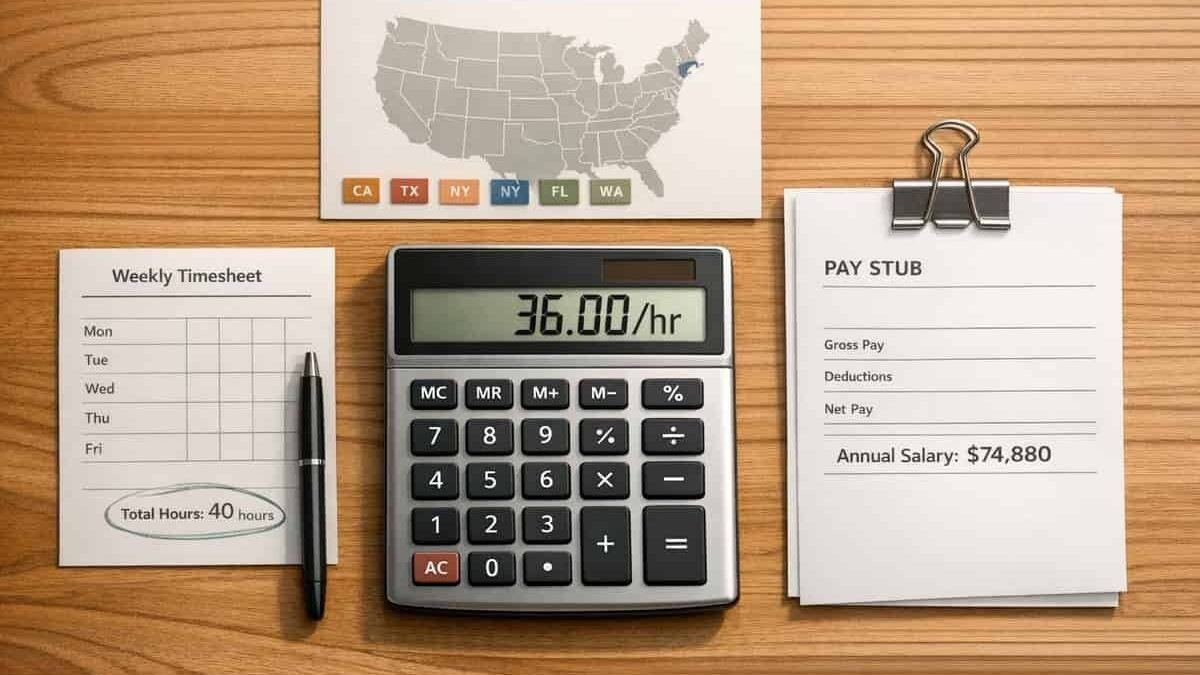
Working full time at thirty six an hour equals seventy four thousand eight hundred and eighty a year before tax, with monthly planning placed at its heart. The honest test is how ordinary months feel, not how impressive the annual headline sounds in isolation.
The Monthly Promise and Why It Attracts Attention
Attention gathers around this wage because its monthly shape looks reassuring from almost any angle. Averaged across the calendar, the pay works out at six thousand two hundred and forty a month before tax, a figure substantial enough to make careful planning feel worthwhile rather than like an exercise in scarcity. Households sense, correctly, that a monthly sum of that size can hold housing, transport, food and saving in the same conversation without one of them immediately evicting the others.
A generous monthly figure only delivers on its promise when everyday spending is organised to arrive in step with the pay cycle, and readers building that organisation will find practical help in setting up automatic bill payments securely so that regular commitments leave on schedule without constant attention. Automation suits this wage particularly well, because the amounts involved are large enough that a missed payment or a drifting subscription quietly wastes money that better habits would have kept working.
Underneath the monthly promise sits the agreed nature of the pay itself. The Wikipedia article on salary frames salary as payment settled between employer and employee for work across a stated period, and that framing matters here: the month, not the hour, is the period most households actually live inside. This appraisal therefore keeps returning to the month as its unit of judgement, weighing strengths and limits by how they feel across ordinary weeks rather than by how they gleam inside an annual total.
Strengths That Make This Level Feel Secure
The first strength is simple headroom. A standard week brings one thousand four hundred and forty before tax, and a fortnight brings two thousand eight hundred and eighty, so ordinary setbacks such as a repair, a replacement appliance or an unexpected journey can usually be absorbed from income rather than borrowed at punishing cost. Security, in everyday terms, is often nothing grander than that: problems arriving one at a time and being paid for without drama.
Regular saving also becomes realistic instead of aspirational at this level. When the monthly average is six thousand two hundred and forty, setting something aside no longer depends on a perfect month with no surprises; it can be scheduled like any other commitment and left to accumulate quietly. That shift, from hoping to save toward planning to save, changes how a household thinks about the future, turning distant goals into dated projects with visible progress.
Choice is the third strength, and it is easy to underrate. This wage lets a household decline the cheapest option when the cheapest option is poor value, whether that means safer transport, fresher food, or housing nearer to work. None of that amounts to luxury, yet the cumulative effect on daily life is large, and it explains why people who reach this level often describe the change as breathing room rather than wealth.
A fourth strength deserves naming before the appraisal turns: resilience against small price rises. Households living close to their margin feel every increase in food, fuel or energy as an immediate emergency requiring something else to be sacrificed. At this monthly level, modest rises can usually be absorbed by adjusting discretionary spending rather than by renegotiating essentials, and that difference in how inflation is experienced, as an annoyance rather than a threat, is a genuine component of the security this wage provides. It should not be overstated, since sustained rises erode any fixed wage eventually, but the buffer is real while it lasts.
Limits Hidden Inside an Impressive Headline
Balance demands the limits receive the same generous hearing as the strengths, beginning with the deductions no headline ever mentions. The Wikipedia entry on payroll tax notes that these taxes fall across both employers and employees and typically support social insurance programmes, which means a portion of every packet is spoken for before personal choices enter the picture at all. Beyond those taxes, amounts held back toward income obligations, the household’s filing circumstances, and sums directed before tax into benefits or retirement provision all reduce what actually arrives, by amounts that shift with location and personal situation.
A second limit is geographical, and pretending otherwise would flatter the wage dishonestly. The same monthly figure that feels ample in a modest cost town can feel tightly stretched in an expensive city where housing alone consumes a formidable share of it. The wage itself has not changed between those places; the contest it must win has. Any appraisal ignoring local prices is grading the wrong exam.
Premium pay, often imagined as the wage’s bonus feature, carries a limit of its own. Plenty of posts paying this much sit in the exempt category, leaving extra hours without any enhanced payment at all. Readers should establish their own classification early and treat any premium talk as unconfirmed until paperwork supports it, because a budget quietly counting on money the contract never promised is a budget preparing its own disappointment.
Ordinary Months Versus Months With an Extra Packet
No appraisal of this wage is complete without separating the month that happens most often from the month people prefer to remember. Fortnightly pay delivers two packets in the great majority of months and three packets in just two months of the year. The ordinary month, built from two packets, is therefore the only safe foundation for rent or mortgage payments, utilities, food and every other commitment that repeats without asking permission.
The generous month deserves a plan rather than a celebration. Its additional packet, arriving on top of a budget that already balances, can be assigned in advance to yearly insurance, property related bills, travel, or an accelerated payment against borrowing. Assigned early, it feels like strategy; left unassigned, it evaporates into small upgrades nobody remembers by the following month, and the household ends the year no stronger despite having received it.
This contrast explains a puzzle many earners at this level describe: the annual total insists life should feel comfortable, yet certain months feel strangely tight. Nothing is broken when that happens. The calendar is simply uneven, and a household budgeting from the ordinary month while deploying extra packets deliberately will experience the same income as steadiness rather than as a puzzling alternation between ease and squeeze.
There is a subtler calendar effect hiding between these two kinds of month, and it involves bills that are charged yearly rather than monthly. Insurance premiums, memberships and certain taxes often present themselves annually, and households frequently experience their arrival as an ambush even though the date never changes. The extra packet months are the natural counterweight to that ambush, arriving often enough to fund such charges when someone has matched the two together in advance. Viewed across several years, this matching game, dull as it sounds, is a large part of why some households on this wage steadily accumulate while others, earning identically, perpetually feel one surprise behind where they expected to be.
Shorter Schedules and Their Honest Trade Offs
Reducing hours tests this wage in a different way, trading money for time at a rate worth examining plainly. Half time work brings the year down to thirty seven thousand four hundred and forty before tax, and the monthly average falls in proportion, while many household costs decline far more reluctantly. Housing rarely halves because a person works less, and neither do the basic costs of running a car, heating a home or feeding a family.
The trade can still be the right one. Time released from work may protect health, hold a family together through a demanding season, or allow training that raises the rate itself later on. What honesty forbids is pretending the trade is free. A household choosing fewer hours should rebuild its monthly plan around the smaller figure from the first reduced packet, not ease into the change while commitments still assume the full time pattern described earlier.
Unpaid leave acts as a temporary version of the same exchange. Each unpaid week removes a weekly slice from the year, and a cluster of such weeks can quietly turn a strong annual figure into a noticeably smaller one. Counting paid weeks realistically, before the year begins, keeps the appraisal grounded and prevents a familiar surprise when the yearly total is finally reviewed.
The Verdict on Planning Around This Wage
The verdict, after strengths and limits have both had their say, is favourable with conditions attached. Seventy four thousand eight hundred and eighty before tax is a genuinely strong yearly figure, and for households in low and moderate cost areas it generally stretches to stable housing, dependable transport, regular saving and a reasonable amount of enjoyment without constant vigilance. It does not, on its own, stretch to careless spending in an expensive city, to supporting every commitment a household might wish for at once, or to ignoring the deductions and calendar quirks this appraisal has catalogued.
Comfort at this level is therefore manufactured rather than automatic. It is built by budgeting from the ordinary month, by giving extra packets an assignment before they arrive, by confirming premium eligibility instead of assuming it, and by reviewing the smaller print of benefits and leave whenever an offer is judged. Households doing those unglamorous things tend to report that the wage feels as good as its headline, while households skipping them often insist the headline lied.
One practical habit ties the whole appraisal together: review the plan whenever the calendar, the household or the job itself changes shape. A new home, a new arrival, a changed commute or a revised schedule all quietly rewrite what this monthly figure must accomplish, and a budget written for an earlier life will misjudge the current one even though the rate never moved. A short review at each such change keeps the verdict honest.
Planned around the month, then, this wage deserves its reputation. Its promise survives honest scrutiny, provided the scrutiny actually happens and the plan is written for the months that occur most often rather than for the months everyone enjoys remembering.