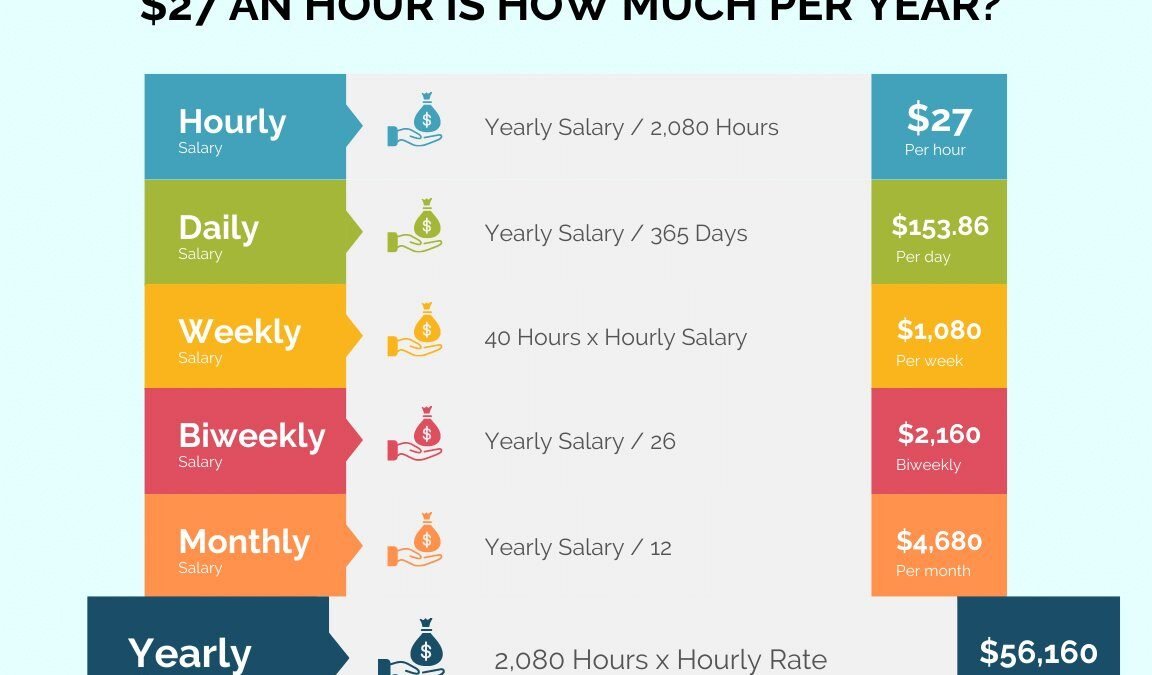
At twenty seven an hour, fifty six thousand one hundred and sixty is the full time yearly total before tax. Following that sum backwards through months, pay packets and single weeks makes the wage far easier to judge.
Phase One From a Single Hour to a Working Week
Begin where the rate itself begins, with one paid hour and the modest promise it carries on its own. A single hour rarely buys anything memorable, which is exactly why hourly figures mislead people who try to plan around them. Nobody arranges housing, food or transport in sixty minute slices, so the opening step on this climb is simply to gather those small units into something recognisable. Stack a normal working week together and the picture sharpens at once: the week delivers one thousand and eighty before tax. That weekly shape is the first honest rung, because bills, fuel and groceries already tend to be thought about in weekly terms by many households.
Each rung of this ladder becomes easier to read once it is set beside the rung underneath it, and readers who want that comparison spelled out for a lower rate can follow twenty an hour converted to a year to see the same climb built from smaller steps. Holding the two ladders side by side shows how a handful of extra units per hour quietly compounds once weeks begin stacking together. The lesson of this opening phase is patience: resist judging the wage by its smallest unit, and let the totals accumulate in order before drawing any conclusion about comfort or strain.
A week also reveals rhythm in a way an hour never can. Some weeks carry extra shifts, others lose hours to illness, weather or quiet trading, and the weekly figure shows that wobble honestly. Treating one thousand and eighty as the standard full week, rather than a guaranteed arrival, keeps expectations grounded from the very start of the journey.
Phase Two From a Week to a Full Pay Packet
Most employers do not settle up weekly, so the next phase doubles the frame and looks at what lands in a single pay packet. Two standard weeks pooled together produce two thousand one hundred and sixty in gross terms before tax, and that packet becomes the amount daily life actually runs on. Rent contributions, card payments and food shopping all tend to be timed around packet day, which makes this figure more practical than either the hour or the week for day to day decisions.
Seeing pay in packet form also changes how a raise or a lost shift feels. A small hourly improvement looks trivial in isolation, yet across a whole packet it becomes visible money, and a dropped shift cuts the packet by a noticeable slice rather than an abstract fraction. Workers who think in packets usually spot trouble earlier, because a thinner packet announces itself immediately in the bank balance instead of hiding inside an annual average.
Hold on to this packet figure as the climb continues. The month and the year that follow are both built from these packets, and every later judgement in this piece traces back to whether two thousand one hundred and sixty, arriving on its regular cycle, covers the commitments stacked against it.
Packet thinking also exposes timing problems that annual figures politely conceal. A large bill falling two days before packet day is a different challenge from the identical bill falling two days after it, even though the yearly total never changed. Households on this wage often rearrange payment dates where providers allow it, clustering the heaviest outgoings just after pay arrives and leaving the leaner stretch before payday carrying only smaller, flexible spending. That rearrangement costs nothing, requires no extra income, and takes a surprising amount of friction out of an ordinary fortnight. It is a good example of this ladder rewarding attention at every rung rather than only at its summit: the week taught the rhythm, and the packet teaches the scheduling that rhythm makes possible.
Phase Three From Pay Packets to an Honest Month
Months refuse to cooperate neatly with fortnightly pay, and this phase exists to make peace with that awkwardness. Spread across the calendar, the wage averages four thousand six hundred and eighty a month before tax, yet the average month is a bookkeeping creature that seldom visits in person. Most months deliver exactly two packets, while two months in the year deliver three, so the money arriving in a typical month sits below the neat average even though nothing has gone wrong.
The honest response is to anchor every fixed commitment to the two packet month. Housing, utilities, insurance and subscriptions should all fit inside what two packets bring in, because those bills arrive with complete reliability while the third packet does not. When a three packet month does arrive, its extra packet already has a waiting job: clearing a balance, rebuilding a cushion, or covering the yearly costs that ambush people who never assigned them a home.
Viewed this way, the monthly figure stops being a disappointment and becomes two separate tools. The average helps with yearly planning and comparisons between jobs, while the two packet reality governs ordinary spending. Confusing those tools is where the familiar end of month squeeze is born, even on a wage that is perfectly adequate across the year as a whole.
Phase Four From Months to the Full Time Year
Only now, with weeks, packets and months assembled, has the yearly figure been earned rather than merely quoted. A full time year built on the standard pattern of forty hours weekly across fifty two weeks gives fifty six thousand one hundred and sixty in gross terms before tax, and each smaller total already visited explains exactly where that headline comes from. Nothing has been rounded into existence or borrowed from optimism; the year is simply the week repeated with discipline.
Agreed pay for a set stretch of work is the arrangement at the heart of this conversion, and the Wikipedia article on salary sets out that idea of salary as payment settled for a defined period. Reading the annual figure through that lens helps when a salaried post is placed beside this hourly one, because both sides can then be compared as complete yearly packages rather than as mismatched units designed to confuse.
The yearly total earns its keep in specific places: tax planning, pension thinking, mortgage conversations and side by side job comparisons all demand an annual language. Outside those rooms, though, the year should step aside. Nobody spends annually, and a household that keeps returning to the weekly and packet rungs for everyday choices will judge this wage far more accurately than one hypnotised by its biggest number.
Phase Five Shorter Weeks and Lighter Schedules
Not every reader climbs this ladder at full height, so this phase tests how the totals behave when the working week shrinks. At half time, working roughly half the standard hours, the year settles at twenty eight thousand and eighty before tax, precisely half of the full time summit because the arithmetic scales in a straight line. Shorter patterns between half time and full time land proportionally between those two points, which makes estimating a reduced schedule refreshingly simple.
What the straight line hides is that living costs refuse to shrink proportionally alongside it. Housing, transport and energy all stay stubbornly close to their full time size, so a lighter schedule squeezes from both directions at once: less arriving, nearly as much leaving. That squeeze does not make reduced hours a poor choice, since time carries its own value for caring, studying or recovering, but it does mean the trade should be priced honestly before it is accepted rather than discovered afterwards.
Unpaid time away works on the same principle in miniature. A week without pay removes a full weekly rung from the year, and several such weeks quietly lower the summit by a packet or more. Readers whose roles include unpaid breaks should rebuild their personal yearly figure from the weeks they will genuinely be paid for, instead of borrowing the standard total calculated a phase ago.
There is one more negotiation hiding inside this phase, and it concerns what gets traded when hours come down. A lighter schedule arranged deliberately, with the hourly rate protected and the reduced yearly figure accepted openly by everyone involved, behaves very differently from hours quietly evaporating through cancelled shifts. The first is a chosen exchange of income for time; the second is an income cut wearing a rota’s clothing. Readers considering either should name which one they are looking at, rebuild their expected year from the weeks genuinely on offer, and only then decide whether the exchange still looks fair. The ladder built across the earlier phases makes that naming easier, because every lost week now has a known price attached to it.
Phase Six Take Home Pay and Premium Hours
The final phase deals with the distance between the gross totals climbed so far and the money that finally becomes spendable. As the Wikipedia article on tax withholding in the United States describes, employers hold back sums from wages and pass them onward toward what an employee will ultimately owe. Around that withholding sit other moving parts: payroll taxes drawn from pay, the filing position a household files under, and sums set aside before tax for benefits or a workplace retirement plan. Each part trims the packet by its own amount, the mixture differs from state to state and household to household, and so no universal spendable total can honestly be printed here.
Premium hours can narrow that distance for workers whose roles qualify for enhanced rates on extra time. Eligibility is never something to assume, since plenty of posts at this level sit outside premium arrangements altogether, and any extra should be treated as a welcome addition layered over a budget that already works without it. Affordability, mentioned only in passing at this final stage, follows the same rule: a wage planned from its ordinary two packet months, with premiums and third packets treated as bonuses, tends to feel steadier than its headline first suggested when this climb began.