Sentimental clutter resists ordinary sorting because every object arrives carrying a person, a place or a version of yourself you are not ready to release. Keeping well becomes possible once the memory, rather than the object alone, decides what truly needs shelf space.
Separating the Memory From the Object Itself
Hold any difficult item and ask two questions in a deliberate order. First, what does this bring back. Second, does holding the physical thing strengthen that recollection, or would the recollection survive perfectly well without it. The gap between those answers is where most progress hides. A concert ticket stub may carry an entire evening in a few square inches of paper, easy to keep and easy to revisit. A bulky souvenir may carry the same evening far less efficiently, taking a shelf to do the work a photograph could manage alone. Neither answer is wrong. The exercise simply returns the decision to the memory, which is the part you actually value, instead of leaving it with the object, which is only the memory’s container.
Travel belongings expose this distinction beautifully. Shells, brochures, key rings and novelty gifts pile up because each one certifies that a journey happened, yet the journey lives in your mind and your photographs far more than in the pile. Many travellers discover that their affection shifts forward over time, and reading about the cheapest time to book a flight for wherever comes next stirs more happiness than dusting a shelf of ageing mementos from everywhere that came before. That ache attached to the older objects has a name, and Wikipedia’s entry on nostalgia characterises it as yearning directed backwards, towards times and places remembered with affection and personal warmth. Naming the feeling helps because it shows the emotion belongs to you and your history. It was never stored inside the object, and it will not be thrown away with the object either.
Keeping the Finest Example of Each Story
Most sentimental categories arrive in crowds. There is rarely one childhood drawing, one holiday ornament, one programme from a school performance. There are bundles, and bundles are mercifully easier to judge than single items, because comparison does the heavy lifting. Spread a whole category across a table and the finest example usually identifies itself: the drawing with the most personality, the ornament in the best condition, the programme from the performance you still describe to friends. Keeping that standout deliberately transforms the rest from treasures into supporting material, and supporting material can leave without the story leaving with it.
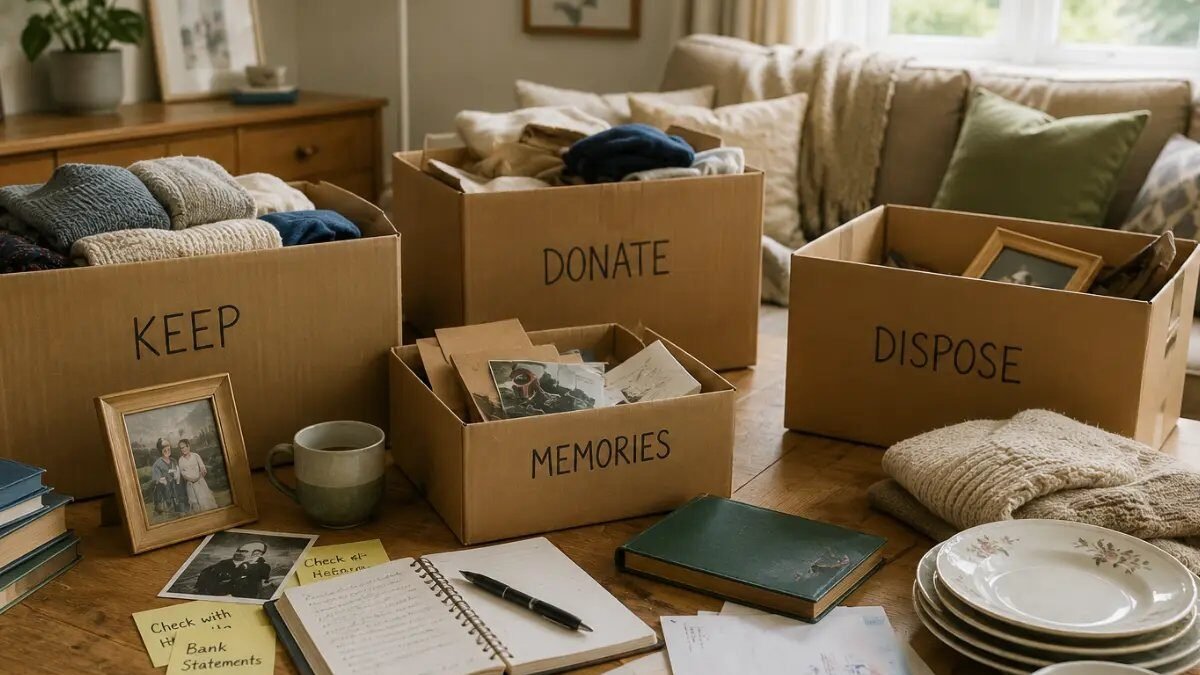
Quality here means emotional quality as much as physical condition. Choose the example that triggers the clearest recollection when you pick it up, not the one that merely looks smartest on a shelf. If two items tie, keeping both is not failure; the aim is a curated handful rather than an unexamined heap. Duplicates deserve special honesty, because a second and third copy of the same photograph or certificate adds storage weight without adding memory. One well kept original honours the moment better than three fading copies scattered across drawers. Work category by category, resting between them, and let each finished group be wrapped, labelled and put away before the next spread covers the table. The visible shrinking of the unsorted pile is its own encouragement.
Photographs and Letters Handled With Care
Paper memories frighten people most, because paper feels like the original record and originals feel irreplaceable. Treat photographs and letters as an archive project rather than a decluttering session. Sort them slowly into piles by person, place or period, and set aside true duplicates and blank backed strangers for release. Handling originals with clean dry hands, supporting fragile sheets from beneath, and keeping food and drink away from the table are small courtesies that protect what you keep. Letters can be read once more before deciding, and that reading often settles the question by itself: some correspondence glows on rereading, while other letters turn out to be routine notes whose warmth belonged entirely to the day they arrived.
Scanning the keepers creates a second, safer home for them. A clear scan, stored in a named folder and backed up in a separate place, means a flood, a fire or a mislaid box can no longer erase the only copy. Questions naturally arise about whether files themselves endure, and on that point Wikipedia’s article on digital preservation gathers the methods used to keep digital material reachable and readable across the years, from careful file formats to refreshing storage as technology changes. You do not need a professional system. Consistent folder names, sensible dates written into file titles, and copies in two locations will serve an ordinary family archive well. Once the digital copy exists, some households happily release bulky albums while keeping a slim selection of originals, and that exchange of shelf space for security feels like a bargain rather than a loss.
Gifts and Inherited Pieces Without Guilt
Gifts carry the giver into every sorting decision, which is why a never used present can survive years of purges untouched. Untangle the two halves of the transaction. The kindness happened fully at the moment of giving, when the thought was offered and received with thanks. That completed kindness cannot be cancelled by later passing the object to someone who will use it gladly. Keeping an unwanted gift in a cupboard does not honour the giver; it merely stores a small daily reminder of obligation. Releasing it returns the object to circulation and leaves the relationship exactly where it always lived, between people rather than inside packaging.
Inherited pieces ask for even gentler handling, because grief and housekeeping make poor partners. Nothing needs deciding while a loss is fresh, and boxing inherited belongings respectfully for a season is a legitimate choice rather than avoidance. When sorting eventually begins, remember that a loved person’s whole life cannot and need not be preserved by you alone. Siblings, cousins and friends may each hold different pieces, spreading the keeping across many homes. Retain what connects you most strongly: the tool that still works in your hands, the dish that appears at your table, the chair that suits your room. Pieces kept purely from duty tend to gather resentment along with dust, and no one who loved you would wish their belongings to become your burden.
Children’s belongings form a category many households postpone for decades, partly from love and partly because the decision feels like it belongs to someone else. Artwork, schoolbooks, outgrown toys and tiny clothing all document a person who no longer exists at that size, and the parent doing the sorting is really curating their own memories of those years. A fair approach keeps a compact selection that shows the child’s personality at several ages rather than a complete warehouse of everything produced. Where the child is old enough, invite their judgement before anything leaves, since some pieces they treasure may surprise you and others you guarded carefully may mean nothing to them at all. Their indifference is a gift of permission, not a rejection of the past you shared.
Recording Stories Before Letting Objects Leave
When an item must go but its story deserves to stay, record the story first. Write a short account in plain words: what the object is, where it came from, who gave or used it, and why it mattered. Attach that account to a photograph of the item and file the pair together in the same archive as your scanned letters. The writing itself often relieves the pressure, because much of the fear behind sentimental clutter is not losing the thing but losing the tale attached to it, and tales survive beautifully in sentences. A few honest lines written now will mean more to future readers than a box of unexplained objects ever could.
Voice recordings serve the same purpose for anyone who finds writing slow. Speak about the item as if describing it to a grandchild over the telephone, then save the recording beside its photograph with a clear file name. Families sometimes gather for this part, turning the recording into an occasion where memories are shared aloud before boxes are sealed. Practical details belong in the record too: names spelled correctly, places identified, dates written as fully as memory allows. Vague labels help nobody later. This stage converts letting go from an ending into a transfer, moving the value out of fragile physical form and into words and images that weigh nothing, travel anywhere and can be shared with relatives near and far without dividing a single teapot between households.
A Small Permanent Place for What Remains
Everything that survives your sorting deserves a proper address. A single shelf, one handsome box, a defined section of a cabinet: choose a boundary that suits your home and your temperament, and let that boundary be the final editor. A defined place transforms keeping from an accident into a decision. Visitors see a display rather than a storage problem, and you meet your memories during ordinary life instead of only during rare expeditions into the loft. Rotate displayed pieces occasionally if the collection is slightly larger than the shelf, storing the resting items in one labelled box nearby. Rotation keeps every object in active relationship with you, which is precisely what separates a cherished collection from forgotten clutter.
Protect the boundary kindly as new sentimental items arrive, because they will: another trip, another celebration, another inherited treasure. Each newcomer faces the same gentle questions as everything before it, and shelf space claimed by a newcomer may ask an older resident to retire into the archive of photographs and written stories. There is no failure in that exchange, only the collection staying alive and proportionate to the home around it. What remains, in the end, should be the pieces that still make you pause with pleasure as you pass them on an ordinary weekday. A small place, deliberately kept, holds more love than a houseful of boxes ever managed, because every object inside it was chosen, and chosen things get looked at, remembered and enjoyed.