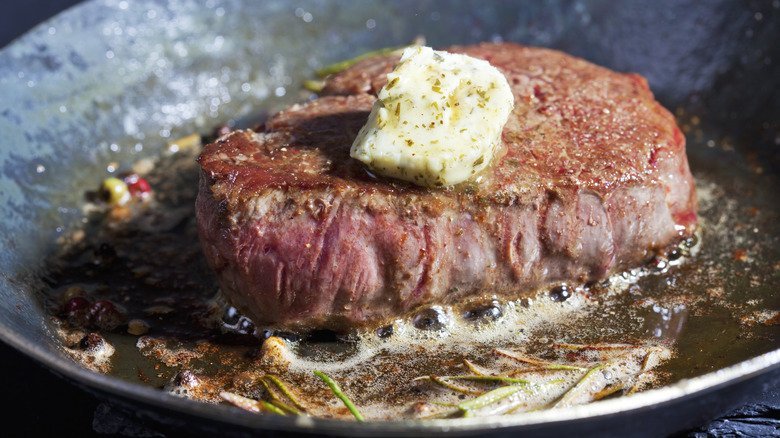
Cutting a steak open to peek at the centre feels cautious, yet the cut itself spills the juices the cook worked to keep, and the colour seen mid-cook will change during resting anyway. Better evidence sits in temperature and touch. A probe slipped sideways into the thickest part reads the centre without carving the meat, while the feel of the surface, learned against your own hand and checked against a thermometer at first, grows reliable with practice. The questions below lead the method, covering pull temperatures in words, resting carryover and the visual signs that actually mean something at the stove.
Why a Cut Gives Misleading Evidence
The slice and peek habit fails for three separate reasons, and each one is worth understanding. The first is simple loss. A cooking steak holds its juices under gentle pressure inside the meat, and a cut opens a door for them. The puddle that spreads on the board while you admire the colour is moisture that was meant to be in the bite. A small probe hole costs almost nothing by comparison, which is why the thermometer can be used again and again while the knife can only be used once at the price of the whole result.
The second reason is that the colour you see is not the colour you will eat. A steak straight off the heat is still travelling. Its centre will rise in temperature while it rests, its juices will settle, and its cut surface will change as it meets the air. A centre that looks alarmingly red at the stove may be a calm, warm pink at the table, and a centre that looks safely done at the stove may rest its way into dryness. Judging by a mid cook cut means judging a moving target at its least representative moment.
The third reason is that colour was never a reliable instrument in the first place. The red and pink shades inside beef come from a pigment in the muscle, and that pigment behaves differently depending on the cut, the animal, how the meat was stored and how long it has been exposed to air. Two steaks at the identical internal temperature can show noticeably different colours. Once you accept that colour is a hint rather than a measurement, the need for a better method stops feeling fussy and starts feeling obvious. Temperature measures the thing you actually care about, which is how cooked the centre is, and touch, once trained, estimates the same thing from the outside.
Reading Temperature From the Side
The reliable technique is a sideways insertion. Slide the probe in sideways, entering at the edge, so its tip comes to rest in the middle of the thickest part, surrounded by meat on every side. Coming down through the top risks pushing the tip too deep, close to the hot pan or through the steak entirely, and a tip sitting near metal reads the pan rather than the meat. Keep the tip away from bone and away from pockets of fat, since both read differently from the lean meat around them. If the first reading surprises you, take a second one a short distance away and trust the lower, steadier figure while the steak continues to cook. This sideways probing habit is the same skill a beginner needs over smoke and fire. Anyone learning smoking ribs for beginners without guesswork faces the same problem in a larger shape: thick meat, a closed cooker, and a strong temptation to keep opening and cutting to see what is happening inside.
Wikipedia’s meat thermometer page states the principle plainly: a thermometer placed in the thickest part of the meat gives the most trustworthy reading of its internal temperature. That placement rule is the whole method in one line. The numbers then need honest framing. The agriculture department’s official safety advice puts steaks at a minimum of one hundred forty-five degrees Fahrenheit, followed by a rest period, and that is the figure to follow whenever safety is the priority. Alongside it, many diners deliberately choose lower temperatures as a matter of preference: rare and medium rare are eaten well below that mark by people who understand the choice and accept it. Presenting both honestly matters. The official recommendation is one hundred forty-five degrees with a rest, and anything lower is a preference, not a safety standard.
Pull temperatures sit below final temperatures because of the rest that follows. A steak aimed at a rare finish should leave the heat a little early, a steak aimed at medium rare should leave it a little early too, and the thicker the steak, the more the centre will climb while it sits. Thin steaks climb only slightly and also cook so fast that the window between stages is short, which is why they forgive neither distraction nor slow probing. Thick steaks give you more time at the stove and demand more patience off it.
Ribs reward the cook who probes for tenderness and checks temperature at the bone without tearing the meat apart, and steaks reward exactly the same restraint. In both cases the meat finishes better when the cook gathers evidence without damaging the evidence.
Learning Touch Against Your Own Hand
The touch test compares the steak’s resistance with the fleshy pad at the base of your own thumb. With your hand open and relaxed, that pad feels soft and gives easily, much as a rare steak gives under a fingertip. Touch your thumb lightly to your first finger and the pad firms a little, springing back in a way that resembles medium rare. Pressing thumb against the middle finger feels firmer again, closer to medium. Thumb to the next finger feels firmer still, in the region of medium well, and thumb to the little finger makes the pad hard and unyielding, like a well done steak. Use tongs or a clean fingertip on the centre of the steak, press briefly, and compare honestly.
The warnings matter as much as the scale. Hands differ. A manual worker’s thumb pad and an office worker’s thumb pad are not the same instrument. Cuts differ too. A tenderloin steak feels softer than a strip steak at the same internal temperature, and a well marbled ribeye gives differently from a lean fillet. Touch tests vary by cut and by hand until they are calibrated, so treat the hand scale as a rough map and check it against thermometer readings across your first several steaks. Press, guess, then probe, and note how far your guess sat from the reading. That small loop, repeated over a handful of cooks, is what turns a party trick into a genuine skill.
Surface Colour and Other Honest Visual Cues
Some visual signs do carry real information, as long as they are read as supporting evidence. Beads of juice on the top face of a thick steak often appear around the later stages of cooking, and a steak’s sides change colour from the bottom upward as heat climbs through it, so a shrinking band of raw colour at the side’s centre suggests the middle is advancing. A steak also stiffens as it cooks. Picked up in tongs, a rare steak hangs soft and loose, a medium one keeps a slight curve, and a well done one feels rigid. None of these signs carries a number, and all of them arrive too late or too early on some cuts, so they belong behind temperature and trained touch in the order of trust.
The colour of the meat itself deserves its clearest warning here. The reference entry on myoglobin names that pigment as the substance behind the red colour of meat, and that is exactly why colour alone misleads as a doneness test. Pigment changes with air exposure, with storage and with the particular muscle, so a steak can look pink at a temperature where another looks grey, and freshly cut meat can deepen in colour simply by sitting in the air for a few minutes. The grey band that worries many cooks can appear in meat cooked gently from cold or in meat with less pigment to begin with, at a perfectly good internal temperature. Read the thermometer, glance at the surface for the supporting signs, and let the cut colour at serving time be a pleasure rather than a verdict.
Pulling Early for Carryover During the Rest
Carryover cooking is the quiet final stage. Reference writing on carryover cooking explains that internal temperature keeps rising after meat leaves the heat, because the hotter outer layers pass their heat inward toward the cooler centre. A thin steak may climb only a little. A thick steak can climb noticeably, enough to carry it a full stage further than it was when it left the pan. Pulling early is therefore not timidity; it is arithmetic. You remove the steak below its target so that the rest delivers it to the target.
Rest the steak, covered loosely, on a rack or a warmed plate for roughly half its cooking time as a working guide. During those minutes the temperature evens out through the meat and the juices, which cooking pushed toward the centre, spread back through the whole cut. Slice before that settling and the juices run out exactly as they do from a mid cook cut, which defeats the entire method. Slice after it, against the grain where the cut has a clear grain, and the steak on the plate matches the temperature you pulled for.
What temperature should a medium rare steak reach?
Medium rare is a preference rather than an official standard, and it sits below the official safety recommendation of one hundred forty-five degrees Fahrenheit followed by a rest. Cook the steak to a little under your chosen final temperature, rest it, and let carryover carry the centre the rest of the way. If safety guidance is your priority, follow the official figure and accept a firmer result.
Can the touch test be trusted on its own?
Only after calibration. Match your guesses against thermometer readings on the cuts you cook most often until the two agree, remembering that hands and cuts both vary. After that apprenticeship, touch is a fast and honest first check, with the probe kept for the final call.
Why does the inside colour not match the temperature?
Because colour comes from pigment, not from heat alone. The pigment changes with air, storage and the muscle itself, so two steaks at the same temperature can look quite different inside. Treat colour as a hint, temperature as the measurement, and the puzzle disappears.
How long should a steak rest before slicing?
Roughly half its cooking time is a sound guide, with thick steaks needing longer than thin ones. The rest lets carryover finish the centre and lets the juices settle back through the meat, so a patient wait is what keeps the first slice moist.