A camera on the windscreen only becomes evidence when the angle is right, the card is healthy and the settings suit the road, and most owners discover the gaps on the day they need the footage most. Getting a camera working well takes an hour of careful fitting and setting up, and building the habits that keep it honest takes about a fortnight of driving with attention. That timing matters, because a camera that merely records is not the same as a camera that can prove what happened. The first hour decides whether plates stay readable, whether the lens sees the road rather than the sky, and whether the card survives months of constant writing. The fortnight that follows decides whether the owner checks the camera, formats the card, and keeps the angle true, or whether the device slowly drifts into decoration. This piece follows that timeline, from choosing a camera through mounting it, setting it, keeping it within the law, and looking after it month after month.
What Good Footage Actually Requires
Good footage begins with the camera itself, and the choice is simpler than the shelves suggest. A front-only camera suits a driver who wants a straightforward witness to what happens ahead, while a front-plus-rear camera adds a second eye that watches the road behind, catching the rear-end collisions that a front-only camera misses entirely. Night vision outweighs a lengthy catalogue of extra features, because many incidents happen in low light, and sample footage taken after dark tells the truth about a camera far better than a specification sheet ever will.
Power and storage decide whether that footage survives. Capacitor power survives cabin heat far better than a battery, because a hot car in summer can weaken a battery until it fails without warning, while a capacitor keeps working through the same heat. A high-endurance memory card withstands constant rewriting where an ordinary card fails within months, because a windscreen camera writes and overwrites all day, every day, and a card made for occasional photos cannot bear that load. Loop recording in short segments keeps the card from filling, and an impact sensor that preserves crash footage locks the important clip while the rest of the loop keeps turning over. Sensor sensitivity belongs on medium, because a setting that is too eager locks a clip for every bump and hollow in the road, while a setting that is too lazy may miss a real impact.
Resolution and parking behaviour complete the picture. The highest available resolution gives plates the pixels they need, and storage is cheap enough that saving at full quality costs little. Parking mode, where the camera watches while the car stands still, catches the hit-and-run in a car park that a driving-only camera would miss, though it needs a clean power supply to work reliably. A driver who is planning a longer journey may also want to think about the vehicle itself, and renting an RV for the first time on renting an RV for the first time offers useful context for anyone whose road trip involves a hired vehicle rather than a familiar car. The camera, the card, and the power supply form one system, and a weakness in any of them weakens the evidence that the whole system is meant to protect.
Choosing Between Front Only And Front Plus Rear
Front-plus-rear coverage is the fuller answer, and it earns its place wherever rear-end collisions are a real worry. A rear camera watches the driver behind, records a shunt that a front camera would never see, and completes the picture of an incident that involves more than one direction. It needs a second cable run to the rear window and a little more patience during fitting, yet the extra effort is modest beside the value of the second view. Drivers who spend long hours on busy roads, who park in crowded places, or who simply want the most complete record will find the second channel worth the extra fitting time. Readers who want the wider background can consult the dashcams entry on dashcams, which describes how these devices grew from niche gadgets into everyday road companions.
Mounting High Behind The Mirror
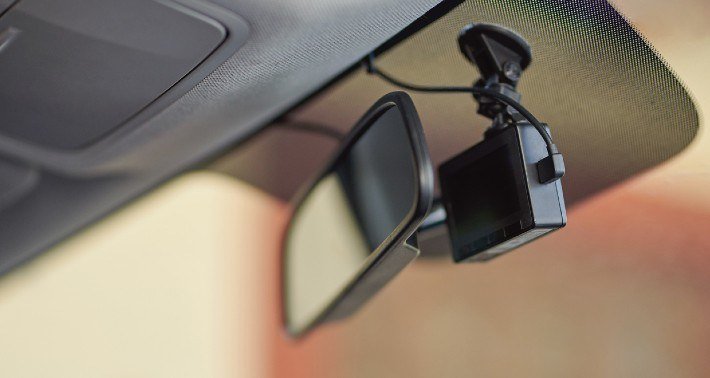
Placement determines everything, and the right place is tucked up high just behind the mirror glass, toward the passenger side, where the lens watches the road ahead while staying clear of the driver’s line of sight. That position keeps the camera out of the sightline, complies with obstruction rules everywhere, and gives the lens a clear, centred view of the road ahead. A camera mounted low on the dashboard sees too much bonnet and too little road, while a camera mounted in the middle of the windscreen becomes a distraction that the driver must look around. High and behind the mirror is the position that disappears from the driver’s awareness while doing its work.
Angle is the final part of mounting, and it is the part that most owners get wrong. The horizon belongs near the top of the picture, so the road and plates dominate rather than the sky, because a frame full of sky wastes pixels on clouds while the evidence sits small at the bottom. Aim the lens so that the road fills most of the frame, the lane markings run true, and the plates of nearby vehicles stay readable in the test footage. If the horizon sits too low, tilt the camera upward a touch; if the sky dominates, tilt it downward. A few minutes spent on angle at fitting time will save hours of regret later, when a clip that should have proved a case instead shows a beautiful sky and an unreadable plate.
Settings That Decide Whether Plates Stay Readable
Loop length and sensor sensitivity work together. Brief clips keep files easy to handle while still holding the moments around an event. Medium sensitivity for the impact sensor is the sensible middle ground: too sensitive, and the card fills with locked clips from every pothole and speed bump; too lazy, and a real impact may pass without locking the footage. Parking mode should be enabled where the power supply supports it, using motion or time-lapse recording to catch parking-lot hits without draining the car battery. These settings take minutes to choose and months to prove their worth, yet they decide whether the camera is a witness or a decoration.
Audio and speed stamps deserve a deliberate choice rather than a default. A speed stamp from satellite positioning can in theory be used against the owner, which is why many owners keep location but drop the speed display, preserving the place of an incident without handing over a number that could be argued about later. Audio is covered more fully in the next part, because it carries legal weight of its own, yet the principle is the same: choose each stamp and each recording option with intent, and review the test footage to confirm that the choices suit the roads the owner actually drives.
Staying Inside Audio Recording Law
Video recording from a windscreen camera is legal in every state for personal use, yet audio recording falls under wiretapping law, and that distinction matters. A minority of states require every party to agree before a conversation is recorded, with California, Florida and Pennsylvania among them, so a camera that records voices inside the car can create legal risk in those places even when the video itself is entirely lawful. Switching audio off sidesteps the risk entirely, and many owners choose that simple answer rather than trying to track the law across state lines on a long drive.
The risk is not theoretical. A conversation recorded without the agreement of everyone in the car can complicate a claim, an investigation, or a court case, even when the video proves the owner’s innocence on the road. An owner who drives across state borders faces a patchwork of rules, and a setting that is safe in one state may be risky in another. Turning audio off removes the patchwork entirely, leaving the camera to do what it does best: record the road, the vehicles, and the movement, without capturing words that were never meant to be evidence.
Owners who do keep audio on should understand the trade and make the choice with open eyes. They should know the rules of the states they drive in, they should tell passengers that audio is being recorded, and they should never edit footage they intend as evidence, because unaltered originals carry the weight that edited clips lose. Readers who want the wider context of road incidents can read the traffic collisions entry on traffic collisions, which explains how collisions are understood and recorded. The safest habit, though, is simple: let the camera watch the road in silence, and let the video speak for itself.
Answers To The Questions Every New Owner Asks
Is a windscreen camera legal in the United States? Video recording is legal in every state for personal use, provided the camera sits high behind the mirror and does not obstruct the driver’s view. Audio recording is the part that needs care, because a minority of states require every party to agree before a conversation is recorded, and switching audio off removes that concern completely. Mounting the camera in the right place and keeping audio off is the combination that stays inside the law on any road in the country.
How much should a new owner expect to spend on the whole setup? The honest answer is qualitative rather than a single figure, because the camera, the card, and the fitting each carry their own outlay. A solid camera with good night vision forms the largest part, a high-endurance card adds a modest amount, and a hardwire kit for parking mode adds a little more, with professional fitting as an optional extra for owners who dislike car wiring. The total for a complete first setup is a modest sum beside the cost of a single disputed claim, where clear footage often decides the outcome in the owner’s favour, and where the absence of footage can leave a driver paying for someone else’s mistake.
Will a camera lower insurance rates? No major American insurer offers a standard discount for a windscreen camera, and no owner should buy one expecting a lower premium. What clear footage does offer is far more valuable than a discount: it often decides a disputed claim, it speeds up the work of adjusters who love clear video, and it protects an owner against a fraudulent claim that would otherwise rest on one person’s word against another’s. A camera that records correctly is not a way to save on a premium; it is a way to protect a driving record, a no-claims history, and a quiet conscience on the road.