
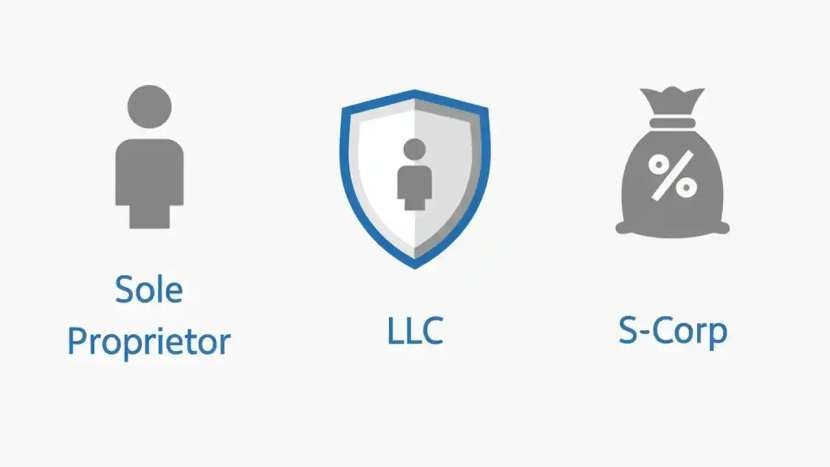
Solo owners often talk about these two labels as rival boxes, although one describes a legal entity and the other describes a tax treatment. That single distinction changes the whole comparison and explains why neighbors in similar trades can choose differently. Following the decision in phases keeps tax effects, payroll duties, and paperwork in their proper places. By the final phase, the better route for your profit pattern should be visible without guesswork. Nothing in the phases ahead requires a decision today. Each stage simply adds one layer of understanding, so the eventual election, or the choice to skip it, rests on how your particular business earns and pays rather than on habit or hearsay.
Phase One: Separate the Legal Entity Question From the Tax Question
Formation and taxation live in different places. A limited liability company comes into existence under state law, creating a legal entity distinct from its owner, with its own name, records, and capacity to hold contracts and accounts. Tax treatment, by contrast, is assigned under federal tax rules, and a single entity can be taxed in more than one possible way depending on elections made or not made. Holding those two ideas apart prevents the most frequent confusion in this area, where owners believe choosing a tax label changes their legal protection. It does not. Protection follows the entity and the discipline with which its finances are kept separate, while the tax label governs only how profit is reported and charged.
Ownership choices at formation reach far beyond paperwork, and anyone weighing whether to decide to partner with a friend at the outset will recognise how early decisions about control, pay, and responsibility echo for years afterwards. A solo owner faces a quieter version of the same truth: the structure chosen now shapes how salary can be taken, how profit can be drawn, and how easily another owner could ever be admitted later. Thinking about those downstream effects during this opening phase costs nothing, yet it prevents the common pattern where an election is made for a single tax year advantage and then regretted when the business changes shape.
For grounding in what the entity itself is, reference material on limited liability companies on Wikipedia sets out how this American business structure pairs limited liability for owners with pass through taxation as its usual default. Pass through means the business itself does not pay federal income tax on its profit in the usual corporate manner; instead, profit passes to the owner return and is taxed there. For a company owned by one person, the default treatment is generally that of a disregarded entity, meaning the tax authority looks through the company and treats its activity as the owner own for income tax purposes, typically reported alongside personal income from self employment. That default is the baseline against which any election must be judged.
Phase Two: Compare How Each Route Taxes Salary and Remaining Profit
Under the default route, the whole net profit of a solo business is generally subject to self employment tax, which funds social insurance programmes and applies whether the owner labels a withdrawal as pay, drawings, or anything else. Income tax applies as well, calculated on the same profit, but the employment related charge is the piece owners feel most sharply because it falls on nearly all profit rather than on a chosen salary figure. There is no payroll to run, no wage reporting for the owner, and no separation between being paid and simply drawing money as needed, which keeps administration light while leaving the employment tax charge attached to the full result of the year.
The elected route redraws that picture by splitting what the owner receives into two streams. Salary comes first, paid through payroll as employee wages, and employment taxes apply to that salary in the manner familiar from any job. Remaining profit can then reach the owner as distributions, and amounts taken that way sit outside the employment tax charge, although income tax still applies to the owner share of business profit overall. To place that alternative in context, an account of S corporations and their election on Wikipedia notes how eligible domestic corporations can elect to pass income, losses, and deductions through to shareholders for federal tax purposes rather than bearing tax at the entity level. The possible saving lives entirely in the gap between full profit and a defensible salary, which is why the salary question dominates the next phases.
Hold both pictures side by side without rushing to totals. In the default picture, simplicity is high and the employment tax base is broad. In the elected picture, the employment tax base narrows to salary, yet a new machinery of payroll, returns, and deadlines appears alongside the narrower base. Owners whose profit is modest often find the narrower base saves less than the machinery costs to run, while owners with strong and steady profit may find the gap wide enough to matter considerably. No universal profit line settles the question for everyone, because salary expectations differ by trade, region, and how much of the profit comes from personal labour versus products, staff, or assets.
Phase Three: Add Payroll Returns and Bookkeeping Duties to the Picture
Electing the salary based route means becoming an employer, even when the only employee is yourself. Payroll must actually run on a regular schedule, with withholding calculated, amounts remitted on time, and employment returns filed for each required period, followed by annual wage reporting that matches the payroll records. Paying yourself only in distributions while filing no salary is not a shortcut within this route; it contradicts the structure outright and invites correction. A payroll service or capable software can carry much of the mechanical burden, though the responsibility for accuracy and deadlines remains with the owner regardless of who presses the buttons.
Bookkeeping expectations rise in parallel. Salary, distributions, business expenses, and any reimbursements to the owner need clean separation in the records, supported by an accountable arrangement under which expenses are documented and excess reimbursements returned. The business files its own annual information return under the elected treatment, reporting profit and allocating it to the owner on the accompanying schedule used for personal filing. Bank accounts must stay firmly separate from household money, because blurred finances weaken both the accounting and the liability separation the entity was formed to provide. None of these duties is exotic, yet together they convert tax filing from a seasonal task into a year round rhythm that some solo owners welcome and others resent.
Phase Four: Test Whether a Defensible Salary Leaves Enough Benefit
Salary under the elected route cannot be chosen for tax convenience alone. Guidance from the federal tax authority is clear in substance: an owner who works in the business must receive reasonable compensation, subject to employment taxes, before taking further amounts as distributions. Reasonable means comparable to what the market would pay another person to perform the same work, considering duties, experience, hours, and local pay conditions. Owners commonly support their figure with published pay data for the role, advertisements for similar positions, or a written note explaining how the amount was set, kept with the payroll records so the reasoning survives scrutiny years later.
Testing the benefit now becomes an honest arithmetic exercise using words and ranges rather than wishful precision. Begin with expected profit for a typical year, not a best year. Set beside it the salary the market evidence supports for your role. The portion of profit remaining above that salary is the only portion whose employment tax treatment changes under election, so estimate the effect on that portion alone. Then subtract the realistic annual cost of running the elected structure: payroll help, preparation of the separate business return, any state charges identified earlier, and the value of your own added administrative time. If the remaining advantage looks thin on a typical year, it will look worse on a weak one, and the default route is probably serving you better for now.
Consider also where profit originates, because that shapes how defensible a moderate salary is. A consultant, designer, or tradesperson selling mainly personal hours will usually find that reasonable pay absorbs a large share of profit, leaving a smaller remainder to benefit from election. An owner whose income flows from products, a small team, rental of equipment, or other assets may support a salary well below total profit with a straight face. Revisit this test whenever profit jumps, duties change, or the business hires, since a conclusion that was correct at one scale can quietly stop being correct at another. Keeping the workings on paper turns the decision into a reviewable judgement instead of a hunch repeated annually.
Phase Five: File the Election on Time or Stay With the Simpler Default
An election is made by filing the relevant election form with the federal tax authority, signed as required and submitted within the window that applies to the tax year it should first cover. That window generally opens at the start of the year and closes a limited number of months later, so an owner who wants elected treatment for the current year must act early in it rather than during filing season the following spring. Limited relief exists for some late filings where reasonable cause is shown, yet relying on relief as a plan is poor practice. Mark the deadline plainly in a calendar, confirm receipt after filing, and keep a copy with the formation papers so the business tax status can be proved without searching through old correspondence.
Electing also carries a commitment quality worth respecting. The separate return, payroll cycle, and salary discipline apply in lean years as well as strong ones, and revoking an election can restrict the ability to elect again for a period of years afterwards under the applicable rules. For that reason, owners often test the numbers across several recent years rather than a single strong one, and some wait until profit has held above their personal break even range through varied conditions before filing. Staying with the default is not a failure of ambition; it is the correct holding position while profit is still growing, irregular, or largely consumed by the salary the market would demand anyway.
Whichever route the phases point toward, close with a short written record of the decision and its reasons: the profit figures used, the salary evidence gathered, the costs counted, and the date by which the question will be reviewed again. That record protects the choice from being relitigated after every casual conversation with another owner whose business may differ from yours in every relevant respect. Labels that once sounded like rival boxes resolve, in the end, into a legal entity chosen once and a tax treatment chosen deliberately, reviewed honestly, and changed only when the underlying pattern of profit and work has genuinely changed first.


