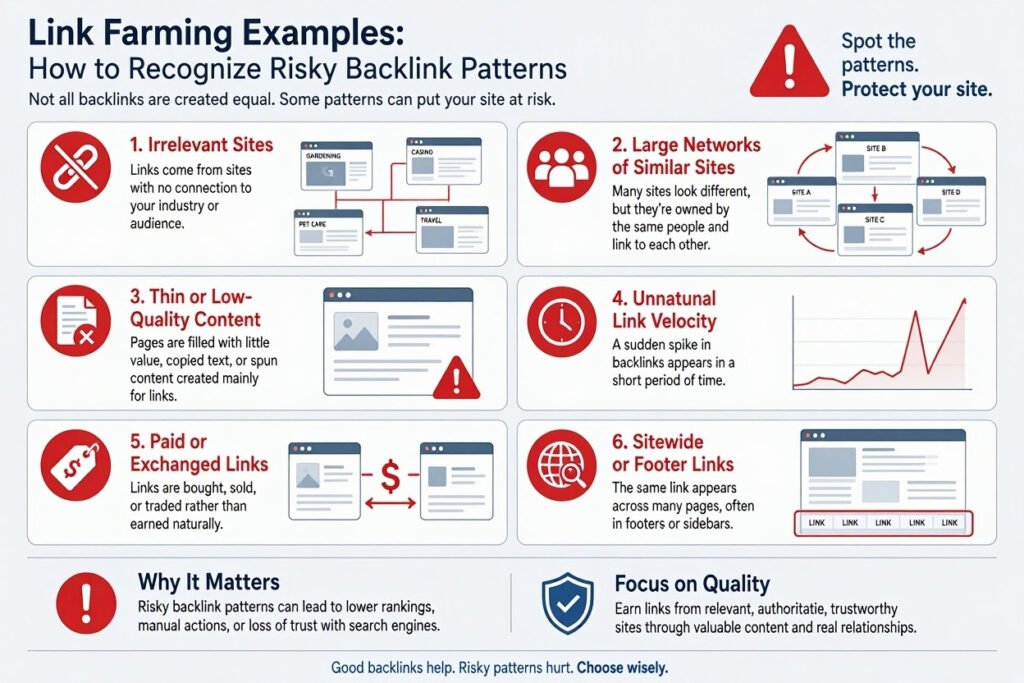
Backlinks can help people find useful reporting, services and ideas online. But when a site builds links mainly to manipulate search rankings, the pattern can put its credibility at risk. Common link farming examples include networks of low-quality sites that link to one another, paid placements with no editorial judgment, and pages crowded with unrelated links. Knowing what these patterns look like helps publishers, business owners and readers distinguish genuine recommendations from manufactured signals.
What Makes a Link Farm Different?
A link farm is a website, group of websites or coordinated publishing arrangement created chiefly to generate backlinks. The links may point to one favored site, or members of the network may link to each other in a planned cycle. The distinguishing feature is not simply that a page has many links. It is that links are created primarily to influence search rankings rather than to help a reader reach relevant information.
That distinction matters because legitimate websites link out all the time. A news story may cite a government report; a travel guide may point to a park’s visitor information; a technology review may link to a manufacturer’s specifications. Those links have a clear purpose for the audience. A link farm, by contrast, often has little original value beyond hosting links.
Search policies and detection systems change, so no single visual clue proves that a site is part of a scheme. For a current overview of the term and practical warning signs, read this guide to spotting link farms in 2026. Treat any one indicator as a reason to look closer, not as a verdict.
Common Link Farming Examples
1. A cluster of sites linking in a loop
Imagine several websites with similar layouts and thin articles. One links to another in a paragraph, the second links to a third, and the third sends a link back to the first. If the sites cover unrelated subjects and the links offer no useful context, the arrangement may be designed to circulate ranking signals. A legitimate publisher network can also share ownership, so the key question is whether the pages serve readers independently.
2. Pages built from lists of unrelated links
A page that recommends a handful of carefully chosen resources can be useful. A page that lists dozens of businesses from unrelated industries, with little description or editorial explanation, deserves more scrutiny. The same goes for articles where links appear in awkward places or are surrounded by generic text that could be pasted onto any site.
3. Repeated guest posts with exact-match anchors
Guest articles can introduce an expert to a new audience. A warning sign appears when many sites publish near-identical pieces, each containing the same keyword-rich link to one commercial page. If the writing is shallow, the host sites have no clear connection to the subject, and the placement seems valuable only because of the backlink, the arrangement resembles link farming more than editorial collaboration.
4. Paid links presented as independent recommendations
Buying an advertisement or sponsored article is not automatically a link farm. The concern is concealing the commercial relationship or arranging links solely to pass ranking value. Publishers should use appropriate disclosures and link attributes for paid placements, and brands should be wary of sellers promising large numbers of backlinks on a fixed timetable. Volume is not proof of quality.
How to Assess a Suspicious Site
Start with the page, not a score from a third-party tool. Ask whether the article answers a real question, whether the outbound links fit its subject, and whether the publisher appears to have an identifiable audience. Then check a sample of the site’s other recent posts. A sudden mix of casino promotions, medical advice, software reviews and unrelated local businesses can suggest that the site accepts placements without meaningful editorial selection.
Look for patterns across multiple sites, too. Matching templates, repeated author biographies, identical phrasing, and links using the same commercial anchor text may point to coordinated publishing. None settles the matter alone. Small publishers often use common website themes, and legitimate campaigns may promote a consistent brand phrase. Evidence becomes more persuasive when several clues appear together.
For businesses, keep a record of who arranged each placement, what the publisher promised, and why the link is useful to readers. If a provider guarantees a specific number of followed links or claims it can deliver rankings quickly, ask for sample sites and examine them yourself. A transparent explanation of editorial standards is more meaningful than a large package count.
Build Links That Can Stand on Their Own
The safest test for a backlink is simple: would the placement still make sense if search engines ignored it? Useful approaches include publishing original research, contributing a genuinely informed article to a relevant publication, and making practical resources that others naturally cite. In guest posting, the topic should fit the host’s readership, and the article should be worth reading even without its link.
There is also a practical budget question behind many digital projects. A company planning a mobile app, for example, may need to compare development costs with spending on content and outreach. Osdire’s mobile app development cost breakdown offers a useful point of comparison when mapping out that kind of investment. Whichever services a business hires, separate product work from promotion and judge each by its own deliverables.
Publishers seeking relevant contributors can explore guest posting opportunities, while still checking that each proposed article suits their readers and meets their standards. A marketplace or introduction is only a starting point; editorial judgment remains the publisher’s responsibility.
What to Do if You Find Links You Regret
First, establish whether the links are actually under your control. Review old agency agreements, contributor arrangements and site sections before taking action. Remove or correct links that are paid, irrelevant or misleading where you can, and contact publishers when a placement needs clarification. Avoid reacting to every low-quality link with panic: websites can receive unsolicited links without having created them.
Keep future outreach focused on relevance, clear disclosure and useful information. A single well-placed citation from a site that serves the right audience can be more valuable to readers than hundreds of links from pages they would never visit. Link farming tries to imitate that trust at scale; thoughtful publishing earns it one useful connection at a time.