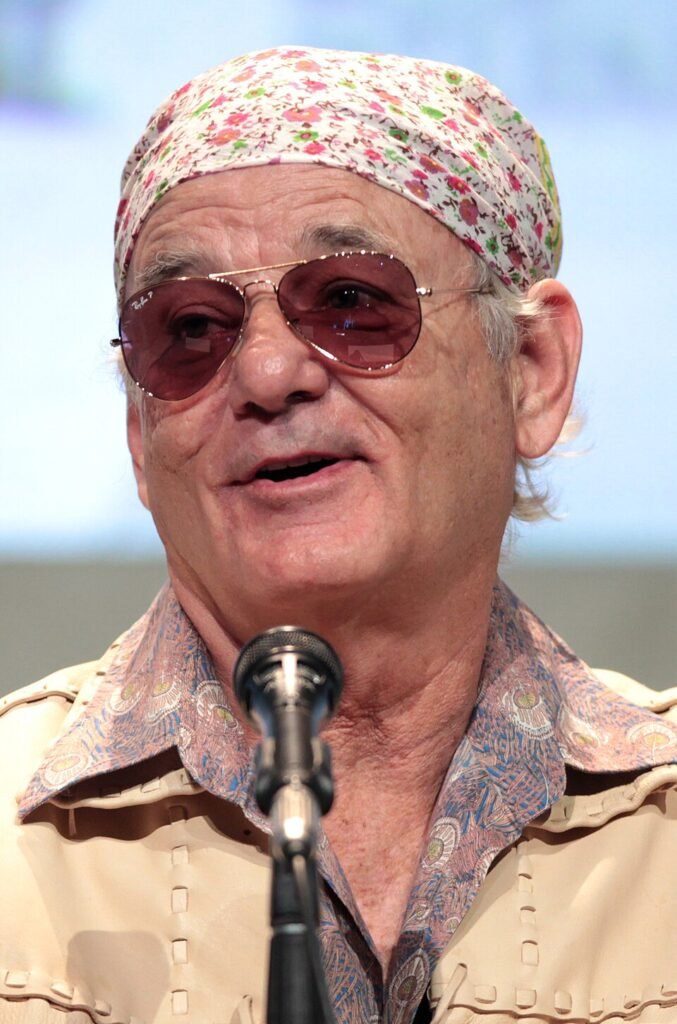
Bill Murray Net Worth, Age, Family, Career and Biography
Bill Murray has a net worth estimated at $180 million by Celebrity Net Worth, a figure that has held steady across trackers for years and reflects five decades of leading roles, a famously agent-free negotiating style, and ownership stakes in the productions that made him. At 76, Murray is the father of six sons, one of nine children himself, and still — in 2025 and 2026 — turning up in new productions on his own famously unpredictable terms.
This biography covers the full record: his birthday and early life in Illinois, his parents and family background, his marriages and his sons, his movies and television shows year by year, and his Instagram position, stated exactly as verified.
Early life
William James Murray was born on September 21, 1950, in Evanston, Illinois, and grew up in Wilmette, a suburb north of Chicago. His birthday makes him 76 years old as of November 16, 2026. He was the fifth of nine children, and the crowded Wilmette upbringing — nine children competing for airtime at the table — is where everyone who knows the family locates the origin of the act.
His parents are Edward Joseph Murray II and Lucille Murray, née Collins. His father was a lumber salesman; his mother worked as a mailroom clerk. His father died in 1967, at the age of 46, from complications of diabetes, when Murray was 17. His mother died in 1988. The family was raised Catholic, money was tight after his father’s death, and Murray and several of his siblings worked as caddies at a local golf club — experience that later fed directly into one of his most famous roles, the assistant groundskeeper Carl Spackler in Caddyshack, a film his elder brother co-wrote.
Murray attended Loyola Academy in Wilmette and then Regis University in Denver, where he enrolled in pre-medical courses before leaving. Back in Chicago, at the invitation of his brother Brian, he joined The Second City, the improvisational comedy troupe, studying under Del Close. Improv taught him the skill that defines his screen work: listening, waiting, and letting a scene come to him rather than chasing it. From Second City he moved to New York, joined the National Lampoon Radio Hour company alongside performers who would soon reshape television comedy, and in 1977 was hired into the cast of a young late-night program called Saturday Night Live.
Career
1977–1980: Saturday Night Live and Meatballs
Murray joined Saturday Night Live in 1977, for its second season, stepping into a cast that had just lost Chevy Chase and was widely expected to decline. Instead, Murray’s second season made him one of the show’s defining performers, with characters including the smarmy lounge singer Nick and the geeky Todd, and he won a Primetime Emmy Award for Outstanding Writing for a Variety Series for his work on the program. He left the cast in 1980. His first leading film role came during the run, as the chaotic but kind camp counselor Tripper Harrison in Meatballs (1979), directed by Ivan Reitman — a modest production that became a hit and established the Murray template: the slacker whose indifference is a disguise for decency.
1980–1984: Caddyshack, Stripes and Ghostbusters
Caddyshack (1980) gave Murray his most quoted early role, the deranged, gopher-hunting groundskeeper Carl Spackler, much of it improvised. Stripes (1981), in which he played a cab driver who talks his friend into joining the Army, was a major hit, and he took a straight supporting role in Tootsie (1982) — uncredited in the marketing at his own request — that critics singled out. Then came Ghostbusters (1984), in which his Dr. Peter Venkman anchored a production that became one of the defining comedies of the decade and one of the highest-grossing comedies of its era. The Razor’s Edge (1984), a serious drama Murray co-wrote and had pursued for years, underperformed, and the contrast between the two 1984 releases — the hit he made look easy and the passion project that stumbled — set the pattern of a career that would alternate between the two poles for forty years.
1988–1993: Scrooged, Ghostbusters II and Groundhog Day
Scrooged (1988), a dark retelling of the Dickens Christmas story with Murray as a cynical television executive, reunited him on screen with three of his brothers. Ghostbusters II followed in 1989, and What About Bob? (1991) paired him with Richard Dreyfuss in another durable hit. Groundhog Day (1993), directed by Harold Ramis, cast him as Phil Connors, a weatherman condemned to relive a single day until he becomes a better man. The film was a success on release and has since been elevated to the status of a modern classic, preserved in the National Film Registry; it is the performance most often cited when critics argue Murray is not merely a comedian but one of the finest screen actors of his generation. Readers building a public-facing business of their own may value our guide on how to handle negative reviews without hurting your brand, a practical look at responding to criticism without making it worse.
1998–2003: Rushmore, the Wes Anderson partnership and Lost in Translation
Rushmore (1998) began Murray’s defining late-career collaboration, with director Wes Anderson, who cast him as the melancholy industrialist Herman Blume. The Royal Tenenbaums (2001) continued the partnership, which has extended across ten Anderson productions including The Life Aquatic with Steve Zissou (2004), Moonrise Kingdom (2012), The Grand Budapest Hotel (2014) and Isle of Dogs (2018). In 2003 Sofia Coppola’s Lost in Translation cast him as Bob Harris, a fading star filming commercials in Tokyo, in the most acclaimed performance of his career: he won the BAFTA Award and the Golden Globe Award for the role and was nominated for the Academy Award for Best Actor. Broken Flowers (2005), with Jim Jarmusch, kept the dramatic run going.
2009–2026: Zombieland, Olive Kitteridge and The Friend
Murray’s later career has mixed franchise returns with independent work and a celebrated willingness to appear anywhere interesting. His self-parodying cameo in Zombieland (2009) became one of that film’s signature sequences. He played Franklin D. Roosevelt in Hyde Park on Hudson (2012), starred in St. Vincent (2014), and won his second Primetime Emmy Award for the miniseries Olive Kitteridge (2014). Voice work included Baloo in The Jungle Book (2016). He returned as Venkman in Ghostbusters: Afterlife (2021) and Ghostbusters: Frozen Empire (2024), and starred opposite Naomi Watts in The Friend (2024), playing a writer whose death leaves his dog — and his unfinished business — to a friend, in a performance reviewers treated as a late-career highlight. Through 2025 and 2026 he has continued to work selectively, on the same terms he has kept for decades: no agent, no publicist-driven schedule, and a willingness to appear in a small production that interests him while passing on a large one that does not.
Personal life and family
The bank keyword for this profile asks about Murray’s wife, and the verified answer is plain: he has no current wife. His first marriage, to Margaret Kelly, ran from 1981 until their divorce in 1996. His second marriage, to Jennifer Butler, ran from 1997 until their divorce in 2008. Butler died in January 2021; that fact is recorded here in a single line, in plain terms, with no further detail. No marriage or publicly confirmed partner has been reported for Murray since 2008, and none is claimed here.
Murray has six children, all sons. With Margaret Kelly he has two sons: Homer Murray, born in 1982, a chef and restaurateur, and Luke Murray, born in 1985, a college basketball coach who has served on the staff at the University of Connecticut during its championship era. With Jennifer Butler he has four sons: Caleb Murray, born in 1993; Jackson Murray, born in 1995; Cooper Murray, born in 1997; and Lincoln Murray, born in 2001. The six sons span nineteen years, and Murray has described fatherhood across two marriages and two very different periods of his own life as the constant underneath the career.
His siblings are a story in themselves. Murray is one of nine children of Edward and Lucille Murray: five brothers — Ed Murray, a businessman, who died in 2020; Brian Doyle-Murray, the actor and writer who co-wrote Caddyshack and has appeared alongside Bill in productions from Caddyshack and Scrooged to Groundhog Day; Andy Murray, a chef; John Murray, an actor; and Joel Murray, an actor known for his television work including Mad Men — and three sisters: Nancy Murray, an Adrian Dominican nun who has also performed a one-woman religious stage production; Peggy Murray; and Laura Murray. Four of the siblings besides Bill have acted professionally. The family that produced a nun, three working actors, a chef and a businessman out of one Wilmette upbringing remains, by every account including Murray’s own, the center of his life.
Net worth and assets
Celebrity Net Worth estimates Bill Murray’s net worth at $180 million, and the figure is notable for its stability: trackers have converged on about $180 million for years, with no competing Forbes total published for him and no disagreement of substance to print. The fortune rests on an unusual structure. Murray has famously worked without an agent or a manager for most of his career — productions reach him through a widely reported toll-free telephone line and a post office box — and he has historically taken ownership positions and backend participation in his productions rather than maximum upfront salary, a structure that rewards exactly the kind of long-tail catalog his filmography became. His Ghostbusters-era participation, his dramatic-era salaries, four decades of residuals from a catalog in permanent rotation, and business interests shared with his brothers, including restaurant ventures built on the Caddyshack name, support the estimate. No salary, settlement or single transaction is presented here as net worth; the $180 million is the attributed tracker estimate, and it is the only one the record supports.
On Instagram, the verified position is stated plainly: Murray has no confirmed official public Instagram account. Accounts exist under his name, but no account has been verified as operated by Murray himself, and his documented position for decades has been to stay off social platforms entirely — consistent with the agent-free, telephone-line system through which he has run his whole career. No handle is printed here as his, because none can be printed honestly.
Key facts
| Key Facts | Details |
|---|---|
| Born | September 21, 1950, in Evanston, Illinois |
| Age | 76 years old (as of November 16, 2026) |
| Height | 6 feet 2 inches (1.88 m) |
| Weight | No reliable published figure exists |
| Wife | No current wife; former wives Margaret Kelly (married 1981, divorced 1996) and Jennifer Butler (married 1997, divorced 2008) |
| Children | Six sons: Homer (born 1982) and Luke (born 1985) with Margaret Kelly; Caleb (born 1993), Jackson (born 1995), Cooper (born 1997) and Lincoln (born 2001) with Jennifer Butler |
| Siblings | Eight: brothers Ed, Brian Doyle-Murray, Andy, John and Joel; sisters Nancy, Peggy and Laura |
| Net Worth | $180 million, estimated by Celebrity Net Worth |
Bill Murray’s story, stripped to the verified facts, is a Wilmette caddy from a family of nine who lost his father at seventeen, learned improv at Second City, and built a fifty-year career on a single principle: never chase the scene. The $180 million estimate, the six sons and the ten Wes Anderson productions all follow from the same man — the one the whole industry has to telephone, and wait for, on his terms.