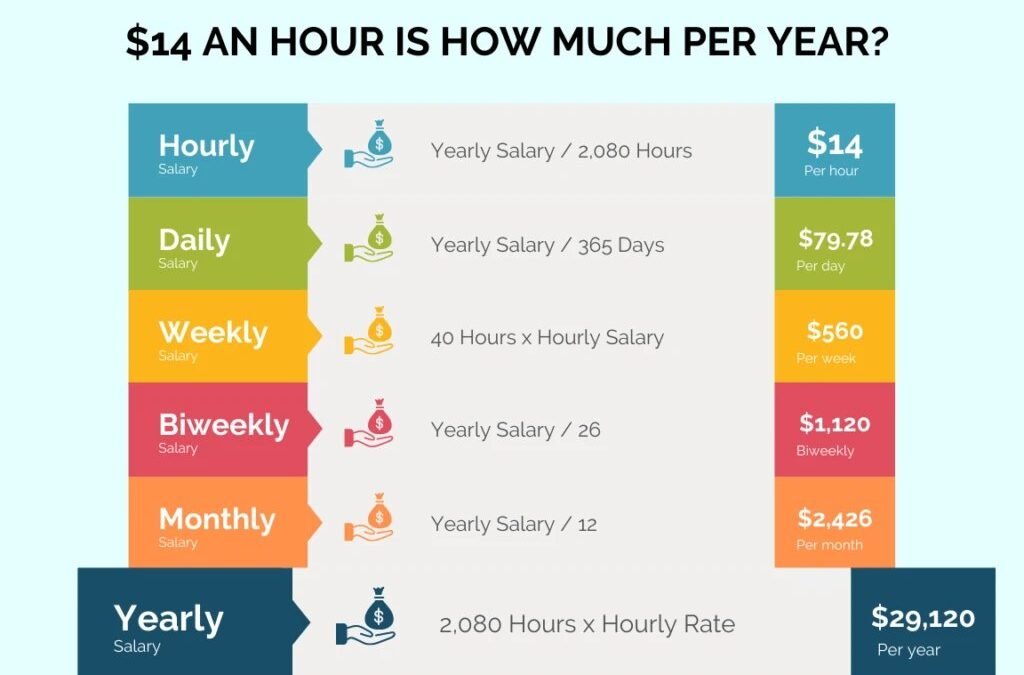
Fourteen an hour works out to twenty nine thousand one hundred and twenty a year before tax only when full time hours truly happen. At this level, scheduled hours, paid leave and available credits matter just as much as the headline rate.
The Hours Checklist to Run Through First
Before any total in this piece can be trusted, four checks need honest answers, because at this wage the assumptions underneath the arithmetic matter more than the arithmetic itself. First, confirm the hours genuinely scheduled in a typical week, not the hours mentioned hopefully during recruitment. Second, establish whether holidays, closures and leave are paid or unpaid, since the difference quietly rewrites the year. Third, learn the pay cycle, because when money arrives shapes how far each packet must stretch. Fourth, ask which credits a household in your position might be able to claim, a subject returned to properly in its own section later.
Readers who clear those checks while also weighing a small second strand of practical work alongside a main job are common at this level, and starting a mobile car detailing business is one route people examine when a single wage feels too thin to carry every goal. Any such plan should be added to the checklist rather than substituted for it: extra work brings its own costs, hours and uncertainties, and it deserves the same sceptical questions before enthusiasm takes over.
Work through the four checks in writing if possible. A schedule confirmed by a manager, a leave policy read rather than summarised, and a pay cycle seen on an actual rota all outrank cheerful verbal assurances. The totals in the next section assume the checklist comes back clean, with full time hours that genuinely happen week after week; where it does not, later sections show how to rebuild the picture around the hours that are real.
Full Time Totals Built From the Standard Year
With the checklist satisfied, the standard build can proceed. A complete full time year at this rate, spread over the standard two thousand and eighty hours, reaches twenty nine thousand one hundred and twenty before tax, and its weekly building block is five hundred and sixty. The packet covering two weeks comes to eleven hundred and twenty in total, while the calendar average lands at about two thousand four hundred and twenty seven a month. Memorise the weekly block above the others, because at this wage the week is the unit in which survival is actually managed.
Context for the rate itself helps readers place it on the wider map. The Wikipedia article on minimum wage in the United States sets out how federal law establishes a wage floor while a great many states and cities choose higher local floors of their own. Where this rate sits relative to the local floor changes its meaning entirely: comfortably above it in some places, barely above it in others, and that local reading should inform how hard a reader pushes for more hours, better shifts or a higher rate altogether.
One calendar warning attaches to these totals. Fortnightly pay means most months contain two packets while two months contain three, so the monthly average overstates what an ordinary month delivers. Fixed costs at this level leave almost no slack for that misunderstanding, making the two packet month the only responsible basis for rent, utilities and food planning from the very first packet onward.
Part Time Ladders for Common Weekly Patterns
Part time work is not an exception at this wage; for many readers it is the main arrangement, and its ladder deserves the same respect as the full time build. The rungs scale in a straight line from the weekly block: fewer hours lower the week, the packet and the year in exact proportion. At half time, the year comes to fourteen thousand five hundred and sixty before tax, precisely half the full time total, and schedules falling anywhere between those two landmarks settle in proportion as well.
Fluctuation is the ladder’s hidden feature, and it matters more than the neat proportions suggest. Schedules in retail, hospitality and care frequently swing between quiet weeks and busy ones, so a pattern advertised at one level may average noticeably lower across a season. The standing rule for this piece is blunt: budget from the low weeks, the ones that actually recur, and treat stronger weeks as opportunities to catch up or set something aside. Budgeting from a good week manufactures a shortfall in every ordinary one.
Combining two part time roles changes the ladder rather than escaping it. The combined hours may approach full time, yet neither employer may offer the paid leave or stability of a single full time post, and travel between workplaces eats both time and money. Total the combined picture honestly, including those frictions, before concluding that two ladders leaning together equal one solid staircase.
Unpaid Weeks and Why They Bite Harder Here
Every unpaid week removes five hundred and sixty of gross pay from the year, a slice that sounds survivable until it is set against how little slack this wage carries. At higher rates, a lost week dents a savings plan; at this rate, a lost week can mean a bill negotiated late, a payment split awkwardly, or a small debt taken on that takes months of careful weeks to clear. The same arithmetic event is simply a different human event depending on the cushion beneath it.
Unpaid time rarely announces itself as one dramatic absence. It accumulates quietly: a public holiday the employer does not pay for, a closure for refurbishment, a sickness absence outside any paid allowance, a festive shutdown longer than the paid days attached to it. Across a year those fragments can add up to several missing weeks, which is why the checklist at the start of this piece asked about leave before it asked about anything else.
Defence begins with naming the risk early. Readers who know unpaid weeks are coming can spread the defence across the whole year, holding back a small slice of stronger packets into a dedicated buffer rather than scrambling when a thin packet arrives. Comparing two offers at this same rate, the one guaranteeing paid time away may be worth considerably more across the year than a rival offering a trivially better schedule with unpaid gaps, and that difference should be priced before signatures rather than discovered after them.
Preparation softens the blow further when it starts before the unpaid week itself. Knowing which weeks in the coming year are likely to run short, a closure already scheduled, a holiday period already known, allows the buffer building to be spread thinly across many ordinary packets instead of desperately across one. Even a modest slice reserved from each full packet accumulates into meaningful cover across a year, and the psychological difference matters as much as the financial one: an anticipated thin week is an inconvenience to be managed, while an identical week arriving unannounced feels like a crisis.
Credits and Deductions That Change the Final Picture
The final picture at this wage is shaped from two directions at once: sums subtracted from pay along the way, and support that may arrive through the tax system after the fact. On the subtraction side, amounts are held back toward tax duties, payroll taxes are drawn from earnings, the household’s filing position influences what is held, and any voluntary contributions toward benefits or retirement provision reduce the packet further. The exact mixture is personal, varies by state and circumstance, and cannot responsibly be replaced here with one invented spendable figure.
On the support side stands a provision worth understanding properly. Wikipedia’s earned income tax credit article describes a refundable credit aimed at working people on low to moderate incomes, especially those raising children, which can substantially improve a household’s position once claimed. Because it is refundable, its effect can reach beyond reducing a bill, and for eligible families it may outweigh a small pay rise in practical importance. Other credits may also apply depending on household makeup, so readers should consult current official guidance or a reputable free preparation service for their own situation rather than relying on general descriptions, this one included.
No amounts, thresholds or promises are attached to that description deliberately. Eligibility turns on details that change and differ between households, and a credit wrongly assumed can distort a budget as badly as a credit wrongly ignored. The checklist habit from the opening section applies one final time: verify against official sources, file carefully and on time, and treat any resulting support as a planned part of the year’s picture rather than as a surprise.
Premium Hours and Extra Shifts in Plain Terms
Plain terms first: where a role qualifies, hours worked beyond the standard week attract an enhanced rate, and extra shifts offered at standard or enhanced pay both add gross income packet by packet. At this wage those additions carry unusual weight, because a single extra shift represents a meaningful fraction of a weekly total rather than a rounding difference. Readers offered regular extra time should therefore ask early how it is paid, record the answer, and distinguish clearly between guaranteed hours and hopeful ones.
Eligibility, as ever, cannot be assumed. Arrangements vary by role and employer, seasonal demand can withdraw extra shifts without warning, and exhaustion is a real cost that never appears in a conversion table. Extra hours work best as a deliberate, time limited strategy with a named purpose, such as clearing a specific debt or building a buffer against the unpaid weeks discussed earlier, rather than as a permanent patch over a budget that does not balance on standard hours.
Return, finally, to the checklist where this piece began. Confirm the scheduled hours, confirm whether leave is paid, confirm the cycle, and confirm the credits worth claiming. A reader who can answer those four points owns a truthful picture of twenty nine thousand one hundred and twenty as a ceiling, of fourteen thousand five hundred and sixty at half time, and of everything realistic in between. At this level, that truthfulness is not a refinement of the plan; it is the plan.